
The $333 Option Code That Turned 598 Corvettes Into SCCA Weapons Before The Z06
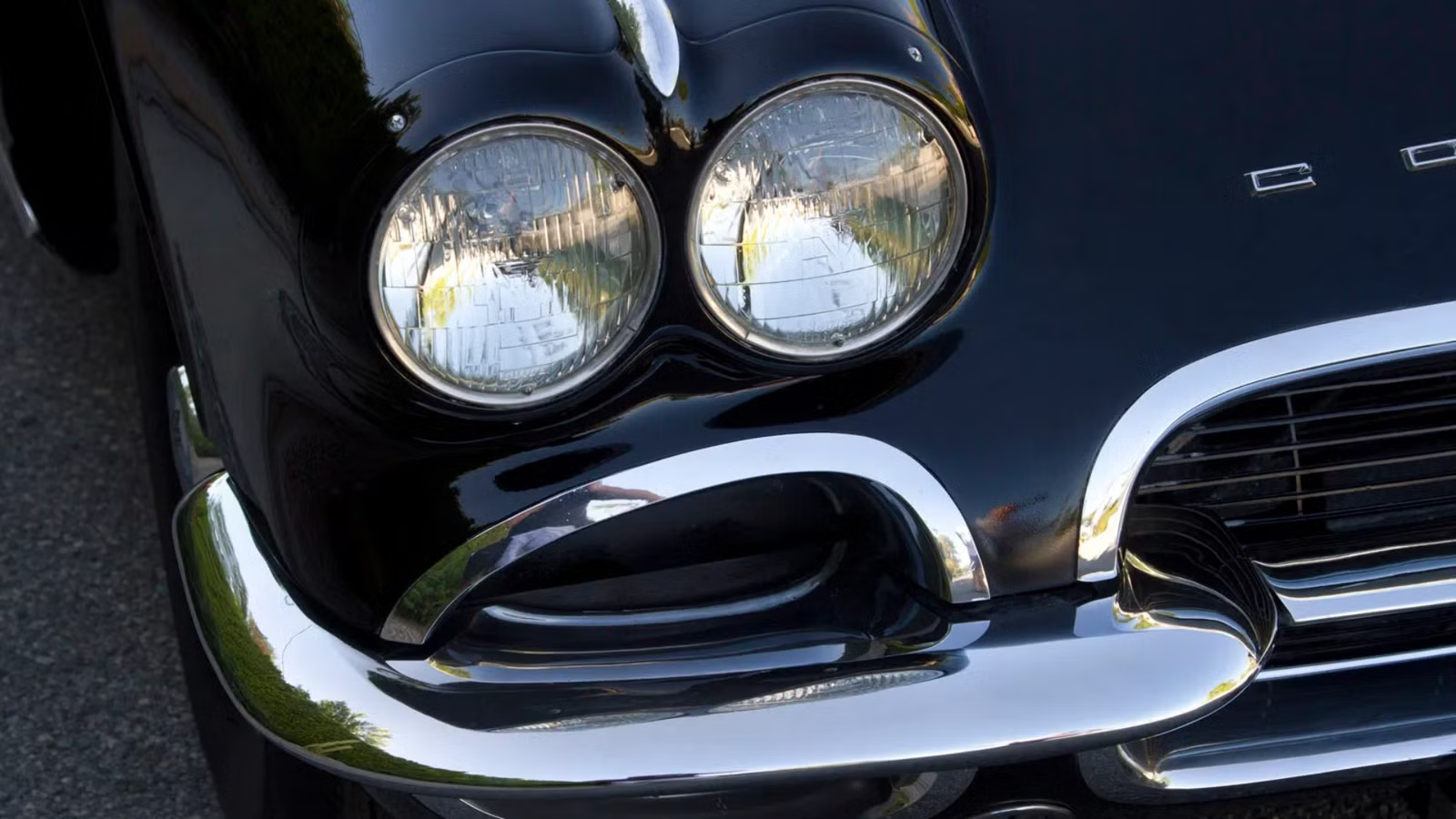
A 1961 Corvette parked in a club racing paddock looked exactly like the one still sitting on the dealer lot back home. Same fiberglass body, same chrome teeth, same scalloped cove along the door. The difference sat behind the wheels: finned drums, vented backing plates, and rubber deflectors aimed straight at the brake shoes.

Chevrolet built 598 cars this way between 1960 and 1962, and most went to buyers who planned to race on Saturday and drive home on Sunday. The order sheet made all of it possible, four years before the Z06 badge existed.
Why Duntov’s Corvettes Kept Cooking Their Brakes
The Automobile Manufacturers Association ban of 1957 pulled Detroit out of racing on paper, and General Motors signed on. Zora Arkus-Duntov, the father of the Corvette, kept developing competition hardware anyway, and Chevrolet kept quietly handing it to racers who asked.

The Corvette had solved power by 1957, with a 283-hp version of its 283-cubic-inch (4.6-liter) V8, a limited-slip differential, and Rochester fuel injection. Drum brakes were the bottleneck, and a few hard laps on a road course cooked them into uselessness.

Chevrolet’s fix arrived through the parts counter instead of a race shop. The factory tested competition components, then listed them as regular production options a buyer could check on an order form. That approach let GM stay out of racing publicly while its cars filled grids.
Briggs Cunningham took three Corvettes to Le Mans in 1960 and won the class with one of them, finishing eighth overall. Period accounts credit that effort with pushing the heavy-duty suspension parts into production, though the link is tradition rather than documented fact.
RPO 687 Cost $333.60 In 1960 And The Same $333.60 In 1962

RPO 687 cost $333.60 on a 1960 Corvette, a car with a base price of $3,872. That worked out to roughly 8.6 percent of the sticker, spent entirely on parts the buyer would only notice under hard use.
Chevrolet never repriced the option as it stayed at $333.60 in 1961, when the base Corvette rose to $3,934, and again in 1962, when the base car reached $4,038. The package got relatively cheaper each year while the car itself got more expensive.

Chevrolet listed the option as Heavy Duty Brakes and Suspension for 1960 and 1961, then changed the name to Heavy Duty Brakes and Steering for 1962. The rename hints at how the factory thought about what it was selling by the final year of the C1.
The package centered on finned drums — described as cast-iron or steel, but it varies depending on the source — with internal cooling fans and metallic linings. Vented backing plates carried air scoops, and ducting fed the rear brakes to fight the fade that ended most Corvette races.
A quick-ratio steering adapter, stiffer springs, heavy-duty shocks, and a thicker front anti-roll bar came with it. Steel wheels were mandatory because they held up better than the standard items under racing loads.

Rubber deflectors bolted to the front backing plates gave the setup its best-known detail. Corvette people call them elephant ears, and they pushed air onto the front drums whenever the car was moving. Early Cerametalix linings were noisy and weak until they warmed up, and improved sintered iron replaced them by 1962.
Metallic brake linings on their own were available as RPO 686 for $37.70 in 1962, and 2,799 buyers took that route. The full package cost nearly nine times as much, which explains why so few cars left St. Louis with it. The cheap box made sense for the street; the expensive one only made sense on a grid.
Checking The RPO 687 Box Forced You To Check Three More

Ordering RPO 687 in 1962 also meant ordering RPO 675 Positraction with 4.11:1 gearing and RPO 582, the 327-cubic-inch (5.4-liter) fuel-injected V8 rated at 360 hp. A four-speed manual was part of the deal as well, which left almost no room to build a soft version of the car.
The engine added $484.20, the four-speed added $188.30, and Positraction added $43.05. Stacked on the $333.60 for the brake package, a 1962 buyer was roughly $1,049 past the $4,038 base before adding a radio or a hardtop.
The 1960 and 1961 pairings are less firmly documented. At least one surviving 1960 example runs the 270-hp carbureted V8 rather than fuel injection, and no reliable count exists for how many big-brake cars used carburetors.

Chevrolet built 119 of these cars in 1960, 233 in 1961, and 246 in 1962, for a three-year total of 598. As a share of each year, that is 1.16 percent of 10,261 cars, 2.13 percent of 10,939, and 1.69 percent of 14,531.
Only 1,918 Corvettes got the 360-hp fuel-injected engine in 1962, about 13% of the year’s output. A car carrying both that engine and the brake package sits inside a small fraction of an already small group.

LPO 1625 swapped the standard 16-gallon tank for a 24-gallon unit in 1961, and factory records show just 25 cars took it. Nearly all were raced, including entries at the 1961 12 Hours of Sebring. Tracking exact chassis numbers is difficult because factory records for the option were never detailed, which is why registry work still matters on these cars.
RPO 276 steel wheels, 15 by 5.5 inches, went on 561 cars in 1962 and 337 in 1961. The combination of those wheels, the brake package, and the fuel-injected engine is the fingerprint that separates a genuine club racer from a well-optioned convertible.
73 Wins In 128 Starts, In A Car You Could Buy From Your Chevy Dealer

Steve Elfenbein’s 1960 big-brake Corvette won 73 of the 128 races and hill climbs it entered, took second 21 times and third 18 times, and failed to finish only four events. Elfenbein was an engineer at Bell Labs who bought the car in early 1961 to race on weekends.
The car ran against fields that included Mark Donohue on East Coast road courses through the 1960s. In 1966, it became the first production car to break one minute at the Giant’s Despair hill climb in Pennsylvania.
Its original fuel-injected 283-cubic-inch V8 was swapped early in the car’s racing life for a 1962-vintage 327, which made more than its 360-hp rating. Everything else stayed a factory-ordered street Corvette that happened to arrive with the right boxes checked.

Grady Davis’s Gulf Oil team bought a 1962 Corvette from Don Yenko’s dealership in Canonsburg, Pennsylvania, ordered with the 360-hp fuel-injected engine, a 37-gallon tank, and the brake package. The car needed preparation rather than construction, because the hard parts were already on it.
Dick Thompson, a Washington dentist who raced on weekends, drove it to 12 class wins in 14 races, including Daytona and Sebring, and took the 1962 SCCA A-Production championship. Gooding & Company sold that car at Pebble Beach in 2008 for $1,485,000.
A privateer could walk into a Chevrolet dealership in 1962, check three boxes on an order form, and drive out in something that needed a roll bar and a fire extinguisher to be ready for a grid.
The Z06 Charged Five Times As Much For The Same Idea

RPO Z06 arrived for 1963 at $1,818.45 on a $4,252 coupe, and Chevrolet built 199 of them. RPO 687 cost $333.60 and moved 246 cars in 1962 alone, so the cheaper option outsold the famous one in a single year.
The Z06 kept drum brakes and added vacuum assist and a dual-circuit master cylinder to finned drums with sintered linings, cooling ducts, and vented backing plates. Take those two additions away and the 1962 specification is what remains.
Both cars used the same Rochester fuel-injected 327, rated at 360 hp in 1962 and carried into the Z06 for its first year. The elephant ear deflectors carried over as well.

A frame-off-restored 1962 big-brake fuelie was offered at $85,000 in 2021, while a 1962 big-brake fuelie tanker sold for $242,000 at Mecum Kissimmee in 2013. A 1957 Corvette Big Brake Airbox brought $715,000 at the same sale in 2025, which hints at the ceiling for factory competition C1s. Condition and documentation drive the spread, and NCRS or Bloomington Gold certification is what separates the two ends. Either way, this rarely optioned Corvette is highly sought after and is unquestionably collectible.
In the end, the $333.60 RPO 687 option was the best $1,049 you could have spent in 1960.
Sources: Chevrolet, RM Sotheby’s, Mecum

Related posts


Latest Post


No Comments