
Suzuki Built A Race-Bred 750 That Cost A Fraction Of Yamaha’s 500-Unit Exotic
In the early 1980s, Suzuki did something that is still considered the benchmark for testing a machine’s durability. The Japanese brand took an early prototype of a motorcycle engine and ran it for 30 hours continuously at 12,500rpm. That was 2,000rpm over the peak power rpm.

While the attempt itself became the talk of the global motorcycle industry back then, what made the anecdote so memorable is the fact that the engine survived the test without any damage. A version of that powerplant made its way into the GSX-R750, a motorcycle highly revered for being a genuine race machine that ordinary riders could buy.
The Cologne Debut And The Race-Replica Blueprint
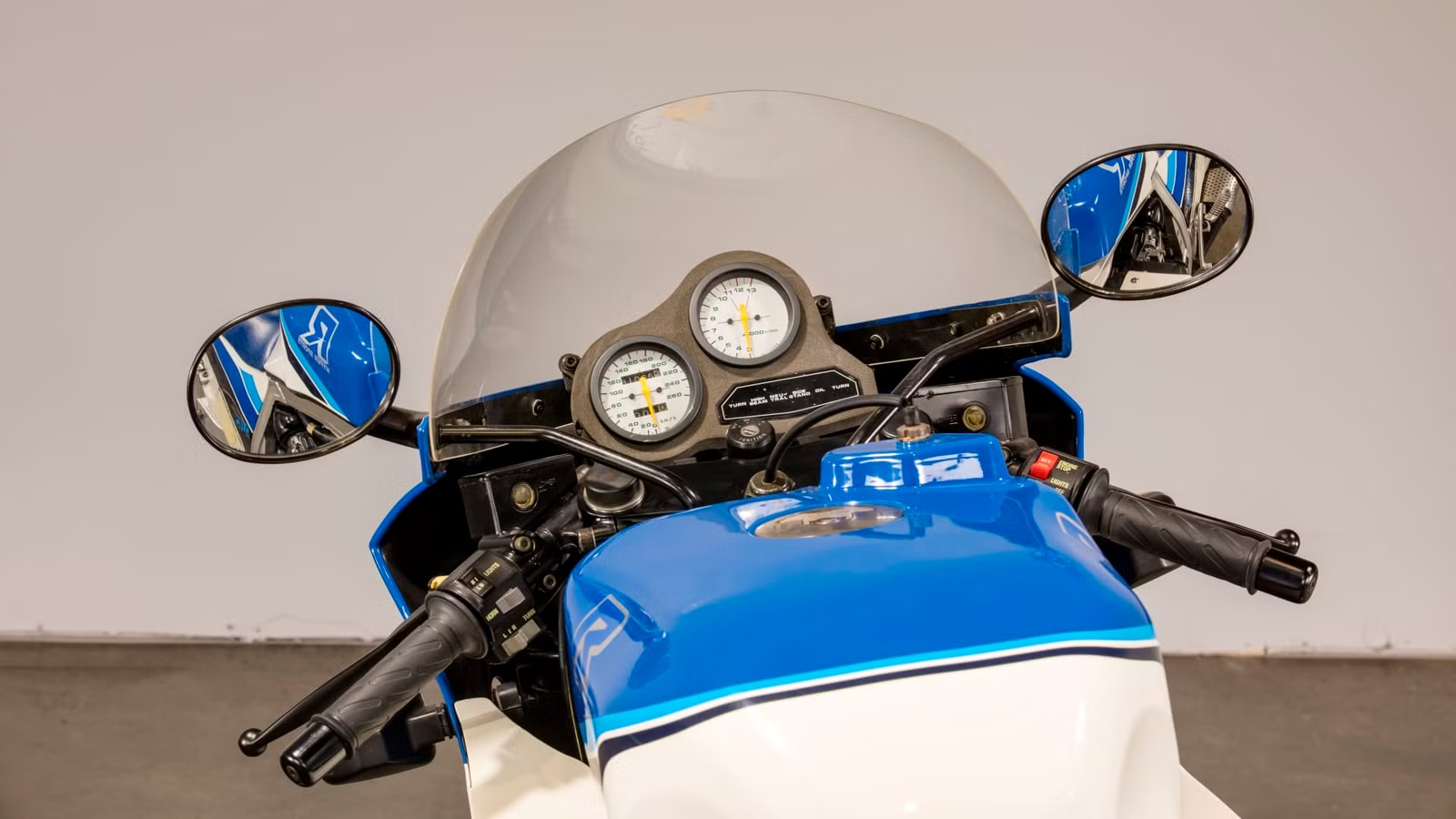
The 1984 debut of the Suzuki GSX-R750 at the IFMA Cologne show in Germany is still considered a landmark moment in motorcycling history. It was deemed to be the first real replica of a race bike for the masses and its twin headlights with a bulbous fairing covering almost the entire engine spoke of its sporty intentions.


Suzuki developed it as the street-legal version of its XR41 endurance racer which spoke volumes of its capabilities and durability. The Japanese brand was the leading contender in the Endurance World Championship — one of the toughest forms of racing wherein motorcycles compete relentlessly for 24 hours to their limits, with just enough breaks to either change tyres or riders. Endurance racing acted as the testing ground in the development of the GSX-R. It was a stark contrast to the Universal Japanese Motorcycles of the 1980s that had taken over the globe, and looked and rode very similarly.
Etsuo Yokouchi And The ‘Light Is Right’ Doctrine

Etsuo Yokouchi, the chief engineer behind the GSX-R750, deserves a lot of credit for making the bike the phenomenon it was. A big advocate of racing and performance, Yokouchi focused mainly on keeping things as light as possible. It was under his supervision that the much-hallowed multi-rib angular aluminum frame of the motorcycle came to life. It weighed just 8.1 kg, which was less than half the weight of a conventional steel frame.
Another trick up the GSX-R750’s sleeve was the Suzuki Advanced Cooling System (SACV). Trickled down from endurance racing, this technology used engine oil jets to cool cylinder heads and pistons and proved to be a superior mechanism to conventional water-based cooling. Under Yokouchi’s leadership, every gram of unnecessary weight on the bike was treated as an enemy and that helped the brand achieve a 394.6-pound (179kg) dry weight – a staggeringly low figure over other 750cc offerings of the era that crossed the 441-pound (200kg) mark.
Mass-Produced Performance Versus Homologation Exotics

The Suzuki GSX-R750 was made available in Japan in 1985 and hit the US market a year later. In its home country, the motorcycle had close to 5,700 takers in the first nine months of its debut. While Suzuki was basking in the glory of its success, the FIM World Superbike Championship was announced in 1988. It came with a unique mandate that brands could only participate with a derivative of one of their street-legal bikes. This is when the GSX saw real competition from Yamaha and Honda.

Honda took the wraps off the RC30 in 1987 and Yamaha unveiled its FZR750R, codenamed OW01, in 1989. Both of them were their respective bike maker’s entry point in the WSBK and, just like the GSX-R, were engineering marvels in their own ways. In fact, they even pumped out more power than the Suzuki. However, the limited availability and exclusivity also meant the prices were exorbitant. Around 1989-90, the prices of the RC30 and OW01 were $15,000 or above. And that’s why the GSX-R750 looked like a steal with an MSRP of roughly $5,799.
Real-World Numbers: Power, Weight, And Accessibility

The Suzuki GSX-R750 was not just about durability and an affordable price tag, but the performance numbers were also impressive enough to make it an enticing proposition. From its 749cc, air/oil-cooled, 16-valve, DOHC inline-four engine, the motorcycle pushed out a claimed 106hp while period tests reported a top speed of 142mph. Moreover, the 388 lb dry weight bestowed it with an incredible power-to-weight ratio and made it the lightest offering in its class.
The on-paper comparison of the GSX-R750 with the homologation specials from Honda and Yamaha always made the Suzuki look a bit modest in terms of engine performance. But when pricing was brought into the equation, it was a different story altogether. The fact that one could acquire the Suzuki for less than half the price of the RC30 and FZR750R made the former’s little compromise in horsepower absolutely worth it.
From 1985 Underdog To Enduring Icon

The 1985 GSX-R750 was responsible for challenging the notion of high-performance superbikes being exclusive to racers or elite enthusiasts. Suzuki literally took its successful racing platform and served it to the general audience in a street-friendly iteration. It laid the foundation of the GSX-R lineage, which proved to be ultra-successful for Suzuki. All the members of this sportbike family have cumulatively surpassed the 1.2 million production milestone.
Over the years, Suzuki spawned multiple models of the GSX-R with varying displacements, ranging from 125cc to 1100cc, with most of them tasting decent success the world over. The targeted demographic for each one of them may be different, but all of them share the same traits — top-notch reliability and affordable performance.

Related posts


Latest Post


No Comments