
Toyota Supercharged Its Smallest Hatchback, And You Can’t Have It
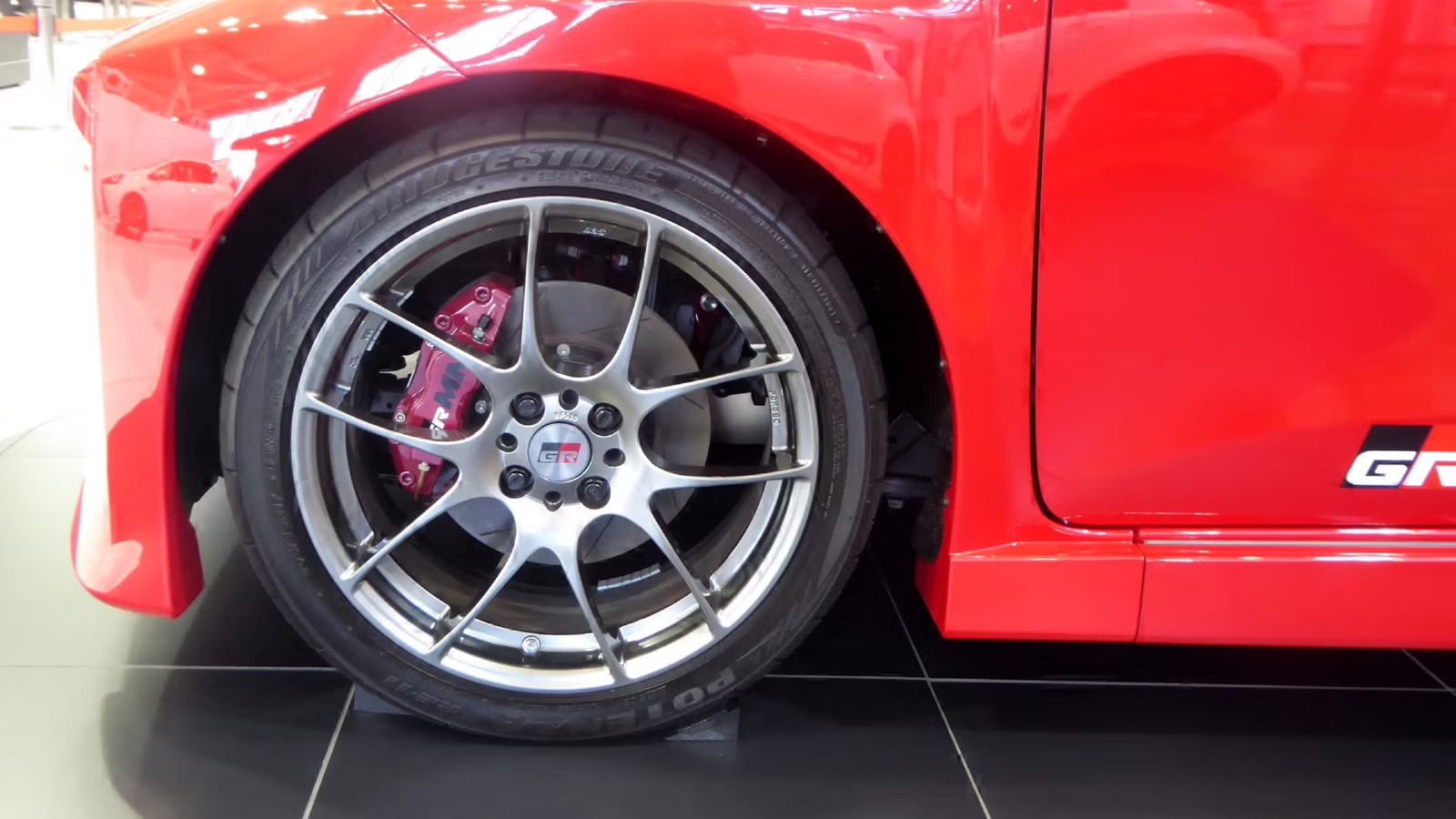
Here in the US, the coolest Toyota hot hatch you’re able to get your hands on is the Toyota GR Corolla. This high-performance turbo machine is the brainchild of Gazoo Racing, and it’s the first time one of the motorsport division’s hotted-up versions of an otherwise sedate model has been sold Stateside.

However, it’s existed for much longer in Japan, and perhaps the coolest car is its first one. A limited-run supercharged hatchback that came long before you ever could have guessed what it would be based on.
Gazoo Racing Was In Its Infancy
Let’s rewind to 2007 for a moment. Akio Toyoda (now Toyota chairman, and then vice-president) is teaming up with Toyota’s chief test driver, Hiromu Naruse, to take on the grueling Nürburgring 24 Hours with a pair of Toyota Altezzas. Forbidden from using Toyota branding for the team, though, it looked to an unlikely source of inspiration.

Team Gazoo was born, taking its name from a little-known used car platform that Toyota had tried to launch during the early ‘00s, Gazoo.com. From 2009, the team got official blessing from Toyota to continue racing as a factory-backed outfit, though it would retain the Gazoo Racing name.
Now with a Nürburgring-battling motorsport division under its umbrella, Toyota decided to let Gazoo’s engineers loose on road cars, with its very first something nobody on the outside could’ve quite predicted.
The Scion iQ Was Never Meant To Be A Performance Car

Ah, the Scion iQ. This compact city car is what happened when Toyota decided it wanted to build the ultimate urban commuter car. Something tiny enough to navigate the hustle and bustle of big city life without compromising on enough practicality for the single driver, one who might now and then fancy taking a friend for a ride too. It was introduced to the US market in 2012, but had been on sale in Japan for a few years by that stage, sold as the Toyota iQ.
Now, it truly was a compact car. It measured just under 10 feet long, five and a half feet wide and five feet tall. Basically, take 3.5 people who claim to be six feet on a dating app despite being nowhere near, and you’d be able to assemble them into the footprint of the iQ pretty easily.

Its powertrains had a pure focus on fuel economy, too. The original iQ featured a 1.0-liter, naturally aspirated, three-cylinder engine producing a mere 67 horsepower and 72 lb-ft of torque. It could cover 0-60 mph in around 13 seconds with a five-speed manual, and a second and a half slower still with the CVT.
In 2009, still a little before the iQ found its way to the US as a Scion, that would be swapped out for a notably bigger engine. A 1.3-liter naturally aspirated four-cylinder was called into action, taking power up to 94 hp and 89 lb-ft of torque, cutting its 0-60 mph to 11.8 seconds with a scintillating top speed of 106 mph. Hey, at least it could do 36mpg in city driving.
Although it wasn’t exactly the natural base for a hot hatch, that didn’t stop a now-famous motorsport division working its magic during its early years.
An Unlikely Hot Hatch Was Born

Meet the Toyota iQ GRMN. Yeah, a Gazoo Racing-tuned version of a car designed to be an inner-city commuter car, and blessed with the ultra-exclusive ‘Gazoo Racing Meisters of the Nürburgring’ badge. We absolutely love how little sense it makes, even looking back on it today.
This was introduced in 2009, and to no surprise, would be a Japan-exclusive model. Powering the GRMN was the new 1.3-liter engine with the exact same power figures as the base Toyota iQ, using the same six-speed manual gearbox that had also just been introduced.
Instead of improving the sheer horsepower of the Toyota iQ, Gazoo Racing focused on the chassis. Its biggest upgrade came in the form of a stiffer suspension setup, while its rear drum brakes were swapped for rotors. A set of 16-inch Rays alloy wheels reduced unsprung mass, and the exterior of the iQ GRMN looked seriously angry thanks to a new bodykit, a rear spoiler and GRMN logos on the side.
When it came to the market, it retailed for around the equivalent of $21,000, just under double the price of the base Toyota iQ. With just 100 made, though, it was clear this was a demonstration of what Gazoo Racing could do rather than aiming to make a huge profit.
Then It Got Supercharged

Not content with leaving the Toyota iQ GRMN as a one-and-done car, Gazoo Racing revisited the model in 2012. The chassis remained identical to the original GRMN, save for some visual changes, but this time, it gained a serious upgrade to the 1NR-FE engine.
With a supercharger now strapped to it, it produced 120 hp with a substantial leap in torque to 128 lb-ft. 0-60 mph now came in around nine seconds, but we can guarantee it felt quicker than that. Before you think those figures are still a little paltry for a GRMN, though, keep in mind this was a car weighing less than 2,200 lbs and was approximately the size of a shoe.
Again, just 100 of the Toyota iQ GRMN Supercharger (that was the official name) were made and this time costing the equivalent of around $38,000, almost triple the price of the regular iQ.
You Can’t Have One (Yet)

Given the original Toyota iQ GRMN was built in 2009 and the Supercharger in 2012, you’ll need to wait until 2034 and 2037 respectively, to legally import them to the US. Keep that in mind if you’re an automotive journalist looking to produce SEO-focused content on cars to legally import to the US in a few years’ time.
If you happen to have space to store one in Japan and fancy hoarding them now, though, examples of the rare hot hatch do occasionally come up for sale in the country. At the time of writing, we couldn’t find any examples of the original model listed but did find three of the Supercharger, ranging from the equivalent of $20,000 through to as much as $41,000.
Although that’s still a lot to pay for a Scion iQ, we suspect values may only increase as US legality comes closer and the global prominence of Gazoo Racing increases.
At Least You Can Buy This GRMN Soon

If you can’t wait until then, or simply want something a little more serious, it won’t be too long before you can get your hands on the US’ first official GRMN product.
Set to hit the US market in very limited numbers in 2027, the Toyota GRMN Corolla is the most hardcore version of the hot hatch yet, and likely the most hardcore to ever come. While engine improvements liberate a modest extra 7 lb-ft of torque, the real changes come in the chassis. The removal of its rear seats, extensive use of carbon fiber and the introduction of full bucket seats lend towards a 66 pound weight saving. Not to mention the seriously cool-looking aerodynamic upgrades, too.
No word yet on US pricing for the Toyota GRMN Corolla, but we’d anticipate a significant increase on the GR Corolla’s $40,520 MSRP.
There Was Another Weird Version Of The Scion iQ

We don’t even think the Toyota GRMN Supercharger was the strangest version of the Scion iQ, if we’re honest. That came from Aston Martin. No, seriously.
The British luxury car brand rebadged the UK-market Toyota iQ from 2011 through 2013, swapping its bumpers for trademark Aston styling and fitting the interior with full leather upholstery. No extra performance came, though, and you could only have it with a CVT.
It was a way of cutting down Aston Martin’s total emissions, allowing it to continue building cars like the DB9 and Vantage without facing hefty fines from the European Union. It wasn’t cheap, though, costing the equivalent of over $46,000. Oh, and there was even a V8 one-off.
Sources: Toyota, Aston Martin, Goonet Exchange,

Related posts




Latest Post


No Comments