
The Twin-Supercharged Muscle Car That Destroyed Supercars In The ’90s
Supercharged muscle cars have always known how to make a statement. From the modern 717-hp Dodge Challenger Hellcat to the 760-hp Mustang Shelby GT500, they deliver straight-line speed and power that punches well above their price point. American tuners like Hennessey push the formula even further, building four-digit-hp monsters that turn quarter-mile strips into battlegrounds. Superchargers boost output without sacrificing the soul of a V8, which is the heart of their appeal.

That strategy has become necessary just to keep pace with high-tech supercars from Europe. Cars like the Ferrari 296 GTB and Porsche 911 Turbo S blend turbocharging with hybrid or all-wheel drive systems, offering staggering acceleration and cornering precision. By comparison, muscle cars often chase raw numbers but rarely beat these supercars across every performance metric.
Yet long before that rivalry became a talking point, one muscle car had already settled the argument — on its own terms. It wasn’t built in Detroit. It was hand-assembled in a quiet factory in England, armed with a 5.3-liter V8 and not one but two superchargers. It outran some of the most celebrated supercars of its era in real-world conditions — not just on paper. Brutally fast, mechanically unfiltered, and unlike anything else the muscle car world had seen before or since, it remains one of the great sleepers of performance history.
The only twin-supercharged muscle car ever made wasn’t American. It didn’t wear stripes or a shaker hood. Yet, in its era, it left Ferrari, Porsche, and Lamborghini looking over their shoulders.

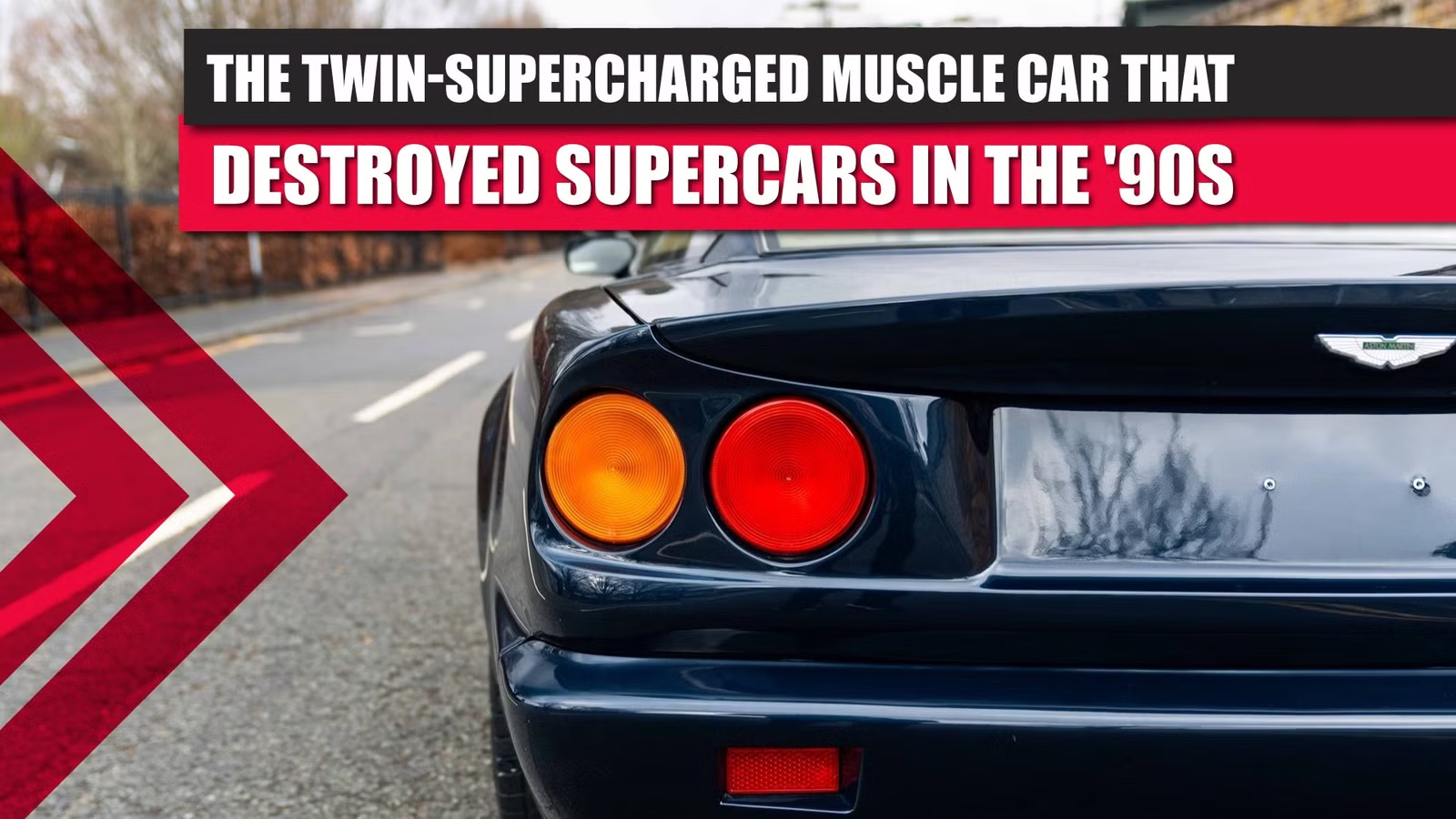
The Aston Martin Vantage V550 Was A ’90s Supercar Killer
The mystery muscle car that humiliated ’90s supercars wasn’t built by Ford, GM, or Chrysler. Known for their elegant grand tourers, Aston Martin shocked the performance world in 1993 with the Vantage V550 — a limited-production two-door coupe that traded refinement for brute force.
Under the long aluminum hood sat a 5.3-liter V8 paired with twin Eaton superchargers. This setup produced 550 hp and 550 lb-ft of torque, figures that rivaled the best in the world at the time. With a six-speed manual transmission and rear-wheel drive, the V550 reached 60 mph in just 4.6 seconds and topped out at 186 mph. Tipping the scales at over 4,000 pounds, it wasn’t light, but it used its mass to its advantage by putting down torque early and consistently.

Compare that to the Ferrari 512TR, which made 428 hp and hit 60 mph in 4.8 seconds, or the 4.7-second Porsche 911 Turbo 964 with 355 hp. Even the Lamborghini Diablo of the early ’90s, with its 485-hp V12, managed a similar time of around 4.5 seconds. Aston’s supercharged coupe didn’t just keep up — it often pulled ahead in real-world conditions, particularly during highway acceleration.
By definition, the V550 checks every muscle car box. It had a front-mounted V8 engine, rear-wheel drive, an aggressive stance, and torque-led performance that prioritized straight-line speed over finesse. Its massive displacement, supercharged power delivery, and manual transmission all reflected classic muscle car traits, even if its British origin and leather-wrapped cabin suggested otherwise. Notably, the V550 was developed during Ford’s ownership of Aston Martin, a period that brought distinctly American performance thinking into the brand’s engineering culture.
Vantage V600: Aston Built A More Powerful Twin-Supercharged Muscle Car

As if the Vantage V550 wasn’t already overbuilt, Aston Martin raised the bar even further in 1998 with the optional V600 package. Created by the Aston Martin Works division, the V600 took the same 5.3-liter twin-supercharged V8 and pushed it to even more extreme levels of output. This was Aston’s answer to customers who wanted more power without sacrificing the car’s brutal, analog character.
The V600 engine retained the same Eaton twin-supercharger setup but received upgraded internals, reworked intercoolers, and a revised engine management system. These changes lifted output to 600 hp and 600 lb-ft of torque — a 50 hp and 50 lb-ft gain over the V550. The six-speed manual transmission and rear-wheel drive layout carried over, while Aston added upgraded brakes, stiffer suspension components, and unique 18-inch wheels to cope with the additional power.

Performance improved accordingly. While exact factory 0–60 mph times weren’t widely published, real-world testing put the V600’s sprint near 4.3 seconds. Top speed crept up to around 200 mph, placing it firmly in supercar territory. Despite weighing over 4,000 pounds, the V600 delivered relentless in-gear acceleration thanks to its broad torque curve and immediate supercharger response.
Visually, the V600 remained nearly identical to the V550, aside from subtle badging and wheel changes. It preserved the understated aggression of the original while delivering significantly more performance. With fewer than 100 examples built to V600 specification, it stands as one of the rarest and most powerful muscle cars ever assembled by hand. For enthusiasts who view the V550 as a brawler, the V600 is the same fighter with a harder punch and sharper reflexes — dressed in a tailored suit, but far more dangerous underneath.
The Vantage V550 And V600 Remain Surprisingly Affordable Today

Despite their performance and rarity, the Aston Martin Vantage V550 and V600 remain undervalued in today’s collector market. Much of that comes down to timing. These cars arrived just before Aston Martin gained mainstream attention with the Vanquish and, later, the DBS. As those newer models captured the spotlight through Bond films and global exposure, earlier cars like the V550 and V600 quietly faded from view.
Collectors tend to gravitate toward more familiar names like Ferrari and Lamborghini. The F50, for example, had 349 units produced, and the Bugatti EB110 saw just 138 examples built. Yet Aston Martin produced only 239 units of the Vantage V550 between 1993 and 2000, with just 84 cars equipped with the high-output V600 package. That level of scarcity would normally command serious collector attention, but many enthusiasts simply don’t know these cars exist.

This lack of recognition makes the V550 and V600 two of the best-kept secrets in the classic performance market. They offer serious performance, old-school craftsmanship, and undeniable rarity at values that still sit below comparable exotics.
According to Classic.com, the lowest recorded sale for a V600 was $82,991 for a 1994 example with over 37,000 miles. On the high end, a 2000 Vantage Le Mans V600 with under 10,000 miles sold for $406,188. Standard Virage-based Vantages, including V550 and V600 models, average around $84,362.
Enthusiast awareness and auction interest are beginning to shift, especially as analog supercars from the 1990s become harder to find. But for now, the Vantage V550 and V600 remain undervalued and underappreciated. They deliver big power, exclusivity, and genuine historical significance — not just the badge recognition most buyers tend to chase. That makes them one of the smartest plays in the collector car market for those who know what they’re looking at.
Sources: Aston Martin, Classic.com, Collecting Cars.

Related posts

Latest Post


No Comments