
The $30,000 New Car Is Becoming Harder To Actually Buy
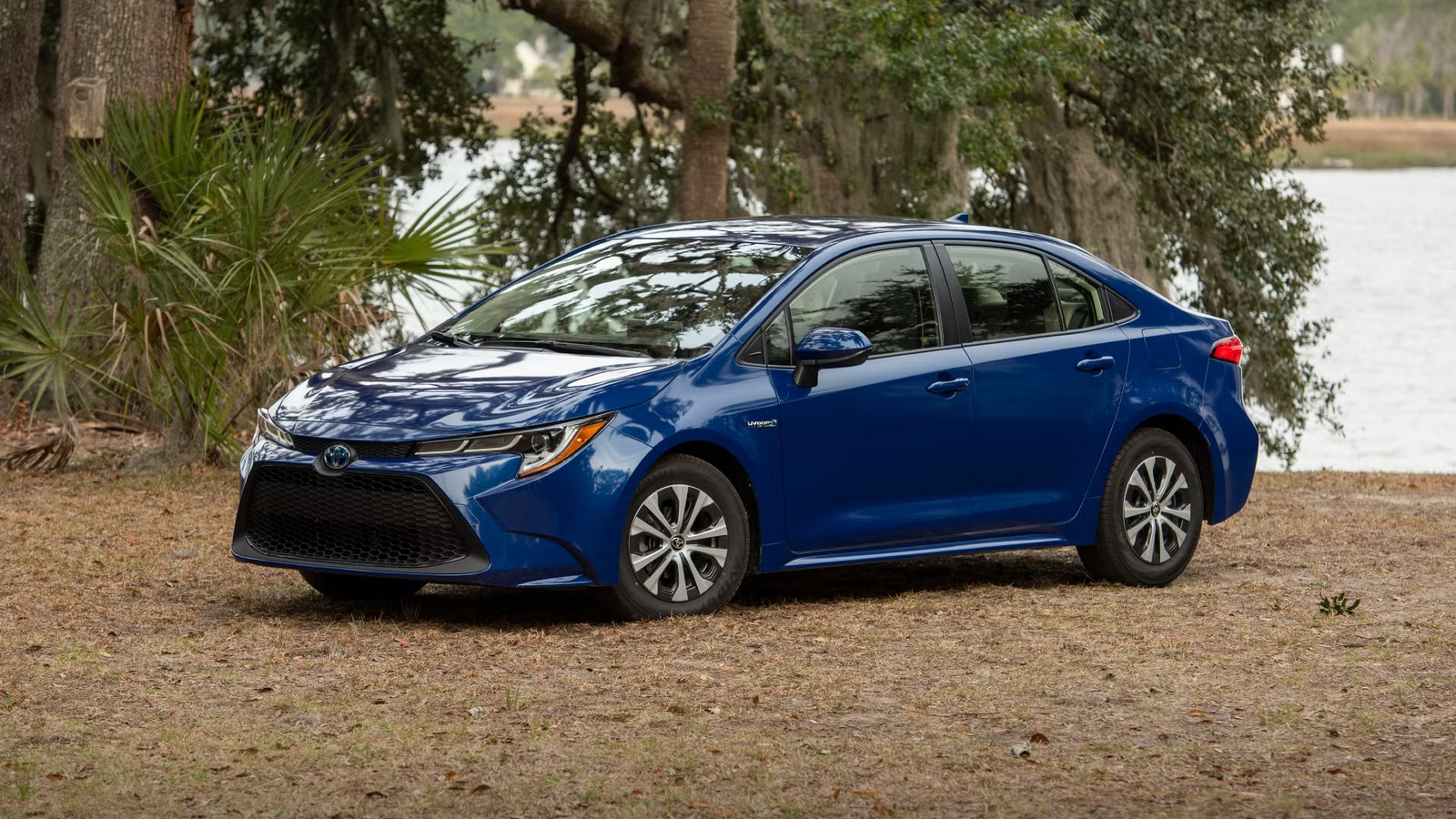
High purchasing prices continue to place a strain on the American new car market, with average prices now soaring well past $50,000. There are some new vehicles with MSRP figures less than $30,000, but taxes and dealer mark-ups always push this value up by thousands, ultimately hurting the consumer.

Dealership floor space typically displays optioned mid-spec sedans and hatchbacks, with luxury packages, and accessory-laden variants. The affordable vehicle exists on paper and digital build tools, yet it remains largely absent from physical retail sales floors.
The Importance Of A Base-Level Trim
Understanding specification disparities requires examining how automobile manufacturers structure entry-level vehicle lines. Base trim levels serve a purpose in vehicle marketing by establishing a baseline price that allows automakers to capture consumer attention. This lower figure gets more attention in promotional materials and search engine listings. A vehicle advertised with an entry price below $30,000 creates a powerful perceptual anchor for potential buyers. This baseline figure allows marketing departments to position a vehicle as accessible to budget-conscious demographics.

The base trim functions a pricing and specification benchmark that defines the entry threshold for a specific model line. The goal is to draw the consumer’s attention by highlighting that the range starts at a specific price in the hopes that they will spend more when they look at the more appealing features found in higher-trim models.
Real-World Examples Of Overpriced Base Models

Several high-volume nameplates illustrate how this marketing strategy diverges from showroom realities. The 2026 Honda Civic displays an advertised starting MSRP of $24,695 for its entry LX trim. Dealerships stock higher-tier Sport and Sport Hybrid builds that push window stickers between $26,000 and $32,000.
The Subaru Crosstrek carries a published base MSRP of $26,000. Physical showroom inventories favor optioned Premium or Sport trims equipped with heated seating packages and roof accessories, driving actual inventory prices closer to $30,000. The Chevrolet Trax advertises a base LS model starting at around $21,500, yet dealer lots feature LT and Activ models with technology packages pricing them thousands higher. The Toyota Corolla lists an entry LE trim near $22,000, yet floor units routinely carry factory options packages and port accessories that push final prices past $25,000.

It’s important to note that franchise dealerships operate as independent businesses that purchase inventory directly from vehicle manufacturers. Dealership financial success relies heavily on gross profit margins generated per individual vehicle sale. Entry-level, non-optioned base models yield minimal profit margins for retail dealerships.
A unit with no options provides minimal financial return relative to the floor space it occupies. The floor-plan interest financing required to hold it and the sales commission paid to dealership staff are also affected. Retailers actively manage their inventory orders to emphasize cars that maximize revenue potential per unit. Mid-tier and high-tier configurations yield higher gross margins, making them the preferred inventory choice for dealership management teams.
Base-Spec Vehicles Take Up Production Space

Factory production allocations further enforce this distribution gap. Assembly plants operate with finite manufacturing capacity and complex supply chain constraints. Vehicle manufacturers want to maximize revenue and operating margins on every production line shift. In turn, assembly capacity gets directed toward higher-trim builds that incorporate premium technology suites, leather interiors, advanced driver-assistance systems, and upgraded engines.
Manufacturing a base-spec vehicle uses virtually the same assembly line time and labor resources as building an optioned variant. However, higher-trim units yield higher profitability per chassis for the manufacturer. Automakers allocate a fraction of overall production to true base-spec models because factory schedules heavily favor higher-trim variants to fulfill regional inventory demand and maximize corporate profits.
How Dealers Bulk Up Floor Pricing

Factory-installed options packages and port-installed accessories widen the price gap between online configurators and physical lot inventory. Even when a manufacturer produces a vehicle in a base trim tier, that specific chassis rarely arrives at a retail dealership without additional features added to it. Factory ordering systems frequently bundle desirable standalone items into comprehensive options packages.
A basic comfort feature, such as heated front seats or upgraded infotainment software, often requires adding an expensive equipment tier. Vehicles arriving at regional distribution ports also receive port-installed accessories. Items like exterior protection films, all-weather floor mats, roof racks, mudguards, and cargo organizers get added before final transport. These accessory add-ons increment the final Monroney window sticker price, effectively overshadowing the true base price before the car ever hits a showroom floor.
Base-Spec Models On The Floor Cost Dealers Money

Retail delivery logistics and floor-plan financing economics also discourage holding base-model stock. Franchise automobile dealers employ specialized commercial credit lines. Floor-plan financing involves the purchasing of vehicle inventory from manufacturers. Dealerships pay monthly interest charges on every vehicle sitting on their lots until that unit sells to a retail customer. High-demand, heavily optioned trim levels move faster off dealer lots because they match the standard expectations of average showroom shoppers.
Rare base-spec models sit longer on lots because they suffer from a lack of appeal, despite being more financially attractive. The market reveals that only a narrow segment of value-focused buyers ever consider these examples. This prolonged lot tenure increases accrued floor-plan interest costs for the dealership. This interest burden further reduces the already slim profit margins on base-tier inventory. Retail managers avoid ordering low-spec stock to prevent slow-moving units from eroding overall store profitability.

Consumer buying patterns and instant gratification dynamics also shape modern inventory composition. Consumers who visit dealerships usually inspect, test-drive, and purchase a physical vehicle available on site. Most retail buyers prefer to drive home in a newly acquired vehicle on the day of sale rather than wait through extended factory-build queues.
Considering a base-spec vehicle means that the buyer has to place a custom factory order with a dealer. This results in waiting times that can take months for production schedule allocation, assembly, port processing, and transport delivery. Facing extended delivery timelines, many buyers compromise on their original budget targets. They find more personal value in choosing higher-priced, optioned inventory already sitting on the lot rather than waiting for an entry-level build.
The Fundamentals Of Dealer Markups

Dealer market adjustments and mandatory regional package additions further elevate real-world transaction prices. When vehicle supply remains constrained relative to consumer demand, dealerships apply dealer markups or mandatory protection packages to available floor units. This is a trend that saw new heights during the COVID-19 pandemic. Common dealer additions include window tinting, paint protection treatments, anti-theft tracking systems, and extended fabric protection guarantees. Dealership sales departments apply these mandatory add-ons directly to the supplemental window sticker, artificially inflating the final retail price.
Even if a rare entry-level vehicle reaches a retail lot, these dealer-applied additions push the final price tag significantly beyond the original manufacturer’s suggested retail price. Budget-focused shoppers searching for entry-level transportation find themselves priced out of low-spec units by mandatory retail add-ons.
Fleet Sales Favor Cheaper Low-Spec Models

Fleet sales and corporate ordering channels absorb a substantial portion of total base-tier vehicle production. Rental car agencies, government departments, corporate logistics fleets, and commercial service companies represent major buyers of low-spec passenger cars and entry trucks. Vehicle manufacturers contract directly with corporate fleet buyers to supply thousands of basic, non-optioned vehicles in large batch orders.
Fleet transactions provide manufacturers with predictable, high-volume production runs that keep assembly plants operating at efficiency thresholds. Because commercial fleets claim the vast majority of base-trim production capacity, very few unequipped entry-level vehicles remain available for distribution through retail consumer dealership networks. Individual retail shoppers compete directly against massive corporate fleet orders for access to basic, cost-effective transport options.
It’s Getting Harder To Make Cheaper Cars

The evolving nature of standard automobile equipment has altered the definition of an entry-level vehicle. Modern government safety mandates, emissions regulations, and baseline consumer expectations have systematically raised the minimum hardware costs for all modern passenger vehicles. Features that were once considered premium options, including backup cameras, automatic emergency braking, blind-spot monitoring, lane-keeping assistance, touchscreen displays, and digital instrument clusters, are now standard equipment across almost all vehicle classes.
Incorporating advanced sensor arrays, computing modules, and high-strength body architectures raises the minimum baseline cost to manufacture any modern automobile. While these additions enhance overall vehicle safety and operational capability, they raise the absolute floor price for entry-level transportation across the entire automotive industry.
Financing Adds A Layer Of Complexity

Automotive financing structures and extended loan terms also encourage consumers to absorb higher option costs during retail transactions. Today’s automotive retail industry relies on monthly payment marketing rather than total purchase price transparency. Finance departments offer extended payment terms, ranging from sixty to eighty-four months, to keep monthly payment figures low for higher-priced inventory.
Spreading the cost of a three-thousand-dollar options package over a long-term financing agreement adds a relatively small amount to a buyer’s monthly installment. Consumers frequently accept higher-trim, lot-available inventory because the monthly payment difference appears manageable during contract negotiations. Dealership sales personnel leverage monthly payment metrics to transition budget-conscious shoppers away from nonexistent base builds and into optioned inventory sitting on the showroom floor.
Sources: Cox Automotive, J.D. Power, Mobility Global, and Nada Industry Reports.

Related posts




Latest Post


No Comments