
The Next Toyota Highlander Won’t Make You Choose Between Gas And Electric
Over time, Toyota has become one of the most dependable, reliable, and affordable brands for families, not only in the US market, but across the world. Toyota became known as the premier family automobile in Japan with the introduction of the extremely popular first-generation Toyota Corolla in 1967. By 1968, it came stateside and was a much more frugal alternative to the massive Chevrolet’s and Ford’s being sold. Later models could achieve an average of 30 mpg compared to the Impala’s 12 mpg, making all the difference in the 1970s fuel crisis.

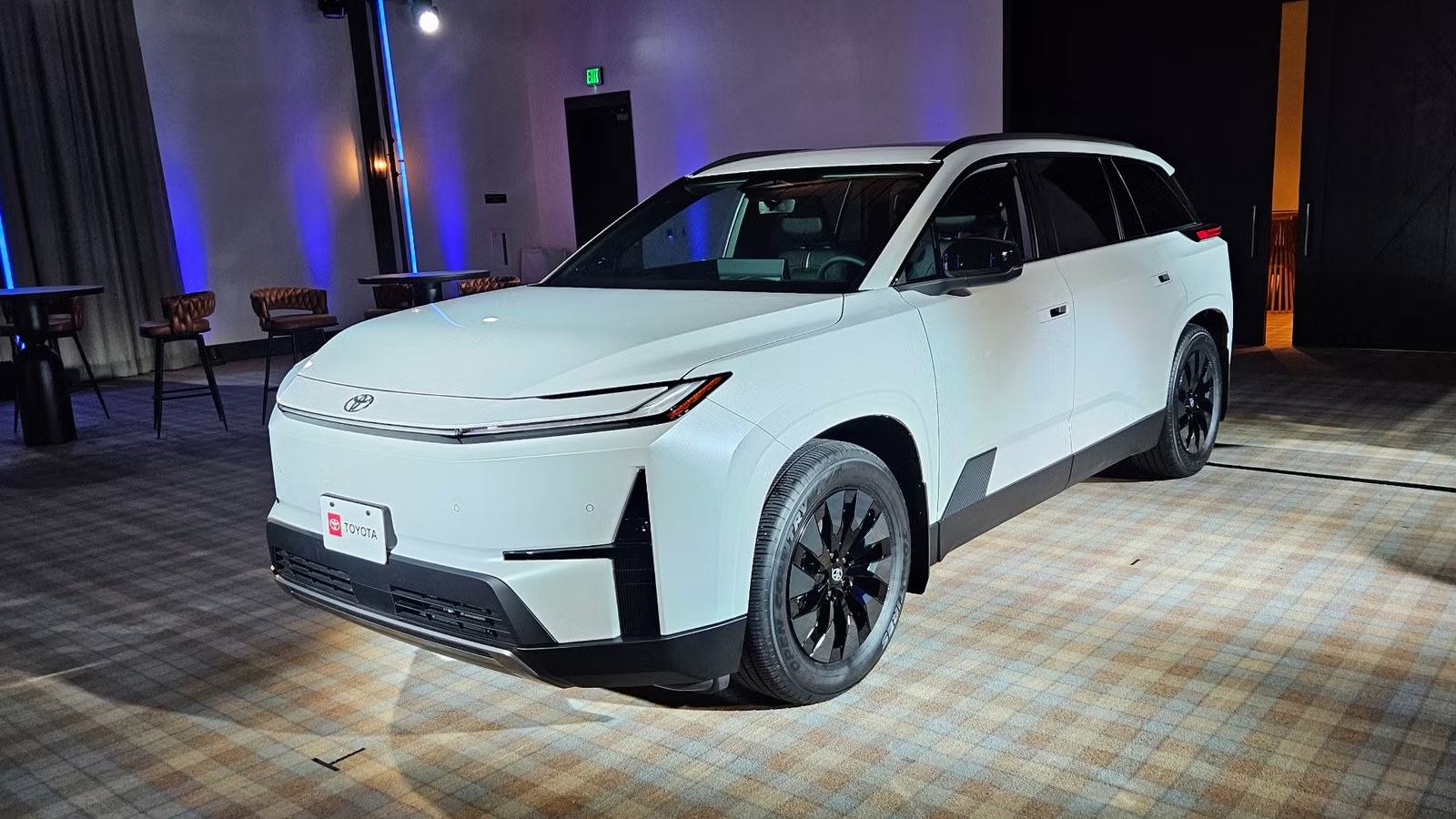
Fast-forward to the new millennium and the automobile market has made a complete 180-degree shift from compact, mid-size sedans to minivans and three-row SUVs. By 2001, the Toyota Highlander had launched with the relatively new unibody crossover SUV motif. Most of what it was competing against were body-on-frame gas guzzlers that were more trucks than they were considered to be SUVs. Now? They’ve taken what’s become one of their most popular family SUVs and made another 180-degree turn by making it completely electric.
From World’s First Hybrid SUV To Fully Electric: The Highlander’s Radical Reinvention
What a complete change this is. The evolution of the Toyota Highlander started with a four-cylinder and a more powerful V6. Then it earned the claim to fame as the world’s very first seven-seater hybrid, thanks to a 3.3-liter V6 hybrid engine. Then, in 2023, they dropped the V6 entirely and left the four-cylinder and four-cylinder hybrid as the only powertrain options, even though they were plenty powerful by that point. Now, the fully electric Highlander has sent shock waves through the automotive industry and is now Toyota’s very first fully electric vehicle to be manufactured in the United States.
Why Toyota Needed The Highlander Name To Save Its EV Strategy


Even though this seems like a dramatic departure from what the Highlander has been, it makes sense in a lot of ways to make this electric. Firstly, the Toyota bZ has had such a confusing lineage that Toyota changed it from the bZ4x to simply bZ. The Highlander nameplate is credible and popular, and will help ease first-time buying concerns for this new electric vehicle. With family automobiles, especially three-row SUVs, already jumping up to $50,000 or more, capturing this segment is crucial, especially for those wanting fully electric seven-passenger SUVs. This is a segment that Hyundai and Kia have already capitalized on with the Ioniq 9 and EV9.
Easing Range Anxiety With The New Highlander

Thankfully, there shouldn’t be too much range anxiety anymore with the integration of the robust NACS charging network, and all vehicles are required to have these ports post 2025 models. However, Toyota is further putting families’ minds at ease by offering two different battery capacities. The standard 77-kWh battery pack outputs an estimated 287 miles of range, coupled with the upgradeable 95.8-kWh battery pack that delivers 315 miles of estimated range. Estimated charge time, thanks to its 900V charging architecture, should bring the battery from 10 to 80 percent in 30 minutes.
The Grand Highlander Is Bigger, More Powerful — And Somehow $4,000 Cheaper Than The Standard Model

What probably makes this one of the most logical moves is the introduction and existence of the Grand Highlander. The Highlander didn’t have much of a leg to stand on with the introduction of the Grand Highlander, which basically forced Toyota’s hand in redefining what the Highlander actually is. The Grand Highlander is, by all accounts, larger, roomier, more powerful, and more luxurious than the outgoing Highlander.
Making The Grand Highlander Do The Hybrid Work

Toyota’s bread and butter is their hybrid powertrain setup. The Grand Highlander will now wear the ICE and HEV crowns going forward. At this point, this gives consumers four powertrains to choose from for their most popular seven-passenger family haulers. A fully non-hybrid engine, two hybrids (one being more powerful), and then the obvious choice: the electric variant. The 2026 Grand Highlander hybrid models can easily achieve over 500 miles of total range and tow 5,000 pounds easily. The Highlander EV, unfortunately, is only estimated to have a maximum tow rating of 3,500 pounds.
The Previous Lineup Was Confusing

While visually they look like two totally different vehicles, they were virtually identical. They both offer four-cylinder hybrid and non-hybrid powertrains, both seat seven, and both can tow 5,000 pounds. There’s also nothing wrong with having several seven-passenger vehicle variants in your lineup. The problem is when the pricing doesn’t make a lot of sense. For the 2026 model year, the Grand Highlander actually has a $4,000 less starting MSRP compared to the base Highlander. The Grand Highlander starts at $43,885 while the more compact original model starts at a whopping $47,775.
How This New Pathway Is Going To Work Well For The Legacy Brand

If you’ve been paying attention to the way the brands have been responding to the call for electric vehicles, you’d know that Toyota has been more tepid than most in engaging. Take, for example, Honda. Honda went all in with a dedicated program and platforms that were going to change the brand almost entirely. Now? It’s all about hybrids for them. General Motors has gone full bore with their ultium battery platform and now Cadillac is mostly EVs. Toyota has stayed on the hybrid path and, in fact, doubled down with the RAV4 and Camry becoming hybrid only. The Highlander EV is the third fully electric vehicle they’ve produced since automakers started going in that direction, while others are on their fourth or sixth model.
Giving Everybody What They Want

This is a great strategy for customer retention, especially as American consumers’ desire for fully electric vehicles has waned in recent years. According to Consumer Reports, customers are just not there with at-home charging or public charging, especially on long road trips, which Americans love to do. Therefore, giving them the option of the ICE/HEV Grand Highlander and the reasonably priced EV variant makes the most sense.
Best Of All Worlds, Not Just Both

The Highlander EV, according to Toyota, is going to have bidirectional charging capabilities. You’ll be able to charge other cars as well as keep essential household appliances powered during power outages. The Highlander EV will also benefit from over-the-air updates, and as we all already know, zero emissions when driving around town.
The Future Of Family Transportation
To further drive the point home that this is a massive shift for the automotive world: this is basically a signal that one of the biggest brands to feature seven-passenger family vehicles is going fully electric — and that should help shift the trend away from tepid EV skeptics toward more confident buyers. This isn’t just conjecture either — it’s a signal verified by S&P Global Mobility Adoption Forecasts. This will also put more pressure on public infrastructure like schools, parks and the like to put more electric chargers on their facilities to accommodate them.
Easing Buyers Into The Future

To some, the upfront cost of a base MSRP of $54,000 might seem like a lot (and it certainly is), but it doesn’t mean that it’ll always be costly. If you have an at-home charger, it’ll cost next to nothing for you to “fill up” once a week. Additionally, maintenance costs will be routine, manageable, and certainly not as high as having to address the transmission fluid, spark plugs, etc. According to a J.D. Power EV Consideration Study, consumers are more likely to buy into the idea of a “newer” consumer product like an EV if it’s tied to a more trusted brand like Toyota.
Resale Value Insights

There is the flip side to this, as the inevitability of a fully electric Highlander might turn some people off to the idea completely. Even if it doesn’t, it will still make the hybrid and internal-combustion-engine-powered Highlander and Grand Highlander much more valuable from a market standpoint. To potentially help persuade consumers on the idea of a fully electric Highlander is the offering of one of the best warranties on the market for an electric vehicle. Toyota offers a ten-year, 150,000-mile warranty (whichever number comes first) for their electric batteries. Therefore, even though this is a first-of-its-kind electric vehicle, this should at least stave off some of the steep value depreciation down the line.
Sources: Consumer Reports, JD Power, iSeeCars, Toyota

Related posts



Latest Post


No Comments