
The Last Japanese V8 Trucks Buyers Are Hoarding For 15-Year Ownership
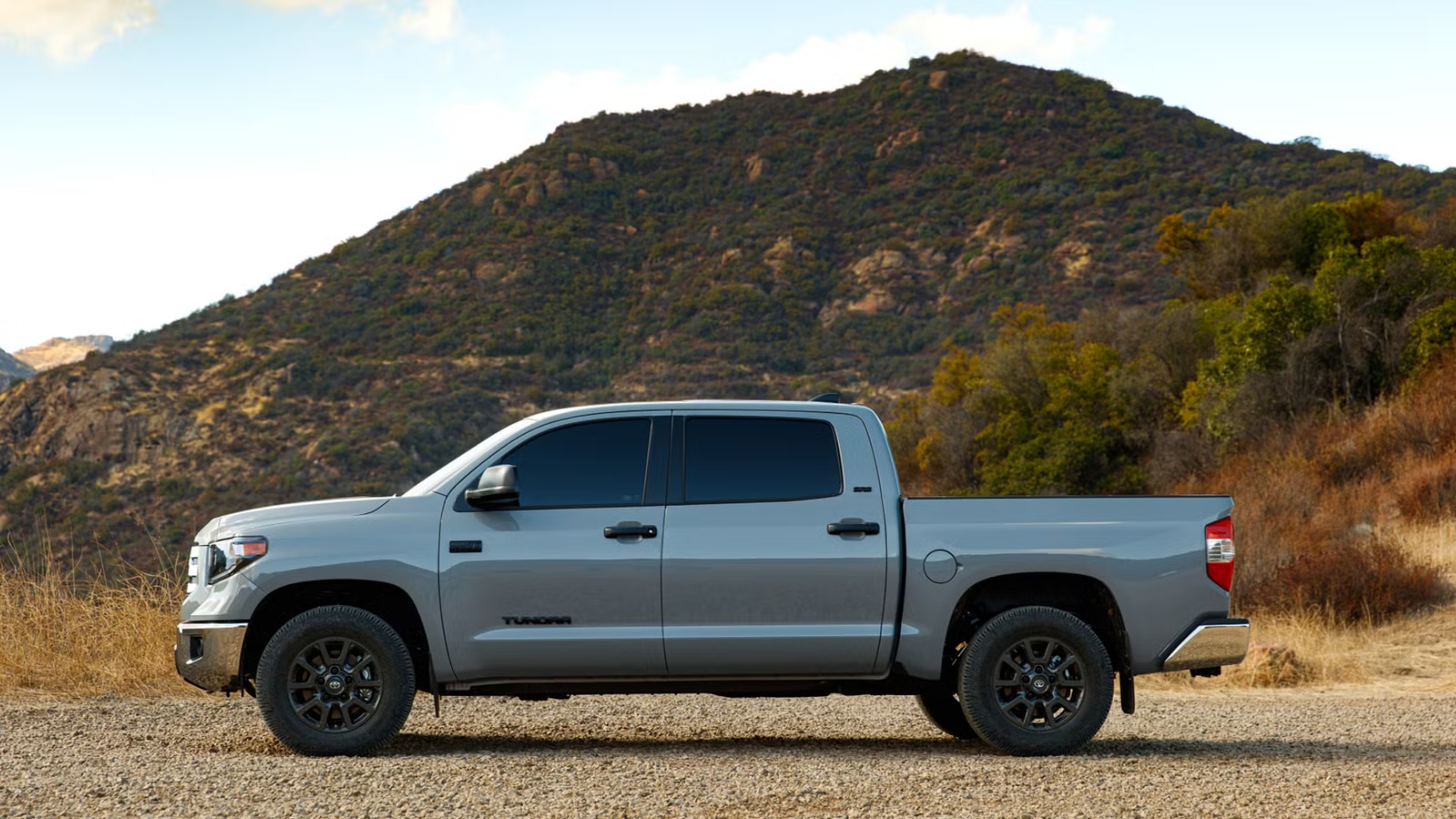
Are you the type of shopper who is looking for a truck that you’d like to own for the next 15 years or so? A common misconception is that buying the newest and most expensive option available is the best course of action to achieve longevity. However, the reality is quite different.

Toyota and Nissan’s naturally aspirated V-8 engines that once powered their full-size truck platforms may no longer be found in new-car showrooms, but they have quietly become some of the most sought‑after powertrains for longevity. These older Japanese V-8s offer a completely different foundation than today’s turbocharged alternatives. Modern trucks may be more powerful and capable, but savvy shoppers who prioritize durability are increasingly betting on simpler engines that already have proven track records of long-term reliability.
The Shift Of The ‘Keep It For 15 Years’ Formula
Buying a long-term truck used to mean ordering the newest model with the longest warranty. Today, many shoppers are deliberately buying the previous generation instead because they trust a proven powertrain more than the latest engineering.
The Cold Hard Statistics That Are Reshaping The Market


If you are curious what the most reliable full-size truck on the market is, it is the Toyota Tundra. According to iSeeCars, the Tundra has an average lifespan of 204,988 miles or about 14.8 years. This estimate assumes an average of 12,901 miles per year over the first ten years, and a 53.4 percent chance of reaching at least 200,000 miles.
While extreme towing ratings may be important for certain shoppers, most people looking to invest long-term in a full-size truck care more about how long it will actually last. The longer a truck lasts, the lower its cost-per-mile will be, which is often more important than the upfront purchase price. That is why if you are thinking about the ownership proposition a decade or more down the line, it only makes sense to prioritize durability over capability.
The Best Truck May Not Always Be The Strongest

So what exactly are the trade-offs you’ll have to make to find a truck that will last you over a decade? When it comes to towing and payload capacity, the Big Three American manufacturers—Ford, Ram, and GM—dominate the conversation. If you want a diversity of engine choices, such as a diesel, American brands will be the only option.
However, if you only need about 8,000 to 10,000 pounds of towing capacity, more than enough for a trailer, boat, or camper, a Japanese V-8 will get the job done. A rule of thumb is that you never want to tow at max capacity, because your payload, hitch, and axle limits will surely be reached before doing so. If you really need a tow capacity around 10,000 pounds, your best bet is a 3/4-ton truck. So, while a Japanese V-8-powered truck may not be the strongest platform on paper, it is the safest long-term ownership bet. But not all Japanese V-8 trucks are created equal — and the difference between the two remaining options could cost you tens of thousands of dollars over a 15-year ownership window.
The Two Japanese V-8s Buyers Still Trust

Brand loyalty is not the real story here. The common denominator is that both trucks rely on simple, naturally aspirated V-8s that spent years building reputations before emissions downsizing changed the market.
The Benchmark: Toyota’s i-Force V-8

Toyota’s last naturally aspirated V-8 truck engine was the 5.7-liter i-Force 3UR-FE, found in the second-generation Toyota Tundra (2007-2021). This engine produced 381 horsepower and 401 pound-feet of torque while mated to a conventional six-speed automatic transmission. The relatively simple drivetrain contributed to an all-time reliability high, with the final model year earning an 86 out of 100 J.D. Power Quality and Reliability score.
The 3UR-FE was overengineered for everyday life, featuring a forged steel crankshaft and forged connecting rods along with six-bolt main bearing caps. With a low compression ratio of 10.2:1, the 3UR-FE is understressed by design. The high-quality standards and mechanical simplicity of this platform have kept resale values high for these trucks despite their age. With strong aftermarket support and parts availability, servicing this platform should be straightforward for years to come.
The Alternative: Nissan’s Endurance V-8

The Nissan Titan, powered by the 5.6-liter Endurance VK56VD V-8, is a frequently overlooked alternative to Toyota’s 3UR-FE engine. This naturally aspirated engine was found in the second-generation Titan from the 2016 to 2024 model years and produced 400 horsepower and 413 pound-feet of torque. The VK56VD is slightly more powerful than the 3UR-FE, but offers similar levels of mechanical simplicity with an emphasis on longevity.
You won’t find any auto-start/stop functionality or cylinder deactivation technology to save a few mpg, which can compromise long‑term reliability. Once the stronger nine-speed transmission was introduced in 2020, the durability of the second-generation Titan became excellent, addressing the shortcomings of the previous seven-speed transmission. With this platform, you are certainly compromising on fuel efficiency with only about 16 mpg combined, along with fewer trim options and a smaller dealer network. However, used market shoppers may actually benefit from the effects of depreciation to find a great deal on a 2020+ Nissan Titan.
Why Modern Turbo Trucks Can’t Keep Up

The newest generation of half-ton trucks is objectively faster, more efficient, and packed with technology. Yet increasing powertrain complexity has made many long-term buyers question whether those advantages still outweigh mechanical simplicity.
The Recall That Broke The Tundra’s Reliability Narrative

For the third generation of the Tundra introduced in 2021, Toyota debuted a new 3.5-liter twin-turbocharged V35A-FTS V-6 engine as the replacement for the 3UR-FE V-8. In terms of reliability, this new generation was a turning point. A major engine manufacturing defect was first discovered in March 2022. The crankshaft main bearing could seize at any time due to machining debris, leading to catastrophic engine failure.
Approximately 98,600 vehicles (produced from late 2021 to early 2023) were affected initially; that later extended to nearly 130,000. The only formal resolution for the recall was a complete engine replacement, which would fracture Toyota’s nearly untouchable reliability image. The brand that represented unshakable reliability began showing cracks in its armor, and the psychological effect on shoppers has led many to shift toward the previous generation of Toyota models.
Simple Things Last Longer

In general, full-size trucks score poorly in modern reliability metrics. Yet, the reason for decreasing reliability standards is no secret. With the added complexity of turbocharged hybrid powertrains and fuel-saving systems like cylinder deactivation, there was only one possible result. More electronics, more sensors, and more complex technology rarely result in better long-term durability.
The 2025 Ford F-150 Hybrid has a predicted reliability score of 7 out of 100, the absolute bottom of Consumer Reports’ rankings. The standard 2025 F-150 and Tundra both scored below 50 out of 100, which is far below the impressive 86 out of 100 score of the final model year of the previous generation Tundra. Despite their capability, these complex turbocharged hybrid powertrains cannot provide the same confidence that their predecessors did. That is why, if you want a truck worth keeping for 15 years or longer, a battle-tested platform with a proven track record is the way to go.
Why These V-8 Trucks Are Disappearing

The best examples of these desirable trucks aren’t getting easier to find. As production ended and long-term owners continue holding onto them, clean late-model Japanese V-8 trucks are gradually becoming a shrinking segment of the used market.
The Simple Math Of Supply And Demand

The V-8-powered Tundra ended production in 2021, and the V-8-powered Titan was discontinued after 2024. Throughout its long production cycle between 2007 and 2021, Toyota produced about 1.6 million units of the second-generation Tundra. However, if you look at the used market today, it is clear that supply is diminishing while demand is steadily increasing.
RV owners, contractors, and track day enthusiasts are all now considering the second-generation Tundra the gold standard of the relatively modern V-8-powered Toyota truck. With the newer generation’s dubious reliability and the discontinuation of the V-8 platform, the proven longevity of the second-generation Tundra has only become more appealing over time. This fact has led to strong resale values, which is a trend that will surely continue for the near future and beyond.
Who These Trucks Are Best For

Now the real question is, should you buy a second-generation Nissan Titan or Toyota Tundra before it’s too late? Well, if you plan to keep your truck for the next decade or more and don’t need to tow anywhere near the 10,000-pound limit, these Japanese trucks are quite convincing. They will not offer the latest infotainment or performance features, but they prioritize reliability in a way that modern equivalents cannot match.
Note that even with record-high gas prices, ownership costs may still be lower than those of a new truck. If you are thinking long term, the smartest truck purchase isn’t necessarily the newest truck on the lot. Instead, we suggest opting for the confidence that comes from hundreds of thousands of miles of proven durability, as found in the final generation of naturally aspirated Japanese V-8 trucks.
Sources: Toyota, Nissan, Ford, GM, Ram, iSeeCars, CarEdge, J.D. Power

Related posts



Latest Post


No Comments