
This Old-School Subaru Coupe Was Built To Humiliate Porsche
The flying wedge cars of the 1980s and 1990s were a high point in automotive design, and collectors are beginning to catch on. Enthusiasts are also beginning to realize that many of the early Japanese sports cars were as fantastic as the European exotics of the same era. One car combined both movements: a Subaru engineered to humiliate Porsche. Unfortunately, the impressive effort wasn’t enough to reverse Subaru’s budget station wagon manufacturer reputation. But it’s finally getting the credit it deserves.
When Japanese Automakers Put Germany On Notice

In 1969, Nissan released the Datsun 240Z “Fairlady” for the North American market. It featured the torquey inline six-cylinder engine and independent rear suspension of a BMW. It boasted the good looks of the era’s Jaguars and Ferraris. And best of all, it was as reliable as anything coming out of Japan.
One car changed the reputation of an entire country’s auto industry. Through the 1960s, Japan had built budget people movers and the occasional knockoff of a British roadster. By the 1970s, everyone knew Japan built sports cars.

Multiple sports cars as iconic as the Datsun 240Z followed. Mazda planted a flag with its rotary engine-powered RX-7. Toyota introduced the Supra. Nissan built on its success with icons such as the 300ZX and the Skyline. Honda’s Acura brand eventually went toe-to-toe with supercar manufacturers when it released the NSX.

By the mid 1980s, Subaru was hungry for a piece of the action. It was a comparatively small automaker. But luckily for Subaru, it was backed by the might of Fuji Heavy Industries.
Subaru’s First Flying Wedge Was All Bark And No Bite

Fuji Heavy Industries was founded when five major Japanese corporations merged in 1953. It built all manner of transportation equipment, from railroad to aerospace to military. The new company immediately began building budget-friendly cars with its 1954 “Subaru 1500.”
Subaru is just the Japanese name for the seven-star Pleiades constellation, which was FHI’s logo because it represents the unity of the multiple corporations. The brand would continue to represent affordable vehicles, including its iconic AWD wagons of the 1970s and 1980s. But FHI was itching to charge into the lucrative Japanese sports car market.
Subaru enlisted FHI’s aviation division to come up with an absurdly aerodynamic wedge-shaped coupe. In fact, when it debuted the Subaru XT for the 1985 model year, the GT car was the most aerodynamic vehicle in the North American market. It was more aerodynamic than a contemporary Corvette or Lamborghini. Only later did FHI introduce the same sports car to the Japanese market as the Alcyone. It lifted this name from the brightest star in the Pleiades/Subaru constellation.
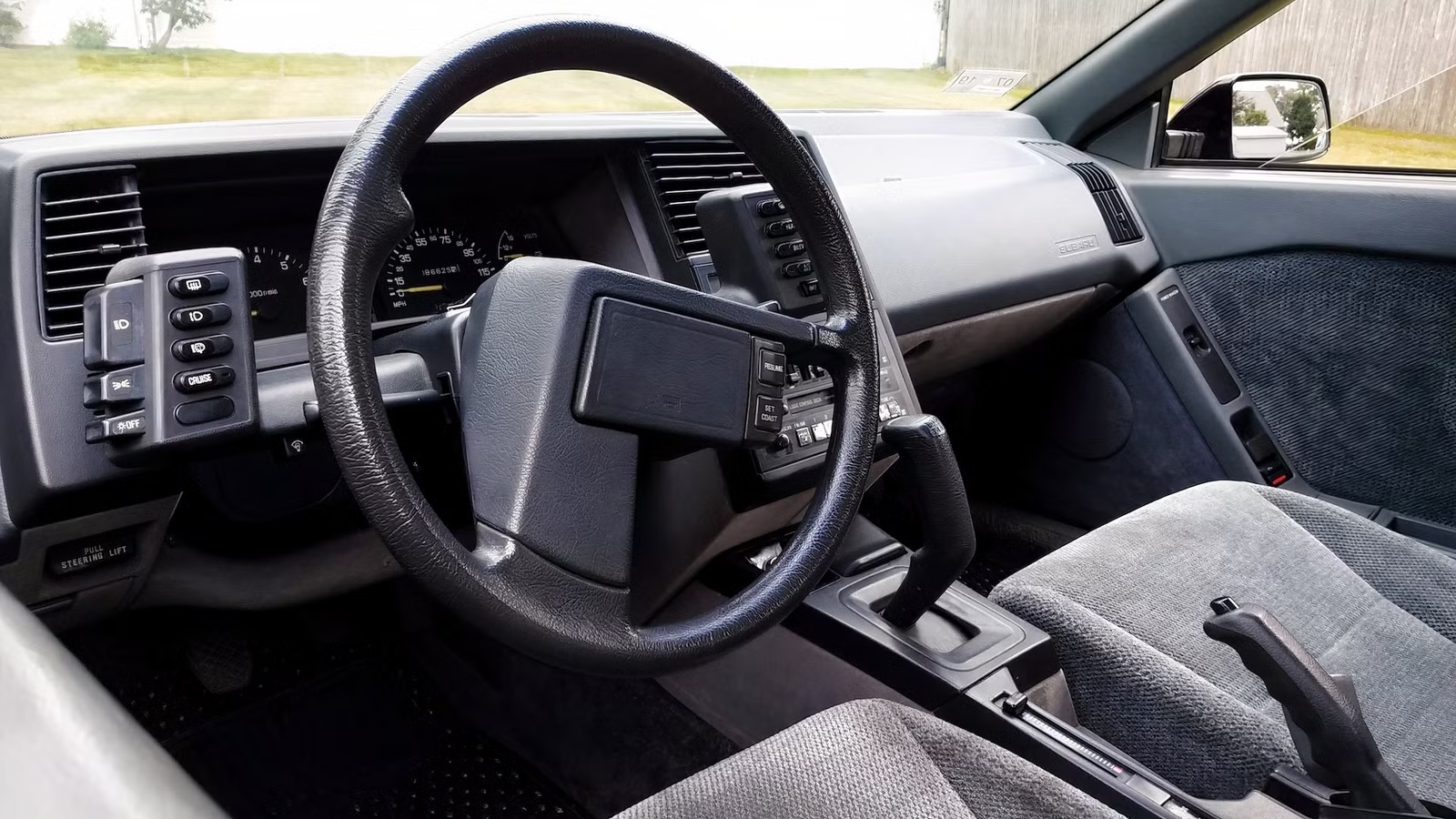
The XT had a drag coefficient of 0.29, a pistol grip shifter, an asymmetrical “L-shaped” steering wheel, flush-mounted door handles, aerodynamic wheel covers, an electronic dashboard with cutting-edge graphics, and a single center-mounted windshield wiper decades ahead of its time. The XT looked as much a fighter jet as a car. There was only one problem: with a 111-horsepower turbocharged flat-four engine, it was all bark and no bite.
The XT6 Featured Subaru’s First Porsche-Style Boxer Six-Cylinder

Subaru took its XT to the next level for the 1987 model year. The automaker expanded its “boxer” style flat-four engine into its first ever flat-six engine.
In 1987, Subaru assembled the XT with three separate engines, with availability varying by market. The EA-82 was the naturally aspirated “H4” (1,781 cc), rated for 97 horsepower at 5,200 rpm and 103 lb-ft at 3,200 rpm. The EA-82T added a turbocharger for 114 horsepower at 4,800 rpm and 143 lb-ft at 2,800 rpm. The new engine was the ER-27. This naturally-aspirated H6 (2,672 cc) made 145 horsepower at 5,200 rpm and 156 lb-ft at 4,000 rpm.

The XT6 was no Porsche. It was a front-engine car, originally engineered as a FWD and now offered with an AWD option. The new engine up front was so heavy that Subaru had to stiffen the XT6 suspension. But the H6 was impossible to ignore. It put the new XT6 in spitting distance of Germany’s most iconic sports cars.
The new engine wasn’t just larger—it represented a philosophical shift. While most Japanese sports cars relied on inline engines or V6s, Subaru doubled down on the horizontally opposed layout that had become synonymous with Porsche. A flat-six keeps its cylinders low in the chassis, lowering a car’s center of gravity and reducing body roll in corners. It also naturally balances its reciprocating forces, making it smoother than many rival engine designs. Subaru wasn’t simply chasing more horsepower. It was borrowing one of Stuttgart’s favorite engineering tricks, hoping that pairing a silky boxer six with standard all-wheel drive and slippery aerodynamics would finally give the XT the performance credentials its futuristic styling promised.
The Right Ingredients But The Wrong Recipe Doomed The XT6 and SVX

Car and Driver’s test numbers show that the Subaru XT6’s aerodynamics and low curb weight helped it enormously. The car weighed just 2,887 pounds in 1988. But all it sacrificed was not quite enough to catch up with Germany’s best.
In its Car and Driver test, the 1988 Subaru XT6 took 9.0 seconds to reach 60 mph. It pulled just 0.77 g on the skidpad. Compared with its contemporaries from Stuttgart, it had a long way to go. The 1987-89 Porsche 928 rocketed to 60 mph in about 6.5 seconds and could pull up to 0.86 g on the skidpad. The 1989 Porsche 944 S2 took 6.5 seconds to hit 60 mph, but could pull up to 0.88 g on the skidpad.
The XT6’s Achilles’ Heel continued to be its engine. While the 944 made 208 horsepower and the 928 S4 boasted 316 horsepower, the Subaru was only getting 145 hp out of its H6.
Subaru introduced its all-new SVX in 1989. With a larger bore and longer stroke than the XT6, it bumped the H6’s displacement up to 3,319 cc (202.5 cu in). The result was 230 horsepower. It also featured a new, rounder design courtesy of Giorgetto Giugiaro’s ItalDesign firm.
Subaru Swapped Approaches, But Fans Appreciate Its First GT Car

Even the SVX’s power and cutting-edge design weren’t enough to change Subaru’s image. In the end, both the XT6 and Subaru SVX may have failed simply because buyers thought of Subaru as a budget car manufacturer.
Years later, Subaru would certainly break into the sports car market. Today, badges such as the WRX, STI, and BRZ command respect. But they do it as lightweight cars with smaller engines than much of the segment. It seems Subaru learned some lessons from the XT6 and SVX, and pivoted away from the big GT car market.
Today, Subaru XT6 coupes are as rare as hens’ teeth in the U.S. Back in 2013, Bring a Trailer featured one on eBay with a $3,700 buy it now. Fast-forward to 2016, and BaT had discovered another one for $3,000 on eBay. That year, the same website found a 5-speed listed for $3,500 on Craigslist.
In 2017, another XT6 appeared on Craigslist for $3,800. Also in 2016, Bring a Trailer auctioned off its first and only XT6. VIN JF1AX9425JG312636 (pictured) went for $5,700. If any more of these cars come up for sale, enthusiasts will likely pay twice as much for this quirky piece of Subaru history. But the XT6 is nearly extinct.
Sources: Hemmings, Car and Driver

Related posts

Latest Post


No Comments