
The 2027 Hyundai Tucson’s Radical Redesign Puts Real Pressure On The RAV4 And CR-V
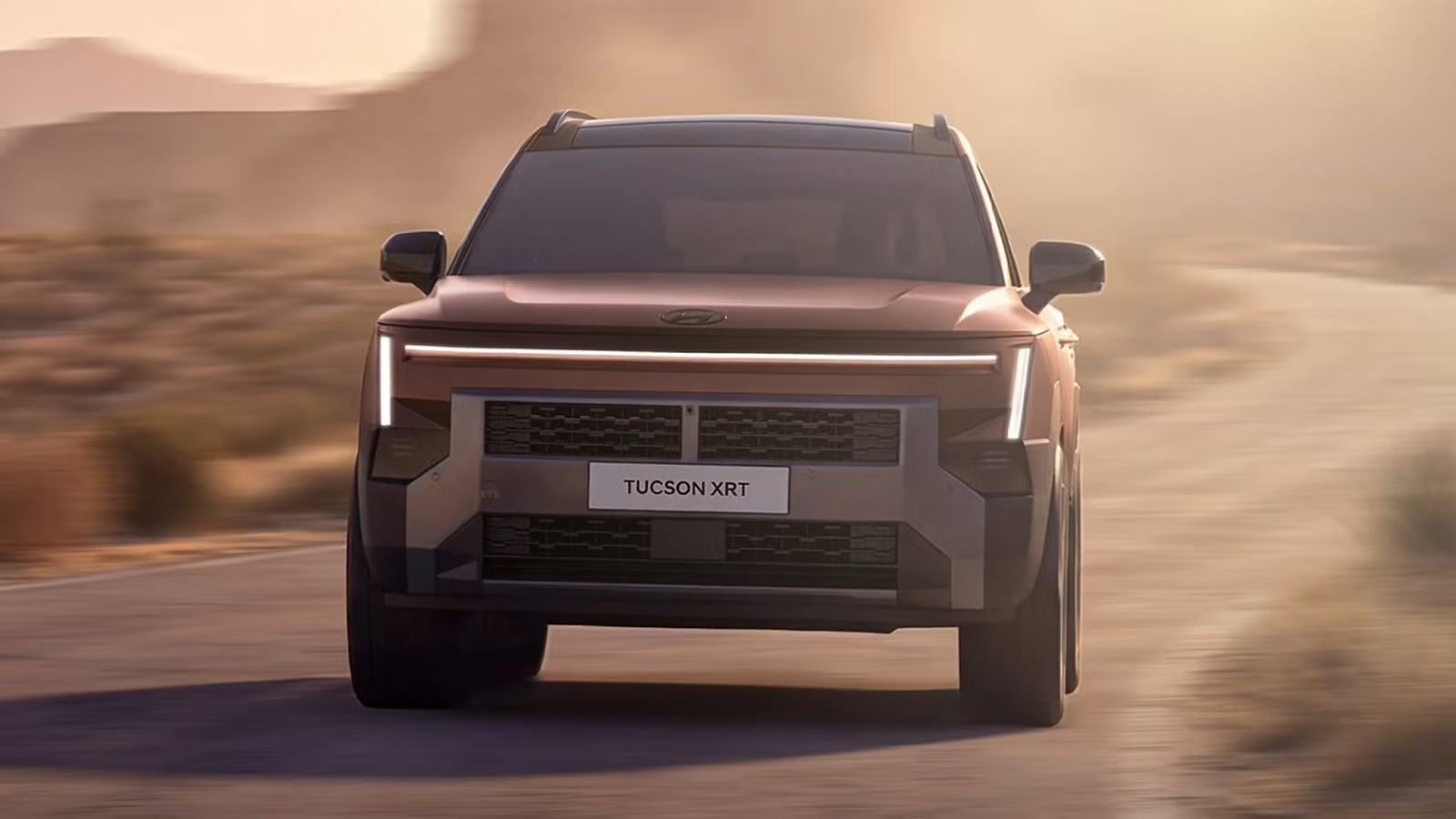
Hyundai revealed the fifth-generation Tucson today, and it looks nothing like the compact SUV segment has seen before. Gone is the soft, rounded body of the outgoing model. In its place: a boxy, angular silhouette with prominent fender flares, full-width LED light bars front and rear, and vertical daytime running lights — a design Hyundai calls “Art of Steel.” It’s a sharp departure, and it’s clearly aimed at shaking up a segment that has long rewarded playing it safe.

The timing matters. The Toyota RAV4 and Honda CR-V have dominated compact SUV sales for years by offering incremental updates and proven reliability rather than bold styling. With this fifth-generation Tucson — larger, more tech-forward, and dramatically more aggressive-looking than its predecessor — Hyundai is betting that buyers are ready for something different.
A Bigger, Bolder Body Built Around the “Art of Steel” Design Language
The numbers tell part of the story. The 2027 Tucson grows 2.3 inches (60 mm) in overall length to 185 inches (4,700 mm), and stretches 1.57 inches (40 mm) wider to 75 inches (1,905 mm). The wheelbase extends 1.1 inches (30 mm) to 109.6 inches (2,785 mm), and overall height rises 0.8 inches (20 mm) to 66.3 inches (1,685 mm). That extra height translates directly into 1.1 inches (29 mm) more rear-seat headroom — a meaningful gain for a family hauler.

Beyond the dimensions, the design itself is the statement. The squared-off quarter panels, sharp body lines across the door skins, and beefy rocker panels give the Tucson a planted, almost architectural stance. Both ends feature an illuminated H motif that makes the headlights and taillights look nearly interchangeable — a deliberate, space-age symmetry. Rear door opening angle increases from 73 to 83 degrees, a practical touch that makes loading kids and cargo noticeably easier. Hyundai’s design chief SangYup Lee has framed the boxy direction across the Santa Fe and Palisade as a move to strengthen outdoor-lifestyle appeal, and the Tucson carries that logic into the heart of the compact segment.
The Interior Upgrades Are Just as Significant as the Exterior

Inside, the 2027 Tucson adopts Hyundai’s new Pleos infotainment system, centered on a large touchscreen — likely in the range of 17 inches based on its use in the Grandeur, though Hyundai hasn’t confirmed the exact size for this application. A slim digital instrument display sits high on the dashboard, positioned above the steering wheel’s upper rim in a way that mimics a head-up display. Physical controls remain underneath the main screen, which is a welcome concession to usability.
The cabin’s character is defined by a rounded center console, a two-spoke steering wheel, orange dashboard accents, perforated upholstery, wood trim, and ambient lighting. Dual wireless smartphone charging pads are confirmed. The overall effect reads less like a mainstream compact crossover and more like something from a segment above — which is precisely the competitive ground Hyundai is trying to claim against the CR-V’s polished but conventional interior and the RAV4’s rugged-but-functional cabin.
Powertrain Details Are Still Coming, But the Lineup Shape Is Clear

Hyundai has not released any powertrain specifications with this design reveal. What the sources confirm is the expectation of both hybrid and non-hybrid versions, consistent with the current Tucson’s lineup structure. The existing model offers a 2.5-liter naturally aspirated four-cylinder as the base engine, a turbocharged 1.6-liter four-cylinder paired with an electric motor for the hybrid, and a plug-in hybrid version of that same 1.6-liter turbo with a larger battery. The next-generation model is expected to carry forward this general architecture, likely updated for improved efficiency. A rugged XRT trim has already been previewed, featuring a distinct front grille with a rectangular motif, contrast black wheel arches, skid plate inserts, and touch-sensitive LED taillighting. Hyundai plans a Korean launch later this year, with broader global availability expected in 2027.
How This Stacks Up Against the RAV4 and CR-V
The compact SUV segment is one of the most competitive in the industry, and the RAV4 and CR-V have historically won it on reliability reputation and steady refinement rather than design risk. The RAV4 leans into its rugged aesthetic with squared-off body cladding and trail-ready trim levels like the TRD Off-Road and Trail. The CR-V takes the opposite approach — clean, restrained, and interior-focused. Neither has made a styling leap as dramatic as what Hyundai is attempting here.
Hyundai moved 234,000 Tucsons in the U.S. last year, making it the brand’s top-selling vehicle by a significant margin — 86,000 units ahead of the second-place Elantra. That volume gives Hyundai something real to protect, which is why the powertrain strategy is expected to stay conservative even as the design goes bold. The new Tucson’s size increase also positions it more squarely against the RAV4 and CR-V on interior space, an area where both competitors have traditionally held an edge. Whether buyers respond to the styling gamble or retreat to the familiar will be the real test when the Tucson reaches showrooms.

Related posts


Latest Post


No Comments