
The Japanese Motorcycle That Makes Premium Rivals Hard To Justify
It was only in the 70s that the Japanese manufacturers were thought of as a real threat to the status quo. Up until then, they were laughed off by the European and American manufacturers that dominated the motorcycle industry. While the small displacement motorcycles, including the famed Honda Super Cub, offered customers cheap, reliable transportation, that was all they were thought capable of. All that changed in 1969.
The Universal Japanese Motorcycle

Emboldened by the success of all the smaller displacement models, Honda USA asked headquarters for a more powerful 750cc model that could take the fight to the leading brands. As history tells us, this would birth the CB750, a motorcycle which was christened a “superbike” by the motorcycling press of the time. While it certainly is not a superbike by modern standards, it blew the competition away, beating out all the bikes of the time in just about every department. The other Japanese brands quickly followed suit, and the Universal Japanese Motorcycle, or UJM for short, was born.
Over 50 years later, you can still find these bikes floating around on the used market, which is a testament to their build quality and longevity. So ubiquitous were these models that they became the default choice for riders all over the world, and while some bikes have become cult classics, others remain affordable and accessible. As consumer trends shifted away from these standard motorcycles and towards motorcycles with more sporting pretensions, the UJM and standard motorcycles of all shapes and sizes took a back seat. But the latest liter-class roadster from Honda has UJM written all over it.
The Honda CB1000F Is A Modern Reinterpretation Of The Classic UJM
MSRP: $10,599


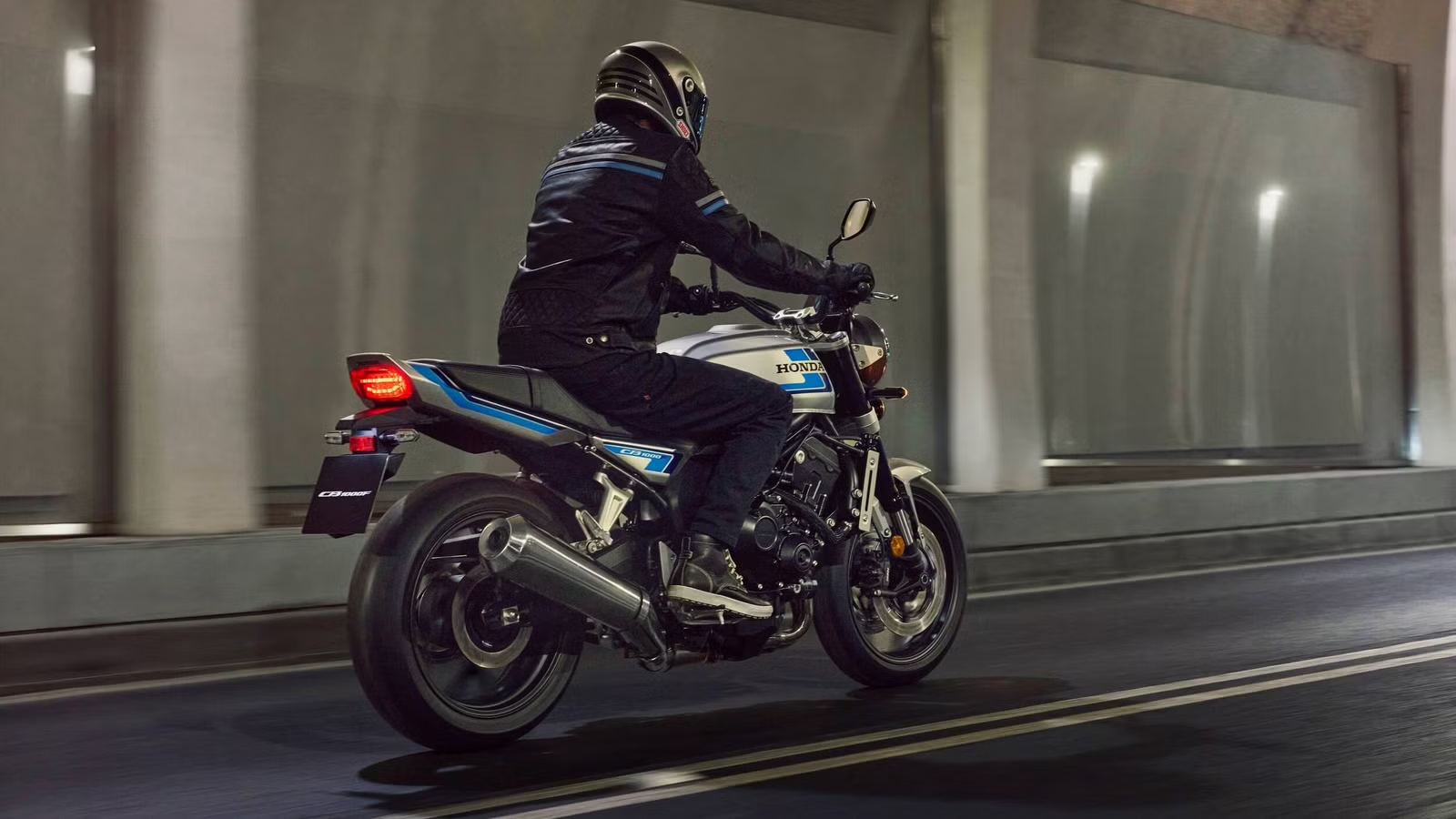
The CB1000F is a call-back to the 80s era Honda CB900F, in particular the bike ridden by Freddie Spencer (video above), with which the modern bike shares a livery. It is a genuinely tasteful rendition, and at this rather low asking price, it is impossible to ignore. Based on the Hornet SP, the retro machine offers an entirely different tune that is even more focused on midrange performance. While we were initially a little surprised that the base model Hornet didn’t make it to the US, the release of this model goes some way to explaining the omission.
The Motorcycle That Makes High-End Bikes Feel Like Overkill
The Honda CB1000 Hornet SP stands out in the crowd of high-tech, high-priced naked bikes with its focus on basics and unbeatable value.
A Superbike Engine Powers This Retro Roadster
Power: 122 horsepower

Modern roadsters, or retro bikes, are largely an exercise in styling, but Honda saw fit to make more than a few changes to the CB1000F. While this is the same engine you find in the Hornet SP model, which in turn is derived from the CBR1000RR superbike, the internals are quite different. The superbike makes 189 horsepower, but this powertrain was already reworked for the streetfighter, and that peak power output was reduced to 150 horsepower (or 129 horsepower for the US model, thanks to noise restrictions). For the roadster, this comes down further to 122 horsepower, thanks to it having even more emphasis on midrange performance, thanks to revised camshafts and intake tracts.
An Inline-Four Reworked For Street Use

On the face of it, sacrificing almost 70 horsepower might seem a little disappointing. In reality, even experienced riders would have a hard time making the most of the power that the superbike has to offer out in the real world, where speed limits exist. The roadster offers an altogether more effective way to make use of that power. Even the gear ratios have been altered from third through to sixth to offer riders a means to make the most of the added low-end grunt.
Why The Honda Hornet Is A Budget Speed Demon One Tune Away From Mayhem
The latest blue-collar superhero comes from an unlikely source
The CB1000F Is An Objectively Beautiful Motorcycle

In terms of design, the CB1000F draws inspiration from the early 80s CB900F but also has more than a little in common with the newer Super Four models that can still be found in other markets around the world. It is most certainly one of the more tasteful renditions, and even enthusiasts with no real affiliation with Honda will still agree that it is not a bad-looking machine. Initially, we were a little confused as to why only the Hornet SP made it to the US.
But the arrival of the roadster at this price point explains the omission of the base model Hornet, because these two bikes rather effectively cover all bases. The CB1000F has a slightly revised chassis, but pretty much the same suspension and brake componentry as that of the base model sold in other markets. If you want a more lively canyon carver, the Öhlins-equipped SP model is a no-brainer for a few hundred dollars more, but if you are after an honest-to-goodness modern UJM, well, this is it.
More Tech For The Retro

The one disruptive design element comes in the form of the rather prominent TFT dash. It is a necessary evil, though, because the bike actually comes loaded with more tech than the more sporty SP model. An IMU is added to the mix, which means both lean-sensitive traction control and cornering ABS enter the fray. Unfortunately, you lose the quickshifter, but it is easy to see why Honda omitted it. It just isn’t expressly necessary for a bike like this that wants you to engage with it. It is not pretending to be anything more than a fun, fast motorcycle that will surely appeal to a broad spectrum of riders looking for a fun street bike on a budget.
In many ways, the price tag is actually the most attractive feature. There are several manufacturers offering more expensive roadsters that don’t even make half as much power as the Honda. It will, no doubt, force some form of retort from the market, but for now, this is the bike that makes it virtually impossible to justify any of those premium rivals.
Chassis, Suspension, And Weight Specifications
|
Chassis |
Steel twin-spar |
|
Front Suspension |
41mm inverted Showa SFF-BP telescopic fork with adjustable preload, compression and rebound damping (5.1-inch travel) |
|
Rear Suspension |
Pro-Link, Showa RSU, spring preload and rebound damping adjustable (5.5-inch travel) |
|
Weight |
472 lbs |
Source: Honda Powersports

Related posts




Latest Post


No Comments