
The Rear Brake Myths That Are Holding Motorcycle Riders Back
Motorcyclists have some pretty strange relationships with their brakes. Spend enough time around cruiser riders, and you’ll meet people who treat the front brake like a dangerous contraption best left untouched. Hang around sportbike enthusiasts, and you’ll find the opposite, with riders convinced the rear brake is practically useless. Meanwhile, dirt bike riders are out there using both brakes to do everything from negotiating steep descents to sliding around corners. So, who’s right? As it turns out, everyone has a point, but they’re also missing a much bigger picture.
Different Motorcycles, Different Braking Habits

There’s a reason sportbike riders rely heavily on their front brakes. When a motorcycle decelerates, weight transfers forward, increasing the load on the front tire while reducing it at the rear. Sportbikes have aggressive geometry (that’s our nerdy term for wheelbase, rake angle, and fork trail), meaning hard braking can leave the rear tire barely touching the pavement. Under those conditions, the rear brake contributes little stopping power and becomes easier to lock. It’s understandable why some sportbike riders conclude that leaving the rear pedal alone is the safest approach.
Cruisers operate differently. Their longer wheelbases, lower centers of gravity, and often rearward weight distribution allow the rear tire to retain more load during braking. Consequently, the rear brake can contribute more to stopping than it would on a sportbike. But that doesn’t mean cruiser riders should neglect the front. In fact, Harley-Davidson’s linked braking systems demonstrate how important balanced braking is, automatically distributing braking force between the wheels on equipped models when conditions call for it. A rider may manually apply the brakes to either the front or rear brake exclusively, but the motorcycle will balance brake pressure between both ends to improve stopping distance and control.
Why Neither Extreme Gets The Whole Story

Yamaha Champions Riding School instructor Nick Ienatsch has discussed this distinction extensively. He describes how cruiser riders can make much greater use of rear braking than riders aboard lightweight racing motorcycles. But he also challenges the idea that sportbike riders should ignore it altogether. The important variables include wheelbase, motorcycle load, available traction, and how much braking force is already being applied at the front. There’s no universal formula that works for every motorcycle.

Your Rear Brake Does A Lot More Than Just Slow You Down

Here’s where things get interesting. Most riders think of brakes exclusively as devices for reducing speed, but a much broader approach is definitely worth considering. Braking also influences weight transfer, suspension behavior, and the motorcycle’s response to rider inputs. The rear brake, in particular, can help manage these changes without demanding the same level of deceleration associated with aggressive front braking. It’s an additional way to fine-tune what the motorcycle is doing beneath you.
Consider what happens when you abruptly grab the front brake. The fork compresses, the motorcycle pitches forward, and the chassis responds to a sudden change in load. Smooth braking inputs make these transitions more predictable, but there is another trick we can deploy: carefully applying the rear can help manage weight transfer in certain situations, too. Applying a bit of rear brake right before engaging the front brake will cause the rear-end of the motorcycle to squat down, helping prevent excessive weight transfer as you begin applying the front brakes aggressively. That sounds like something only useful when coming to the end of a massive straightaway on a racetrack, but for street riding, this could be useful in emergency situations, as well.
The goal isn’t to replace the front brake or eliminate suspension movement. It’s to understand that the two controls influence the motorcycle differently, and that learning to coordinate them gives riders more options.
The Secret To Making Awkward Maneuvers Easier

Anyone who’s wrestled a heavy motorcycle through a tight U-turn knows how intimidating low-speed riding can become. The throttle might be twitchy at low rpm, the bike wants to change speed with every small input, and touching the front brake abruptly with the handlebars turned can lead to a tipover. This is where gently dragging the rear brake becomes incredibly useful. By maintaining a little throttle, controlling power through the clutch’s friction zone, and applying light rear-brake pressure, riders can regulate their speed with greater precision.
The same technique helps when navigating parking lots, crawling through traffic, or making tight turns on narrow streets. Instead of repeatedly opening and closing the throttle, the rider maintains smoother power delivery while using the rear brake to control movement. It doesn’t magically keep the motorcycle upright, and proper vision, steering, and balance still matter. But once these controls work together, maneuvers that previously demanded constant corrections become easier to execute consistently.
Yes, You Can Use The Rear Brake While Cornering

Motorcyclists are frequently taught to finish all their braking before entering a corner, especially in basic motorcycle training courses. It’s straightforward advice for beginners, but it doesn’t describe everything an experienced rider can safely do. Advanced programs like Yamaha Champions Riding School, California Superbike School, and Total Control Training teach riders how to carry braking into a turn through trail braking. Smooth, progressive braking can help manage corner entry speed and tighten a motorcycle’s line, provided the rider respects available traction. The rear tire must still have enough grip for both braking and cornering forces.
There’s an important distinction between controlled braking and stomping on the pedal halfway through a bend. Abrupt rear braking can overwhelm traction, especially when the motorcycle is already leaned over. Even on a motorcycle equipped with ABS, we should know that ABS can only do so much. Skilled riders sometimes use rear braking to manage corner entry, adjust their line, or control wheelies during acceleration, but these are techniques that demand practice and sensitivity. For everyday riders, the takeaway is far simpler: braking while cornering isn’t automatically wrong, but smooth inputs and available grip determine what’s possible. Think about things this way: no one has ever been hurt by going through a corner too slowly. However, the opposite is quite true.
Dirt Riders Have Been Using Both Brakes For Everything

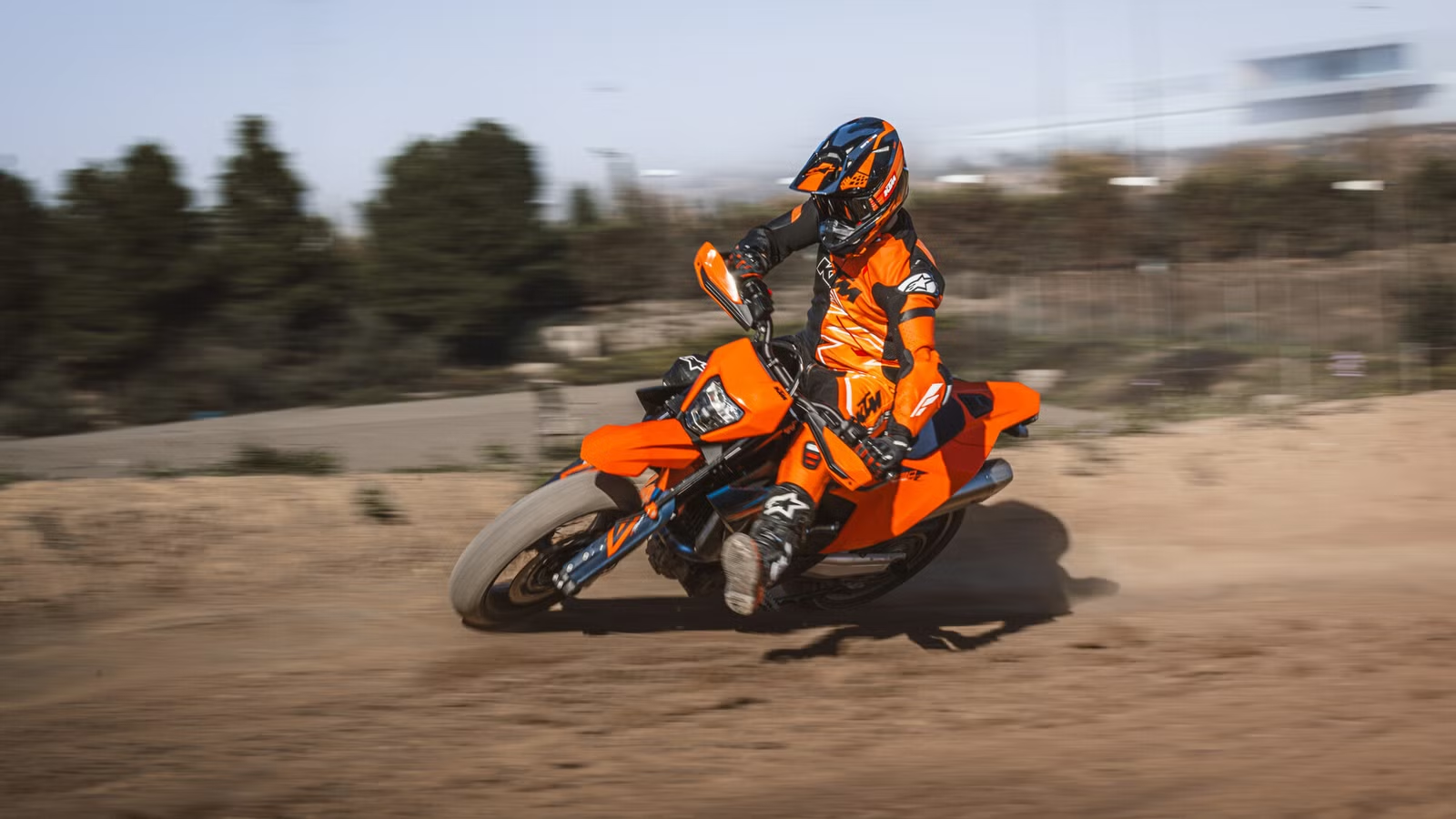
Off-road riding provides an excellent demonstration of how versatile motorcycle brakes can be. Dirt riders routinely use the rear brake to manage traction on loose surfaces, control speed on descents, and influence the motorcycle’s direction. But the same principle applies to motorcycle gymkhana and extremely slow-speed riding. During tight figure eights, full-lock U-turns, and technical cone courses, riders use gentle rear-brake pressure alongside the throttle and clutch to stabilize the motorcycle, regulate speed, and maintain a more predictable balance.
This works because light rear braking creates a controlled resistance against the engine’s driving force, smoothing out abrupt changes in speed and making the motorcycle easier to manage at walking pace. It helps riders maintain steady momentum without constantly opening and closing the throttle, particularly when negotiating tight turns or balancing a heavy bike at near-standstill speeds. Whether you’re navigating a tricky off-road section or threading through a gymkhana course, the lesson is the same: the rear brake isn’t just for stopping. It’s a precision control tool that can make even the most intimidating maneuvers easier to execute.
Learning To Use Both Brakes Could Make You A Better Rider

The best place to explore these techniques isn’t a mountain road or a busy intersection. It’s a safe, empty practice area where you can experiment with progressive braking, straight-line stops, and controlled low-speed maneuvers. Start gently, understand how your motorcycle responds, and gradually build confidence without approaching the limits of traction. More advanced techniques, particularly braking while leaned over, are best developed with professional instruction. ABS can provide an important safety net, but it doesn’t replace proper braking technique.
Ultimately, the biggest rear brake myth isn’t that it’s useless or that it’s essential in every situation. It’s the assumption that braking is only about stopping. This approach encourages riders to understand how their controls affect the entire motorcycle, rather than following blanket rules about which brake deserves attention. Your motorcycle has two brakes, and each has a job to do. Learning how to use both won’t just help you stop. It can make you a smoother, more capable rider everywhere else, too.
Sources: Yamaha Champions Riding School, California Superbike School, Total Control Motorcycle Training

Related posts


Latest Post


No Comments