
The 1990s Jeep That Claimed To Be The Fastest SUV In The World
In the 1990s, an SUV had a fairly clear job description. It needed ground clearance, four-wheel drive, enough room for passengers and gear, and the strength to tow or venture beyond the pavement. Quick acceleration was somebody else’s concern. Sports cars and performance sedans chased the stopwatch; utility vehicles accepted their weight as part of the bargain. Yet SUVs were becoming more comfortable, more desirable, and more at home on the road. That left an intriguing question: what if an SUV could be wanted for something it had never been expected to do particularly well—go fast?
Speed Was The One Thing Nobody Expected From An SUV

The traditional SUVs formula worked against outright acceleration. A high-riding body carried a weight and aerodynamic penalty, four-wheel-drive hardware added mass, and suspension and driveline components had to withstand terrain that would never trouble an ordinary sedan. Even when a V8 was available, its extra output generally served a practical purpose: towing, climbing or moving a loaded vehicle with less effort.
The market was beginning to loosen those assumptions. Buyers were spending more time on pavement, while increasingly sophisticated cabins made SUVs credible alternatives to conventional passenger cars. The vehicles still needed to retain their utility, but their role was expanding. Comfort, road manners and everyday usability were becoming almost as important as what happened when the pavement ended.
Acceleration was therefore becoming a logical frontier. Once an SUV was expected to perform family-hauling, commuting and highway duties alongside its traditional work, there was less reason for performance to remain completely outside the equation. The category was still defined by utility, but the definition was broadening. The question was how to add speed without turning the vehicle into something else entirely.

A Bigger V8 Changed What The SUV Could Do

For a heavy utility vehicle, the appeal of a larger naturally aspirated V8 was straightforward. More displacement could deliver more torque without adding the forced-induction hardware or calibration complexity that would later become common in high-performance SUVs. The objective was not to make the vehicle behave like a sports car. It was to give its existing architecture enough low-end muscle to overcome some of the disadvantages created by its size.
The additional output could not simply be sent through the existing drivetrain unchanged. More torque meant greater loads on the transmission, axles and four-wheel-drive system. Cooling capacity and exhaust flow also became more important as the engine was asked to produce substantially more output. The supporting hardware therefore had to evolve alongside the engine, even if the underlying solution remained deliberately uncomplicated.
That approach had an important advantage. Rather than creating a new performance platform, engineers could work with an existing utility vehicle and strengthen the areas that would feel the additional output most directly. Gearing could help the engine deliver its torque more effectively, while stronger drivetrain components could make the extra power usable rather than merely impressive on paper.
It was an old-fashioned performance philosophy applied to a relatively new market proposition: if a heavy vehicle needed to become quicker, give it more torque and make sure everything behind the engine could cope with it. What happened next would show just how far that uncomplicated formula could go.
The 1998 Jeep Grand Cherokee 5.9 Limited Claimed To Be The Fastest SUV In The World

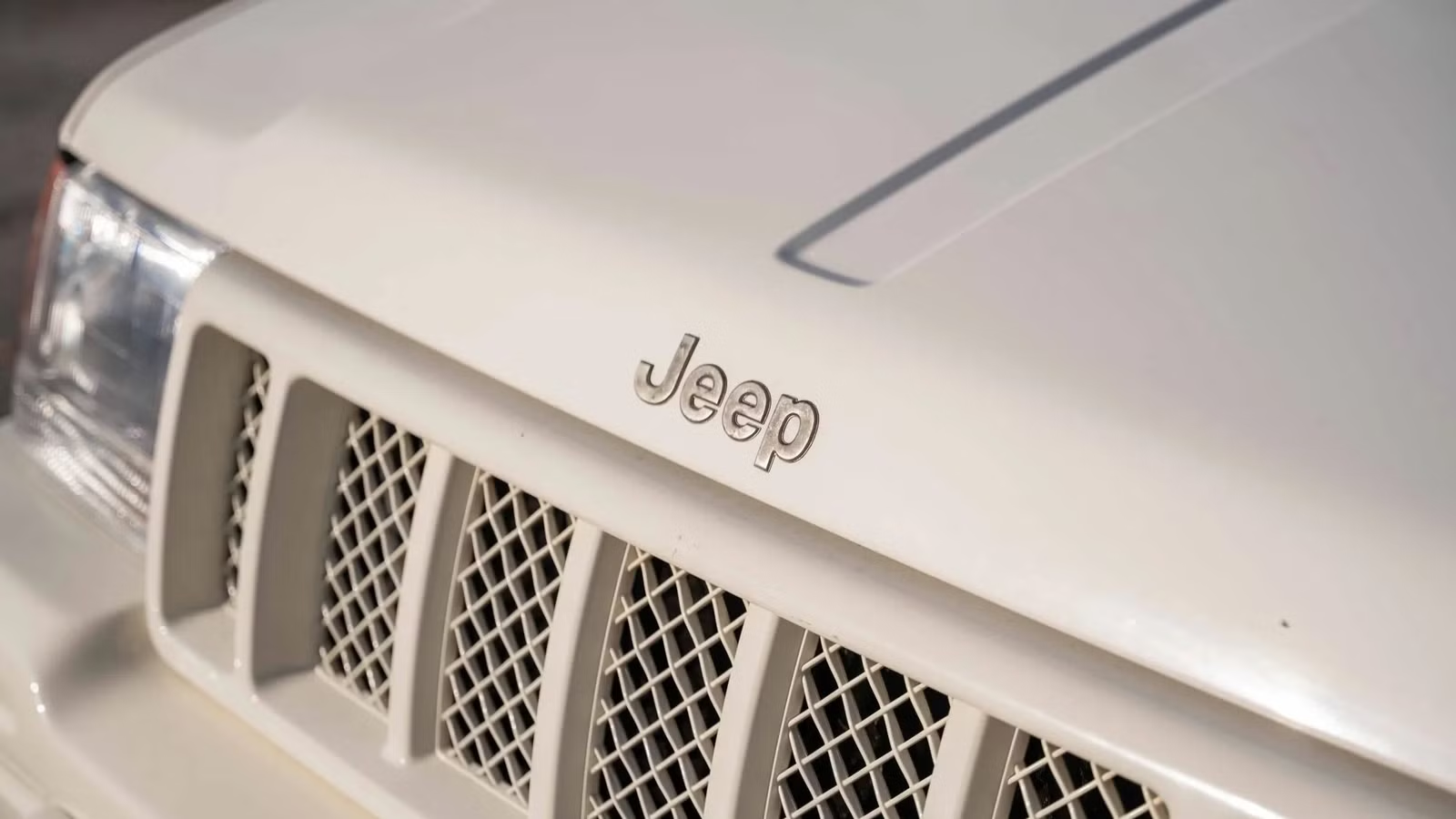
That experiment became the 1998 Jeep Grand Cherokee 5.9 Limited, a special version offered only during the final model year of the first-generation Grand Cherokee. Its 5.9-liter Magnum V8 produced 245 horsepower and 345 lb-ft of torque, with a four-speed automatic transmission sending the output through four-wheel drive. The larger engine replaced the 5.2-liter V8 as the range-topping powertrain, while the rest of the package was strengthened to accommodate its additional output.
Jeep claimed a 0–60 mph time of 7.3 seconds and promoted the vehicle as the world’s fastest sport-utility vehicle. Contemporary independent testing produced an even quicker result, recording 6.8 seconds to 60 mph and a 15.2-second quarter-mile, which made the 5.9 Limited the quickest SUV of that time. That was not merely a better number than other utility vehicles; it put this particular SUV into acceleration territory normally associated with much lighter passenger cars.
The supporting changes helped make that performance repeatable rather than theoretical. The 5.9 Limited received a stronger 46RE automatic transmission, 3.73 gearing, a Trac-Lok limited-slip rear axle, an electric cooling fan and a lower-restriction exhaust system. The package also included four-wheel disc brakes with ABS. The larger V8 supplied the headline, but these changes were what allowed the vehicle to operate as a coherent factory performance package.
The “world’s fastest” description should be treated as a manufacturer’s claim rather than an independently verified permanent record. The stronger historical conclusion is narrower and better supported: contemporary testing established the 5.9 Limited as an exceptionally quick SUV for its time, and the vehicle briefly made acceleration a defining part of what a utility vehicle could offer.
It Looked Like A Luxury SUV Until The Throttle Went Down

The performance was hiding in plain sight. The 5.9 Limited retained the familiar Grand Cherokee silhouette and upscale Limited interior, while its most obvious exterior clues were functional hood louvers, unique five-spoke wheels, 5.9 badging and a larger exhaust outlet. There was no dramatic body kit or oversized spoiler. At a glance, it looked much more like a well-equipped luxury SUV than something built around a sub-seven-second sprint.
The cabin reinforced that impression. Leather, wood trim and extensive equipment remained part of the package, rather than being discarded in pursuit of a stripped-down performance interior. Then the throttle went down. With 345 lb-ft of torque available and four-wheel-drive traction putting it to the pavement, the vehicle’s character changed far more dramatically than its appearance suggested.

That 6.8-second figure is what makes the contrast meaningful. Modern performance SUVs have made sub-seven-second acceleration commonplace, but in 1998 the number belonged to a very different class of vehicle. The Grand Cherokee still had the height, mass and utility-oriented hardware of an SUV, yet its acceleration had become sufficiently serious to define the model’s reputation.
The sleeper quality was therefore more than a styling curiosity. A buyer could have a leather-lined, four-wheel-drive SUV with the comfort and practicality expected of a Limited, then discover that it could reach 60 mph in less than seven seconds. The vehicle did not need to look like a performance car because the stopwatch was doing the advertising.
Its Real Legacy Came Long After The 5.9 Disappeared

The 5.9 Limited was available for 1998 alone, making it a contained experiment rather than an immediate blueprint for every Grand Cherokee that followed. Roughly 14,286 examples were produced, enough to establish that Jeep had built a real production model rather than a handful of engineering curiosities, but not enough to turn the formula into the normal Grand Cherokee configuration.
What followed elsewhere in the industry made the experiment look increasingly prescient. Performance SUVs eventually gained specialized suspension tuning, larger brakes, wider tires, electronic chassis systems and dramatically more powerful engines. Jeep itself returned to the concept with the Grand Cherokee SRT8 and eventually the supercharged Trackhawk. By then, acceleration was no longer an unexpected bonus. It had become part of the reason some buyers wanted an SUV in the first place.

The 5.9 Limited did not single-handedly create that transformation, and calling it the first performance SUV would oversimplify a history that includes earlier high-output utility vehicles. Its importance is more specific. It arrived before performance had become an established SUV category and demonstrated that straight-line speed could itself add desirability to a vehicle whose traditional selling points were utility, traction and practicality.
That is why the 5.9 Limited matters beyond its 6.8-second test. The number proved the experiment worked. The timing made the experiment significant. In 1998, an SUV did not yet need to be fast to sell. This one showed that, eventually, it might.
Sources: Jeep, Stellantis

Related posts

Latest Post


No Comments