
Toyota Venza: Why The Discontinued Hybrid Still Holds Value
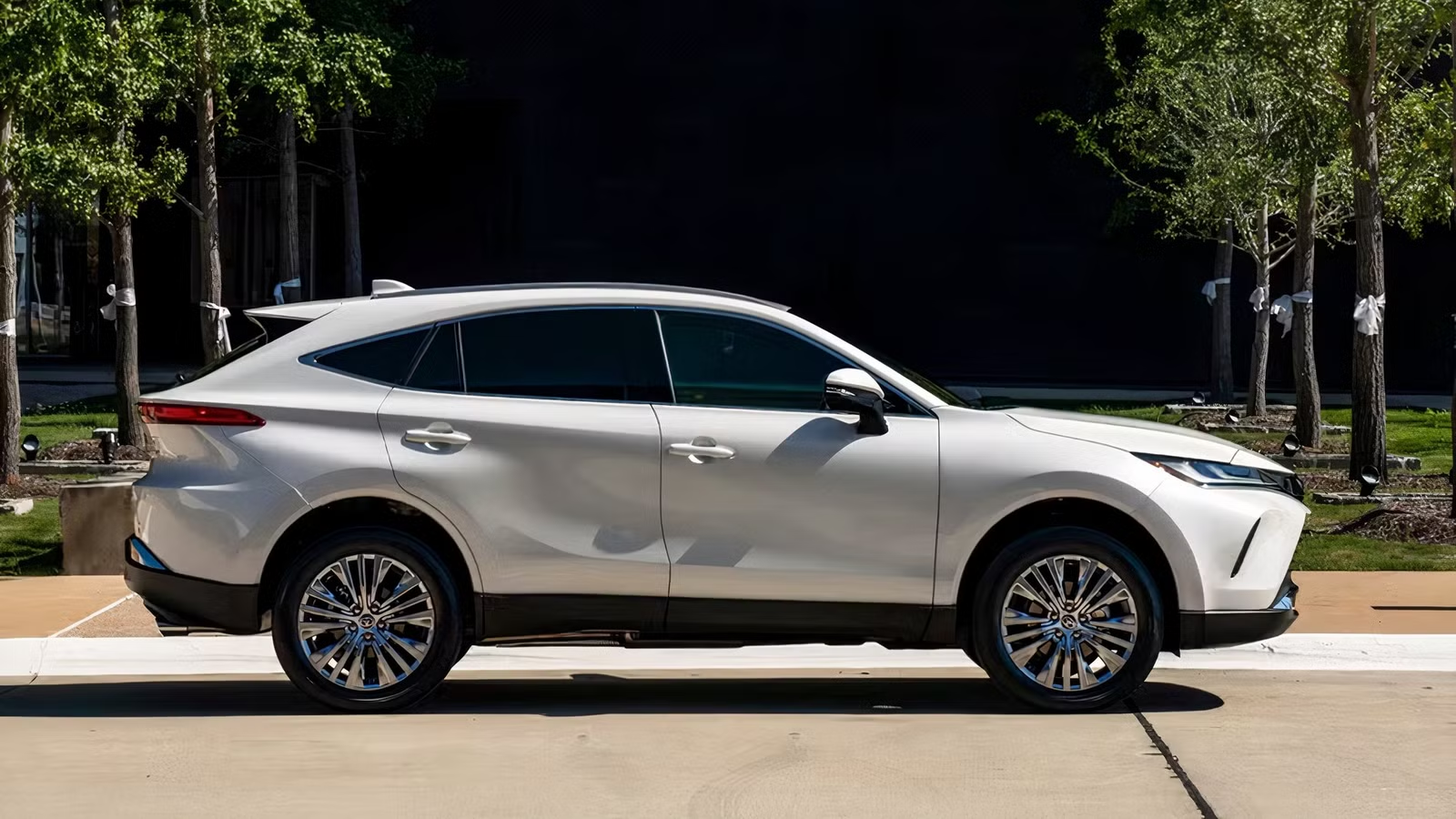
The Toyota Venza is the most intriguing recently discontinued model from the leading Japanese automaker. The Venza only lasted four model years between 2021 and 2024 before it was replaced by the Toyota Crown Signia. It is only now that shoppers are realizing that this hybrid crossover is among the most desirable used Toyota SUVs on the market. If you want the Lexus-quality experience without the Lexus price tag and ownership costs, you won’t find a better used SUV than the Venza. Let’s discuss why the discontinued Venza still holds its appeal, what current owners have experienced so far, and whether right now is the right time to buy one.
Why The Toyota Venza Still Matters After Discontinuation

The Venza’s story is unusual because it wasn’t discontinued due to poor engineering or widespread reliability problems. Instead, Toyota repositioned its crossover lineup, leaving the Venza as a unique snapshot of the brand’s premium hybrid strategy—and an increasingly attractive option for used buyers.
A Hybrid Crossover That Filled A Unique Gap

The Venza may not be a household SUV nameplate in the U.S. at the level of the Toyota RAV4, but it is built on familiar bones. The first generation was built in the U.S. and debuted back in the 2009 model year, with production ending in 2015. The second generation differs by being a rebadged Japanese-market Toyota Harrier, which is built in Japan on the same platform as the fourth-generation Toyota RAV4. When Toyota revived the Venza for the U.S. market, its strategy was to provide customers with a premium luxury hybrid experience.
This positioned the hybrid AWD-exclusive Venza between the RAV4 Hybrid and Toyota Highlander. Its appeal lay in providing a more premium experience than most mainstream compact SUVs without entering Lexus territory. With standard AWD and 39 mpg combined, the Venza provides more versatility and efficiency than any other midsize hybrid on the market. For comparison, the compact FWD 2023 Honda CR-V Hybrid is close, but comes in second at 38 mpg combined, while the Venza’s less-premium and dimensionally smaller sibling, the 2023 Toyota RAV4 Hybrid, achieves a combined 40 mpg.
Why Toyota Replaced It With The Crown Signia


Everything about the Venza sounds solid, and its efficiency is class-leading, so why was Toyota so quick to discontinue it? The Venza came at a time when Toyota was pivoting toward a simplification of its overall vehicle lineup, and the Venza was simply too niche for its own good. The Toyota Crown Signia, which debuted in the 2025 model year, would become the second-generation Venza’s direct successor.

Compared to the Venza, the Crown Signia is more powerful, roomier, and has upgraded infotainment. However, the Crown Signia is not necessarily a direct upgrade to the Venza; it is a different product altogether. Most notably, the 2026 Toyota Crown Signia starts at $44,690, while the final model year base 2024 Toyota Venza LE costs $36,465 when new.

In terms of depreciation since its discontinuation, the Venza has remained highly insulated because it offers excellent fuel economy and great versatility across all trims. Educated consumers are now realizing that the Venza is effectively a premium AWD RAV4 Hybrid with upgraded styling. Early discontinuation normally means a product is bad, but this is not the case at all with the Venza, presenting a real opportunity on the used market for savvy shoppers looking for a killer deal.
Why The Venza Continues To Hold Its Value

A strong resale value doesn’t happen by accident. The Venza benefits from several market forces that continue to support demand, even after production ended.
Toyota Reliability And Hybrid Demand Support Used Prices

At this point, it is common knowledge that Toyota offers the most reliable hybrid powertrains on the market. The 2.5-liter A25A-FXS engine powering the Venza is the current gold standard of Toyota’s naturally aspirated inline-four hybrid engines. The same powertrain is still being utilized in the new Crown Signia, and it is one of the most-utilized powertrains in the entire high-volume Toyota ecosystem.

If there is any vehicle that holds its value in 2026, it is Japanese hybrid models known for their dependability. Toyota is trusted worldwide and is the largest automaker in the world for a reason: it makes high-quality vehicles that emphasize longevity. However, compared to the more popular RAV4 Hybrid, the Venza offers a significantly more limited used supply, selling only 61,988 units in its best-selling introductory 2021 model year. As long as fuel prices increase, which is inevitable, demand for hybrid models will continue to strengthen resale of vehicles like the Venza.
Understanding The Venza’s Depreciation Curve

According to Kelley Blue Book, the fair purchase price of a 2024 Toyota Venza ranges between $30,500 and $38,100 depending on trim. If we look at the 2021 Venza, the KBB fair purchase price shifts lower, between $23,700 and $27,100. CarGurus states that the average price of a 2021 Venza is $27,004, while a 2024 Venza has an average price of $36,805. Edmunds states that the estimated value for the 2023 Venza is $28,905 for an outstanding condition example.

Compared to the Honda CR-V Hybrid, an iSeeCars study showed that over five years, the Venza loses about 38% of its value, while the CR-V Hybrid loses 38.7%. The Venza’s edge in terms of depreciation is essentially insignificant when compared to the CR-V Hybrid in this time period. While both the CR-V Hybrid and Venza are strong in terms of holding residual value, it is important to note this does not mean these vehicles are appreciating, despite their desirability. As higher mileage examples become common and overall hybrid efficiency across the market increases, values of models like the CR-V Hybrid and Venza will drop accordingly.
The Ownership Experience: Reliability, Costs, And Common Complaints

Toyota’s hybrid systems have earned an excellent reputation through decades of diligent service, but no vehicle is perfect. Understanding both the strengths and recurring owner complaints gives shoppers a more realistic picture of long-term Venza ownership.
A Proven Hybrid Powertrain With Predictable Ownership Costs

Toyota has been perfecting inline-four-based hybrid architecture since the early 2000s and remains the global leader in hybrid technology and innovation. The A25A-FXS engine utilized in the Venza was first introduced in the 2017 Camry Hybrid and has since become Toyota’s current go-to inline-four hybrid platform. One of the key components that consumers still do not seem to understand about the Venza’s powertrain is the eCVT, which differs from traditional belt-and-pulley CVT units. The belts of normal CVTs eventually wear down, slip, or snap, but the eCVT relies on an entirely different system. With the eCVT, the transmission is governed by a planetary gearset that is controlled via electronics and magnets, utilizing very few moving parts to eliminate the heavy friction of conventional CVT units.
The lithium-ion battery pack powering the Venza is lighter and more energy-dense than the battery packs found in older Toyota hybrids, with a life expectancy in the 250,000-mile range before experiencing any noticeable battery degradation. Toyota provides a 10-year or 150,000-mile warranty on the hybrid powertrain for added peace of mind. According to Toyota, engine oil only needs replacement after 7,500 to 10,000 miles, meaning upkeep costs are lower than a conventional gas-powered SUV. With a Venza, you will save on fuel and brake component wear compared to a regular SUV, but may have to pay a bit more in insurance premiums compared to a standard RAV4. As far as long-term ownership, you won’t find a more bulletproof hybrid powertrain on the market.
The Problems Buyers Should Know Before Purchasing

One of the most common complaints from Venza owners is the driving dynamics produced by the eCVT. The eCVT works by holding the engine at the most efficient RPM based on the current load conditions, which is often perceived as unrefined and awkward when compared to the experience of a conventional automatic transmission. What you need to understand is that achieving 39 mpg combined in a midsize SUV requires exceptional engineering, including the use of a CVT. So, while it may not feel as good to rev out, your wallet will thank you later.

On premium trim levels equipped with the 12.3-inch infotainment screen, a common issue was the screen randomly freezing or going blank. However, this issue was addressed by Toyota via a technical service bulletin related to the integration control module. Some owners have noted that the coupe-like sloping rear roofline and a high cargo floor mean that the Venza has less vertical cargo space than the RAV4. Another factor worth noting is that the passenger seat lacks power lumbar support across multiple model years, which can lead to discomfort on long road trips.
Should You Buy A Used Toyota Venza Today?

For the right buyer, the Venza may represent one of the smartest values in Toyota’s used SUV lineup. The key is understanding who benefits most from its strengths—and when another hybrid SUV might be the better fit.
The Ideal Buyer Profile For A Venza

If you commute daily, have a small family, or are an empty nester, you might already be considering a vehicle like a RAV4. However, if you prioritize comfort along with build quality, a standard RAV4 might not cut it. What the Venza does particularly well is provide a Lexus-adjacent experience without the full financial commitment of a Lexus. If performance is in any way a factor, prospective buyers would be better served looking elsewhere, because the Venza does not provide an engaging driving experience or a fun and lively character. The Venza has no pretensions about being a fun vehicle and costs about $10,000 less than a Lexus NX. If you are already considering a RAV4 Hybrid, you might just be better off with a Venza. It looks significantly better, has a higher quality interior, is more refined and comfortable, and is only marginally more expensive than the most budget-focused RAV4.
How It Stacks Up Against Today’s Best Used Alternatives

If practicality, the lowest entry price, and maximum cargo space are your primary priorities, a RAV4 Hybrid might be the perfect choice. If you want a similar efficiency standard with a better interior, a Honda CR-V Hybrid is much sleeker on the inside than a RAV4. If you don’t want to compromise on efficiency or practicality but need a bit more engagement, the Mazda CX-50 Hybrid may be the perfect compromise.
Compared with the new Crown Signia, the Venza represents a smarter financial decision for most shoppers in the segment while offering better overall value. The Venza may have been discontinued early, but it remains one of the most overlooked used hybrid SUVs on the market, with its blend of proven hybrid engineering, premium refinement, and good looks.
Sources: OEMs, CarGurus, Kelley Blue Book, Edmunds, iSeeCars, Toyota Venza Subreddit, Consumer Reports

Related posts




Latest Post


No Comments