
The V8 That Changed Muscle Cars Forever
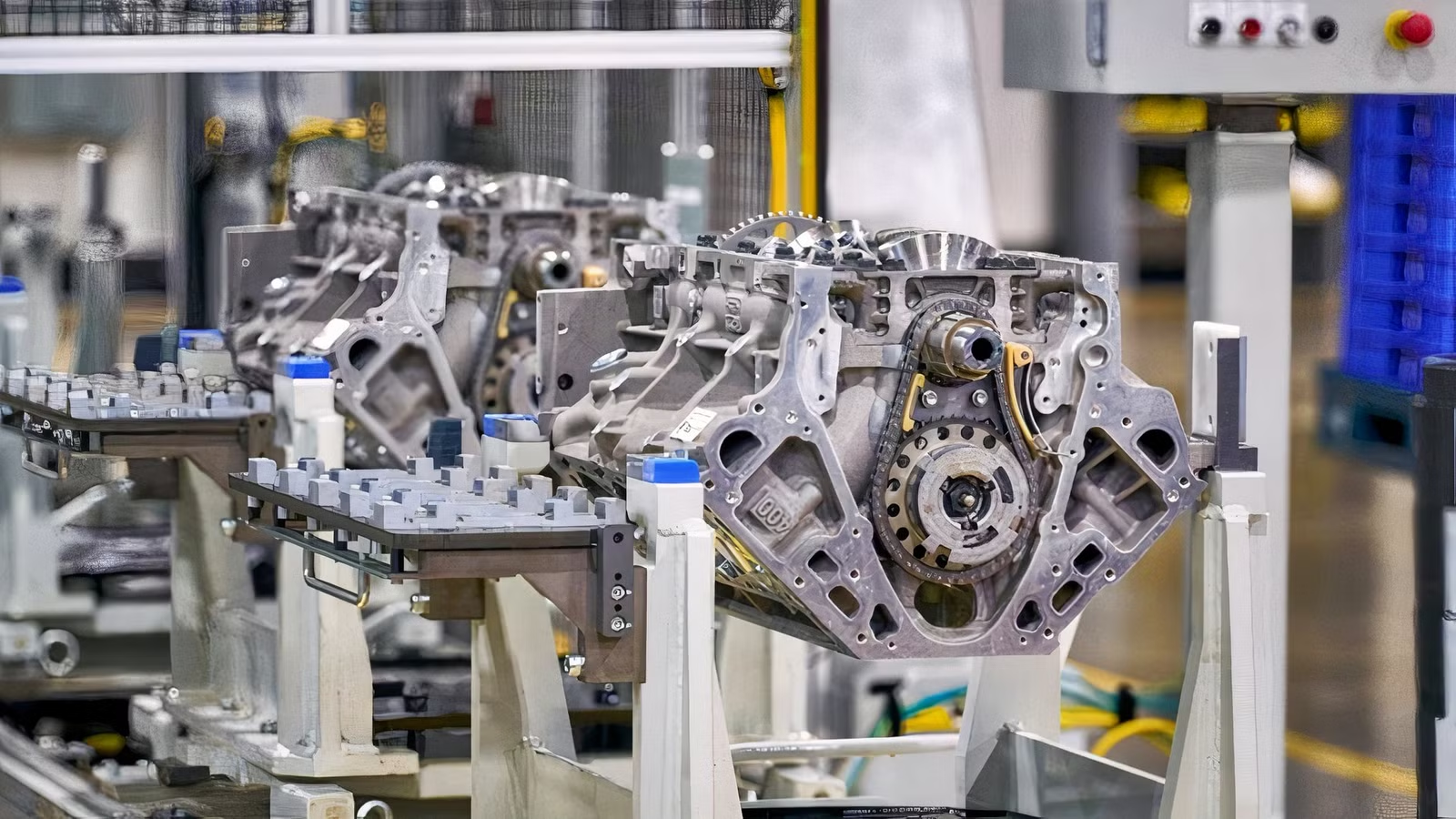
There have been plenty of engines that have changed the course of automotive history over the years. Perhaps none have done more to affect the course of automotive history than the General Motors small block. Not only did this engine alter the course of the muscle-car era, it altered the industry in general. In fact, the small block is still in use by General Motors today.
How It All Began

It all started in 1955 with the 265 cubic-inch (4.3 liters) small-block V8 that was first offered in the legendary Chevrolet Corvette sports car and the Chevy Bel Air full-size car. Hot-rodders and drag racers took to the engine immediately, dubbing it “Mighty Mouse” after the cartoon character. Maybe it was the horsepower, maybe it was the relative ease of modification for street racing — either way, the engine was popular almost immediately.
Oddly enough, the engine, which Chevrolet officially called the Turbo-Fire, wasn’t the first small block the company had produced. That honor goes to the first Chevrolet V8 produced, which hit the market all the way back in 1917 for the 1918 model-year Series D.
In that one-year-only application, the V8, which was Chevrolet’s first and one of the first overhead-valve V8s produced by the industry, displaced 288 cubic inches, or 4.7 liters. It was liquid-cooled and had a 90-degree angle. It produced 36 horsepower — a laughable number by modern standards but plenty of oomph back in the days leading up to World War I. Chevrolet sold about 4,000 units of the Series D.

With the Series D lasting only a year, Chevy wouldn’t have another V8 on the market until the small-block arrived in 1955.
The Turbo Fire came about courtesy of engineer and designer Ed Cole. Chevy was looking for something with more power than the Blue Flame inline-six cylinder that was used in the first Corvette.
Amazingly, the Turbo Fire went from an idea on paper into production in just 15 weeks. At the beginning, it offered up to 165 horsepower with a two-barrel carburetor or up to 195 hp in the Corvette, using a four-barrel carburetor.
It didn’t take long for both displacement and power to increase. In 1957, Chevrolet bored out the 265 cubic-inch V8 to make it 283 cubic inches, or 4.6 liters. A version called the Super Turbo Fire that used Rochester Ramjet mechanical fuel injection achieved the then-impressive one horsepower per cubic inch mark. Only the Chrysler 300B and DeSoto Adventurer had previously reached that mark.
Jumping ahead a bit in time, GM started producing a 307 cubic-inch small-block engine in 1968 in order to meet stricter emission standards. But at the same time, the muscle-car era was in full swing — and GM had ammo in its belt to fight back against Ford and Chrysler/Mopar.
Key Small-Block Applications During The Muscle-Car Era

The small-block really came into its own when Chevrolet bored it out to 4 inches to set the displacement at 327 cubic inches (5.4 liters) for the 1962 Corvette. Following soon were the destroked 302 cubic-inch (4.9-liter) engine for the 1967 Chevrolet Camaro Z/28 and the 350 cubic-inch (5.7-liter) V8 for the Camaro as the L-48 option. That engine would also eventually end up in the Corvette.
In 1970, the LT1 performance version of the 350 came along and was available in the Camaro Z28 and Corvette ZR-1, putting out 370 horsepower.
Those engines helped make the Camaro popular as an alternative to Ford’s Mustang, as the Detroit automakers got into horsepower wars and competed for bragging rights as well as racing trophies. But the 350 small-block wasn’t just a performance engine — versions of it could be found in family sedans and pickup trucks.
Not just the 350 — GM also made larger versions of the small-block, including a 400 cubic-inch (6.6-liter) version for large sedans and for trucks. This was 1970—an era of big cars that needed big motors.
Circling back to muscle cars, we weren’t kidding when we said that GM was fighting Ford and Chrysler on the racetrack. The 302 that went into the Z/28 Camaro was meant to comply with Sports Car Club Of America (SCCA) regulations that limited racing engines to 305 cubic inches and required them to use parts that any average Joe or Jane could buy at their local dealer’s parts department. Chevrolet engineered this engine to be able to survive in the fast-revving world of racing.
Unfortunately for car enthusiasts, especially those who love speed, the malaise era of the 1970s was looming. While the small-block would survive, the muscle-car era was ending. But before we move on to examine how the small block changed from the end of the muscle-car era until today, let’s take a brief look at what Ford and others offered in competition.
What Ford, Mopar Offered To Compete With The Small Block

The muscle-car era was a car lover’s dream. There were plenty of V8s on the market that one could purchase. Ford offered up the 289 and 302 engines in cars like the Mustang Boss 302, which went fender-to-fender with the Camaro in legendary Trans-Am racing battles. Later, the Blue Oval offered the larger 351 Windsor and Cleveland engines, which were meant to slot in between small-block and big-block motors.
Chrysler/Mopar fought off Chevy and Ford with a 340 cubic-inch plant that saw use in applications like the Plymouth Duster and Dodge Dart GTS.
Despite General Motors trying to restrict its different brands from cannibalizing each other too much, Pontiac and Oldsmobile still got in on the fun with 400 cubic-inch and 350 cubic-inch mills. Oldsmobile even used forced cold-air induction to offer up 350 horsepower.
We’ll refrain from taking sides in any discussions about which engine from back then was the best. One could look to sales, racing results, or instrumented testing performed by car magazines to help settle those debates, if those debates can ever be settled. We’ll simply say that the GM small-block was transformative, regardless of whether it is or was the “best” muscle-car engine.
Why The General Motors Small-Block V8 Matters

It’s not just about the fight for muscle-car dominance. If it was only that, it would be a footnote in automotive history. A large and important footnote, to be sure, but just a footnote.
Instead, the small-block V8 matters for two major reasons. The first reason relates to power and performance — the first small-block showed that cars could be powerful without needing engines to have a cylinder count higher than eight or large displacements or big blocks.
While that power started with sports cars, it was also available in family cars like Bel Air. Offering powerful engines was a selling point, of course, but squeezing good power out of a smaller-block, smaller-displacement engine also allowed for better fuel efficiency. Not the kind of fuel efficiency we see today, even from V8s, but enough efficiency to be a selling point.
And that’s where we stand today. The small-block continued to be used in performance vehicles like the Corvette, Camaro, and Pontiac Firebird, and the introduction of fuel injection helped modernize the engine, but we’ve also seen versions of the small block in vehicles like the Buick Roadmaster Wagon—a family station wagon—and the Chevrolet Silverado and GMC Sierra full-size pickup trucks. General Motors has even put the small block in cargo vans.
We’re just skimming the surface here, since the number of variations is dizzying. We’d need to be book-length to hit them all, and to dive deeper into the engineering and design.
Current Uses For The GM Small Block

Versions of the General Motors small block are in use today in the Corvette, Chevy and GMC full-size pickup trucks (both light- and heavy-duty), and family-hauling SUVs like the Chevrolet Tahoe or the luxury Cadillac Escalade. And just this week, General Motors unveiled the new L76 5.7-liter (350 cubic inches) and L78 6.6-liter (400 cubic inches) small-block engines for use in light-duty pickup trucks.
Those new engines can trace their lineage all the way back to the 265 Turbo Fire, or, in a way, to the Chevrolet Series D in 1917.
Powering The Past, And Perhaps The Future

The V8 engine that changed muscle cars forever is still around, and while the muscle-car era is over, it’s still being used in performance cars like the Chevrolet Corvette. And it’s still being used in family cars (well, SUVs, these days) and pickup trucks. We can’t predict the future of the small-block V8 as electric motors become more and more a part of the future, but we’re willing to bet that as long as internal-combustion engines (and hybrid powertrains) exist, there will be a GM small-block in one form or another.

Related posts


Latest Post


No Comments