
The 1970s Mid-Engine V8 Honda Gen-Z Never Even Imagined
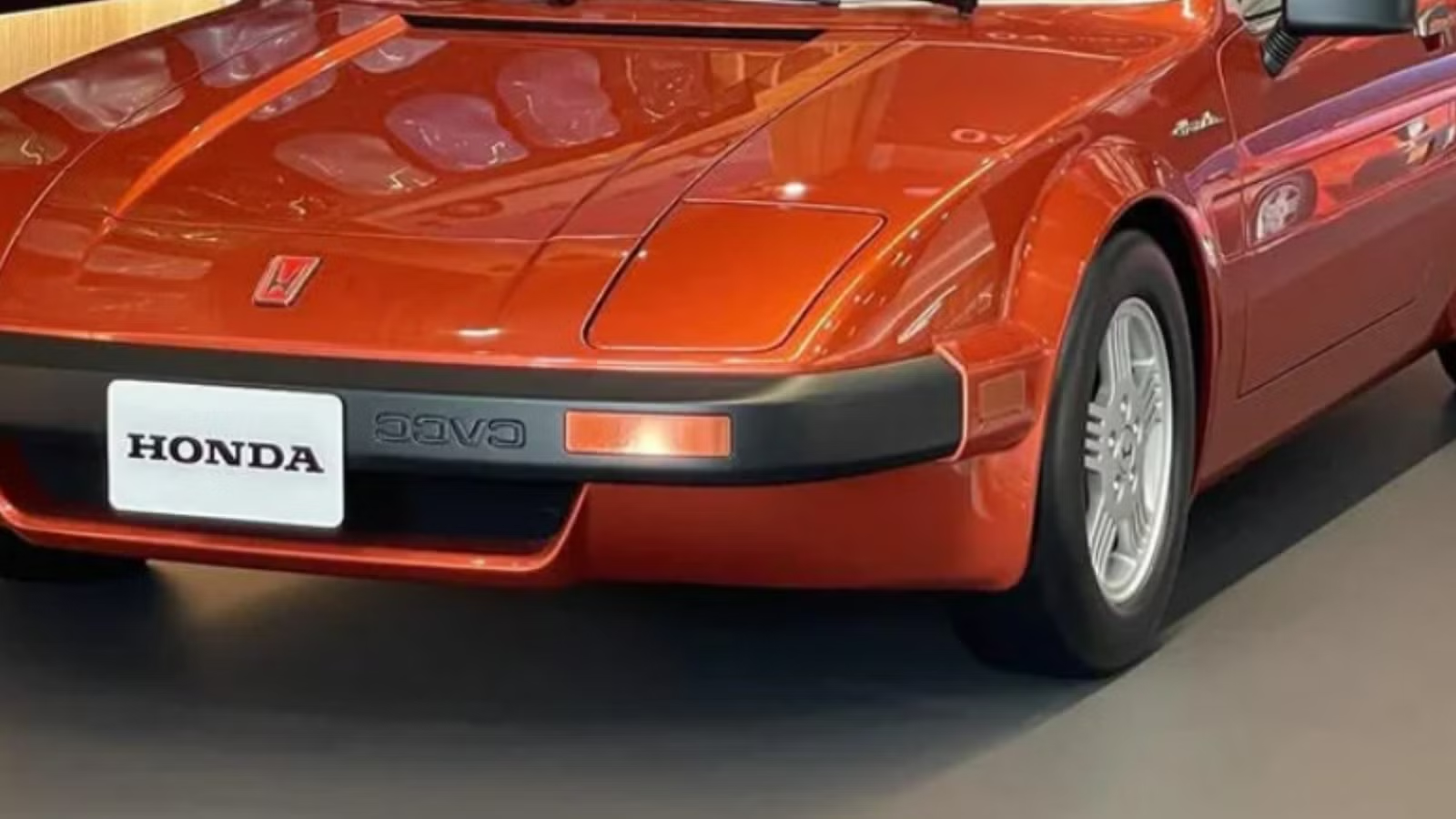
Honda and V8 road cars are like oil and water. For what can only be attributed to its long history of building small motorcycles with equally small engines, that same philosophy seems to have rubbed off on the automotive side of things. Given how addictive rev-happy VTEC engines are, can you blame them? Except, half a century ago, Honda did at least have a cup of coffee with the idea of building a V8 sports car. Not that you’d be wrong for never knowing it; most of the people reading this weren’t even alive when the design study was active. More to the point, Honda never even advertised it.
Honda in the early ‘70s: A Brand Ascendent

The story of how Honda emerged as one of Japan’s most important industrial heavyweights is already quite well known and well celebrated. The brand began in the early days post-World War II, and the company’s founder, Soichiro Honda, was a former contractor and supplier for Toyota. The company stuck strictly to improvised motorized bicycles, and then proper motorcycles, in those early days, establishing a strong domestic customer base that just needed a way to commute around in post-war Japan.
Such was the impetus for Honda’s first entirely in-house-built motorbike, the D-Type. The company’s first proper four-wheeled vehicles, the T360 light truck and the S500 sports car, were equally humble, affordable, and desirable to the emerging Japanese domestic market. Honda expanded outside of Japan in the late 1950s and early ’60s, finding considerable support in places like Australia, New Zealand, and parts of Europe, where small cars like the N600 and Z600 proved viable alternatives to less reliable domestic fare. Still, Honda could properly say it’d arrived globally when it touched down in the United States around the same time.
Via the much-beloved Super Cub bike, Honda completely changed the face of the American motorcycle industry. No longer would Harley Davidson, Indian, and a handful of English coattail riders be the only choices in town. In 1970, the Honda N600 finally made its way to the United States, making way for endless hordes of Civics and Accords just a few years later. From there, Honda was in the US to stay, and right in the middle of the muscle car wars to boot. Rather than try to compete with Chevelles, Chargers, and Torinos, Honda had other plans to offer something the firm thought, at least in the moment, Americans would want to buy.

A Crazy Concept Car, Totally Out of Left Field

Knowing that trying to compete in the muscle car space really would be like a fish out of water, Honda had to get creative in the design department to market something similar, yet just different enough, to entice Americans to Honda dealerships. If Honda knew anything about the American market, it was that eight cylinders in a V formation was the ultimate currency for domestic performance cars. With that said, the prospect of a humble Japanese bikemaker churning out a 400-plus cubic-inch monster motor simply wasn’t going to happen. Not in this universe, anyway, and probably not in any other either.
So, Honda’s tentative approach to building a V8 was going to be, well, as Honda-coded as it could possibly be. Drawing inspiration from the limited success of Honda’s early Formula 1 efforts, the company’s R&D team in Japan set out to adapt a high-revving racing architecture into something that wouldn’t blow up on a city street or an open American highway. Honda’s first, and to that point only attempt at a racing V8 prior was the air-cooled 3.0-liter RA302 from the 1968 F1 season. Suffice it to say, the project was an unmitigated disaster—one that cost the life of French driver Jo Schlesser in its debut at Rouen-Les-Essarts and saw the magnesium-bodied car shelved prematurely.
And yet, lessons learned from the project pointed Honda in the direction of a mid-engine, Italian-style supercar marketed to an American palate. In the end, Honda designed just that, and with a three-liter, liquid-cooled V8 to go along with it. With early Compound Vortex Controlled Combustion (CVCC) capability, the engine was built to rev high, scream loudly, and generally act almost like an early form of VTEC, just without variable valve timing or much in the way of computer controls. In the end, what Honda came up with was brilliant. Well, it would’ve been had it made it past the concept phase.
The 1973 Honda Mid-Engine V8 Study: Utter Madness for 1970s Honda

Just for some context, the Honda Civic had only been in production on the global market for a few months in 1973, and wouldn’t touch down in the States until March of that year. The larger Accord, not exactly a luxury barge in its own right, was still actively in development. In short, these were the formative years of Honda’s “boring but bulletproof and efficient” era. Completely inoffensive, completely uninspired, but so good at moving people from A to B that Americans ditched domestic brands in their millions to buy them. It makes the existence of a mid-engine, V8-powered exotic sports car prototype all the more uncanny.
Still, it was real, styled by Honda’s scrappy young R&D team right at home in Japan, and inspired in no small part by global design firms like Italdesign and Bertone. Frankly, seeing a Honda badge slapped onto a car with such a configuration is enough to make you think it’s AI. Rest assured, it was all too real. With dimensions of 4,180 mm (164.57 in) in length and 1,780 mm (70.08 in) in width, the car’s tiny 1,100-mm (43.3-in) height really did make it look like a Ferrari or a Lamborghini. That swooping, low cowl, pop-up headlights, and sharp front overhang like the leading edge of a fighter jet’s wing were so beyond the pale for Honda that it’s hard to imagine Americans of the day even comprehending its existence.
Still, Honda had every intention of taking its full-size clay model prototype into production, right alongside the first-generation Civic that was about to be a real headache for any manufacturer based in Detroit. Had it done so, it would have beaten the Toyota MR2 and Pontiac Fiero to market by a full decade. It’s fair to say neither of those were anywhere near as ambitious as what Honda was gearing up to build. In truth, it was closer in scope to entry-level Italian jobs like the Ferrari 308 GTB or the Dino 246. By all accounts, Honda was getting ready to pull the trigger on mass production, right up until forces entirely out of its control changed everything, and in a real hurry.
The End of it All? The Same That Ended the Muscle Car

The eagle-eyed readers among us will point to the year 1973, and immediately know exactly what caused Honda to pause the mid-engine V8 design study. With newly enforced EPA emissions restrictions and an OPEC-led oil crisis laying waste to the muscle car era as we knew it, the logic behind Honda fielding a Japanese alternative waned with each day that passed. Realizing that the project was now a massive waste of money, Honda made the unfortunate but logically sound decision to end the program altogether, along with several other sporty or luxurious design studies the company established in earlier years.
The order came directly from Soichiro Honda himself, and Honda’s top brass wouldn’t approve a follow-up prototype until the 1984 HP-X concept was developed alongside the Turin-based Pininfarina. Together, the two prototypes served as a direct bridge between Honda’s early years and the much-beloved NSX that arrived in 1990. Today, a single quarter-scale model of the 1973 design study, some 3D wireframe models, and a few personal effects, are all that remains of what was truly Honda’s most ambitious project of the era.
Sources: Honda

Related posts



Latest Post


No Comments