
2027 Porsche 911 Carrera S Manual Costs $8,550 More Than PDK
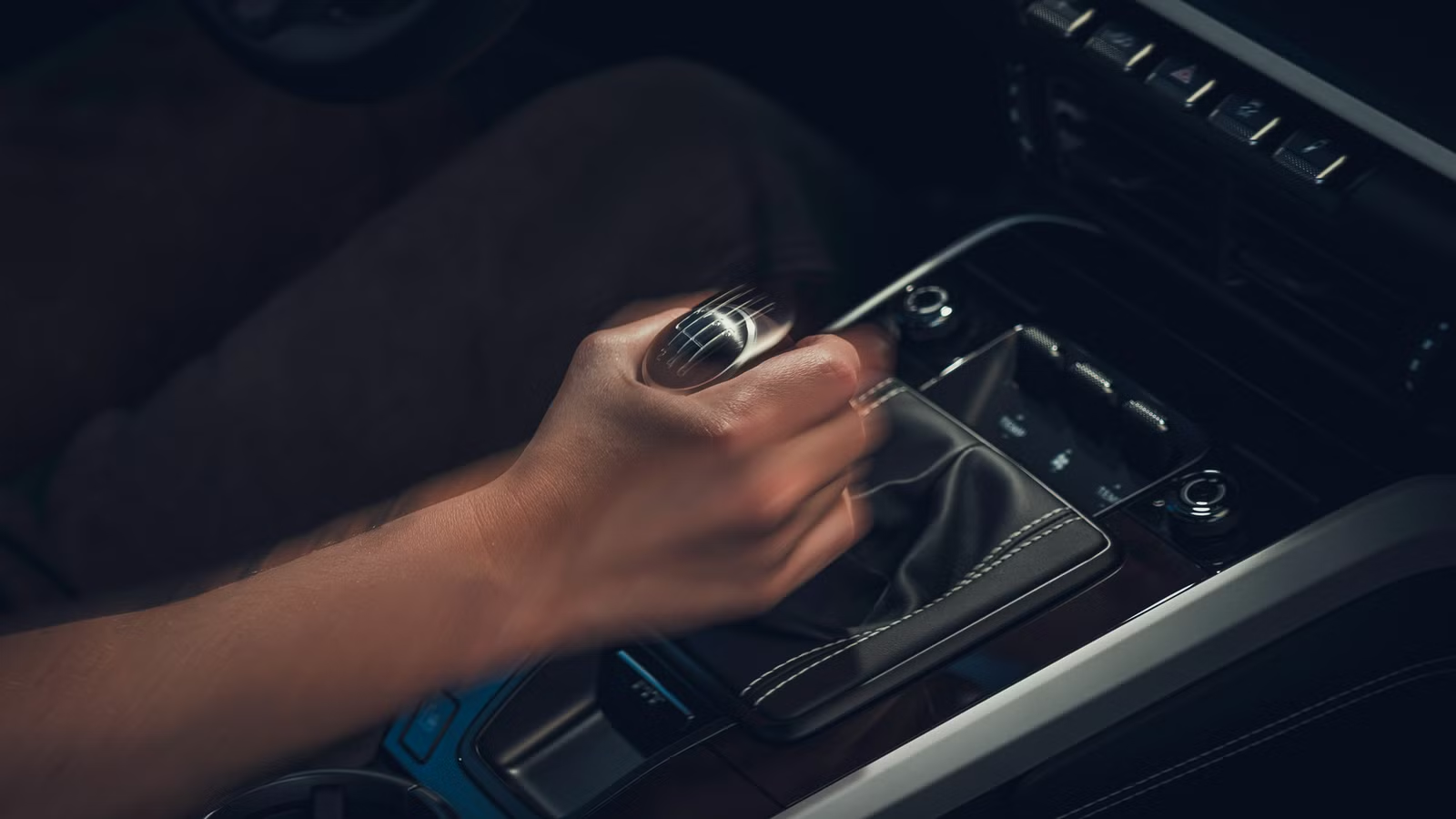
For most of the 911‘s life, choosing a manual gearbox meant paying less — the stick shift was the purist’s discount, the option that said you didn’t need Porsche’s PDK to go fast. That era is officially over. The 2027 Carrera S manual now carries an $8,550 premium over the PDK version, bringing the base price to $167,100 before a single option is ticked.

The shift didn’t happen quietly. Porsche Cars North America CEO Timo Resch addressed it directly during a Monterey Car Week Q&A last week, defending the bundled approach and hinting that more changes to how Porsche prices its manual cars are still coming. His explanation is worth understanding — not because it settles the debate, but because it signals how Porsche intends to position the three-pedal 911 going forward.
What $8,550 Actually Buys in the Manual Package
The premium isn’t just for the gearbox itself. Porsche has bundled the manual transmission with a titanium exhaust, rear-axle steering, and centerlock wheels — equipment that doesn’t come standard on the Carrera S in any other configuration. Resch leaned on that point when speaking to journalists.

“You have to look at the entire package of things that you get,” Resch said. “For example, the centerlock wheels, you don’t even get them on the Carrera S.” His argument is that the bundle assembles the spec a genuine Carrera S enthusiast would order anyway — rear-axle steering for the driver who’s already skipping all-wheel drive, centerlock wheels for the buyer who wants the GT aesthetic without stepping up to a GT3. Whether that logic holds depends on whether you actually wanted all three items. If you were after the manual alone, you’re paying for a lot more than you asked for.
The Manual Wasn’t Even Supposed to Be in the 992.2

Perhaps the most revealing detail from Resch’s Monterey comments: the manual transmission wasn’t part of the original 992.2 brief. Porsche added it after tracking customer sentiment online and recognizing that the U.S. market — its largest globally — was vocal about keeping three pedals alive.
“At the beginning phase of the 992 generation, it was not planned,” Resch confirmed. He credited the U.S. market’s willingness to make noise: “If we, the United States being the biggest market for Porsche, if we raise our voice, we’re like, ‘We really want to have this.’ They are open to listen and they work with us to come up with a solution for that.”
That context reframes the $8,550 premium. Porsche didn’t design the 992.2 with a manual from the start — it reverse-engineered one in, and the bundled package is partly a reflection of what that late-stage integration required to make financial sense. Getting it approved, tested, and certified as a package took more than a year, Resch noted.
Resch’s Hint That More Changes Are Coming

The Carrera S manual bundle may not be a one-off decision. Resch was careful with his words, but the direction was clear.
“I think we have not seen the very end of this development,” he said. “I think there are a lot of interesting changes in the world of manual transmission. And what we do with the Carrera S, with the manual transition package, I think is the most authentic one.”
That word — authentic — is doing a lot of work. Porsche is framing the bundled manual not as a concession to economics but as a deliberate curation of what the enthusiast experience should be. Whether future 911 variants follow the same bundled-premium model, or whether Resch is alluding to broader industry shifts around manual transmissions, remains to be seen. What’s clear is that Porsche views this approach as a template, not a one-time workaround.
For the gearhead who grew up knowing the manual as the honest, no-frills choice, the calculus on the 911 has changed permanently. The stick shift is still here — it’s just become the luxury trim.

Related posts
Latest Post



No Comments