
The 300-HP Supercharged Motorcycle That Defies All Logic
Every few years, a machine arrives that redraws the boundary of what’s considered possible. The Kawasaki Ninja H2R didn’t just redraw it — it erased it entirely. This is a closed-course-only motorcycle whose engineering owes more to aerospace and gas turbine technology than to anything else in the two-wheeled world. It runs to speeds that were purely hypothetical before it existed, it makes professional racing drivers choose their words carefully, and it accomplished all of this from just 998cc. A decade on, nothing has come close to matching it.
Why No Other Production Motorcycle Has Ever Done This

Forced induction on motorcycles isn’t new, exactly. In the early 1980s, manufacturers like Honda, Yamaha, Suzuki and Kawasaki all briefly chased the turbocharged motorcycle dream. The results were technically impressive but practically awkward: turbo lag, heat management nightmares, and packaging challenges that made the idea difficult to execute well on something with a wheelbase under 60 inches. Most were abandoned within a few years, and for the next three decades the industry moved on and pretended it never happened.
Then, in 2014, Kawasaki stood up at Intermot in Cologne and announced it was going supercharged — not turbocharged. The distinction matters. A turbocharger is driven by exhaust gas, which creates the infamous lag between throttle input and power delivery. A supercharger is mechanically driven directly off the crankshaft, meaning boost is near-instant. The historical downside has been heat: compressing air generates it, and without an intercooler to manage temperatures, you’re feeding hot, less-dense air into the engine and sacrificing efficiency. That’s the problem Kawasaki, drawing on resources from its Gas Turbine & Machinery Company and Aerospace Company, set out to solve. The result wasn’t just a supercharged motorcycle. It was the world’s first production supercharged motorcycle in over 30 years, and nothing before or since has come close to what it produced.
Meet the Kawasaki Ninja H2R

 83 autotech Model |
Engine |
Power |
Torque |
0-60 mph |
Top Speed |
|
Kawasaki Ninja H2R |
998cc Supercharged Inline-Four |
322 hp (326 hp with ram-air) |
121.5 lb-ft |
2.9 Seconds |
249 mph (recorded) |
The machine is the Kawasaki Ninja H2R, and the headline figure is 322 hp — or 326 hp with ram-air factored in at high speed, when the bike’s forward motion forces additional air into the engine. Kawasaki claims a peak output of 322 hp at 14,000 rpm and 121.5 lb-ft of torque at 12,500 rpm from the track-only H2R. It’s a 998cc inline-four, the same liter-bike displacement class used by the Ninja ZX-10R, but that’s roughly where the similarities end.
The engine was developed from scratch for the H2 platform, not adapted from an existing unit. The head gasket, cam profile, ECU mapping, exhaust system, and clutch all differ from the street-legal H2, which itself makes a comparatively modest 240 hp. The H2R is the unhinged version with the limiters pulled out.
The price reflects the exclusivity. The H2R is a special-order-only, limited-production machine available through a fixed order window each year — this is not a motorcycle you walk into a dealership and buy off the floor.
Tracking Down A Kawasaki Ninja H2R Today

|
Kawasaki Ninja H2R |
Poor |
Good |
Excellent (Low Hours) |
Concours (New Old Stock) |
|
Prices |
$35,000 – $40,000 |
$45,000 – $50,000 |
$52,000 – $56,000 |
$59,100+ |
Buying a Kawasaki Ninja H2R isn’t as simple as walking into a dealership. Kawasaki produces this 322-horsepower monster in limited batches, with order windows closing months in advance. Miss out, and you’re left searching dealer inventory or the used market, where prices can exceed the original MSRP.
Used H2Rs require careful inspection, as heavy track use can mean expensive supercharger servicing or engine repairs. With no factory warranty, maintenance costs fall entirely on the owner. Unlike the street-legal Ninja H2, the H2R has strong collector appeal, with low-mileage examples often commanding $50,000 or more.
How the Supercharger Actually Works

The engineering behind the H2R’s supercharger is where the story gets properly interesting, and it’s the detail that separates this machine from every other production motorcycle ever built. Kawasaki didn’t adapt an automotive supercharger and bolt it on. That approach would have been cheaper, quicker, and by the company’s own assessment, completely inadequate.
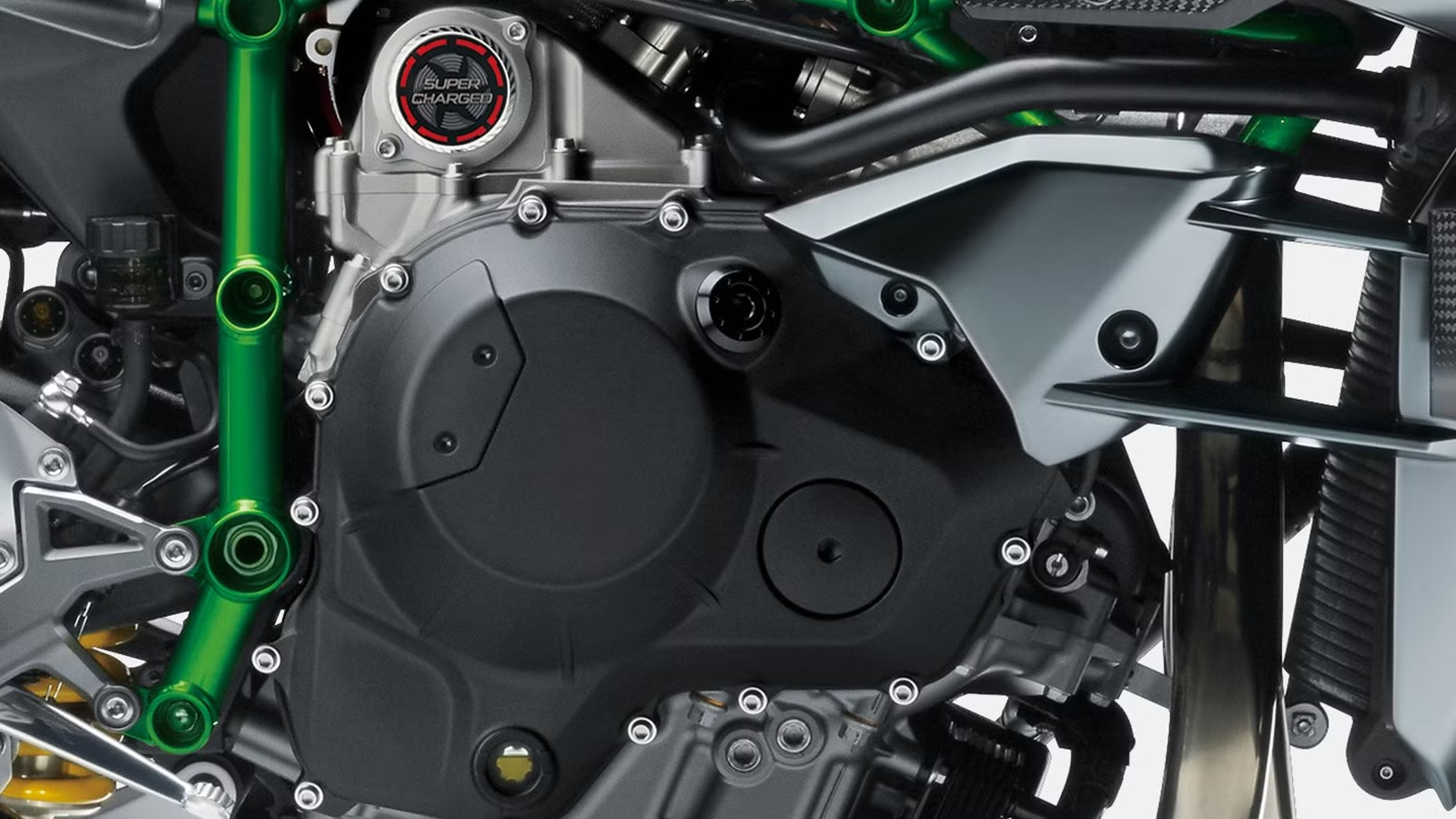
Instead, working with technology developed across the KHI group’s aerospace and turbine divisions, engineers designed a centrifugal-type supercharger built specifically around the characteristics of this engine. The 69mm impeller is machined from a single forged block of aluminum using 5-axis CNC machining, with six blades at its tip and 12 blades at its base, with grooves etched into the blade surfaces to direct airflow. The impeller is driven by a planetary gear train running off the crankshaft, with a 1.15x step gear feeding into an 8x planetary gear — meaning the impeller spins at 9.2 times crankshaft speed. At maximum engine speed of around 14,000 rpm, the impeller shaft spins at nearly 130,000 rpm.
A Lesson In Atmospheric Efficiency

The Kawasaki Ninja H2R’s centrifugal supercharger compresses air to 2.4 times atmospheric pressure while generating remarkably little heat. This eliminates the need for a bulky intercooler, allowing Kawasaki to package the system into a motorcycle roughly the size of a conventional liter-bike.
The supercharger delivers strong, progressive acceleration across a wide rev range, helping make its massive 322 horsepower more manageable. Its impeller spins at an incredible 130,000 rpm, but the H2R’s signature chirping sound actually comes from the airbox pressure relief valve releasing compressed air when the throttle closes.
The Speed Record That Put It All Into Perspective
Numbers on a spec sheet only carry so much weight. What cemented the H2R’s status beyond any reasonable argument was what happened on June 30, 2016, on the Osman Gazi Bridge in Turkey — a newly opened suspension bridge crossing the Gulf of Izmit near Istanbul.
Kenan Sofuoglu, a five-time world champion Supersport circuit racer, made a top speed attempt. Kawasaki supplied a stock H2R fitted only with special tires developed by Pirelli to withstand extreme high speeds, and the bike ran on race-grade fuel. Sofuoglu wore a custom one-piece leather suit designed to reduce his aerodynamic profile. Reaching 248 mph took just 26 seconds, with time at peak speed deliberately kept short to reduce the risk of tire failure.
To frame that: from a standing start, the H2R reached 248 mph in less time than it takes to watch a TV commercial. The Turkish president attended the event. The bridge had to be closed. Sofuoglu later said it was unlike anything he’d experienced even in top-level professional motorcycle racing — and this is a discipline where 186 mph on the longest straights is considered fast.
H2R vs F16 vs F1
Two years later at Teknofest Istanbul’s drag race, the H2R faced off against a Formula 1 car and an F-16 fighter jet. The supercharged Kawasaki edged past the F1 machine by a razor-thin 0.04 seconds. That event wasn’t a scientific test, but it illustrated the point well enough.
It’s worth being balanced here. There’s legitimate debate among enthusiasts about the exact top speed of a fully stock H2R at sea level with standard tires and road fuel. The Sofuoglu run used Pirelli-developed high-speed tires and race fuel, and motorcycle speedometers are known to read optimistically. But even accounting for those caveats, the H2R’s measured real-world capability sits further beyond any other production motorcycle than the spec sheet alone conveys.
Carbon Fiber And The Aerospace DNA

Stability at 249 mph takes more than horsepower. Aerodynamic drag increases with the square of speed, making downforce essential to keeping the Kawasaki Ninja H2R planted. Kawasaki enlisted its Aerospace Division to develop carbon-fiber winglets that generate downforce, while the rest of the bodywork is designed to manage airflow at extreme speeds.
Unlike most modern superbikes, the H2R uses a steel trellis frame instead of an aluminum twin-spar design, helping manage high-speed vibrations. It also packs a six-axis IMU, traction control, launch control, a bidirectional quickshifter, and an Öhlins electronic steering damper. Together, these systems help keep the H2R stable and controllable at speeds few motorcycles can reach.
Why The H2R Exists

The Kawasaki Ninja H2R is a track-only monster, banned from public roads and too loud for many circuits. With no headlights, mirrors, or license plate mount, it was built purely for extreme performance, bypassing the informal 186 mph speed cap on Japanese street bikes.
Its buyers are mostly wealthy collectors and hardcore enthusiasts who value performance over practicality. More than a decade after its debut, the H2R remains a showcase of Kawasaki’s engineering expertise, combining motorcycle technology with aerospace know-how. No rival manufacturer has produced anything quite like it.
Sources: Kawasaki, Cycle News, Motorcycle News, SlashGear, Iconic Motorbike Auctions, TopSpeed, Krrish FR YouTube Channel, Den ProHD YouTube Channel.

Related posts




Latest Post


No Comments