
The Sport Bike That Could Become A Future Classic
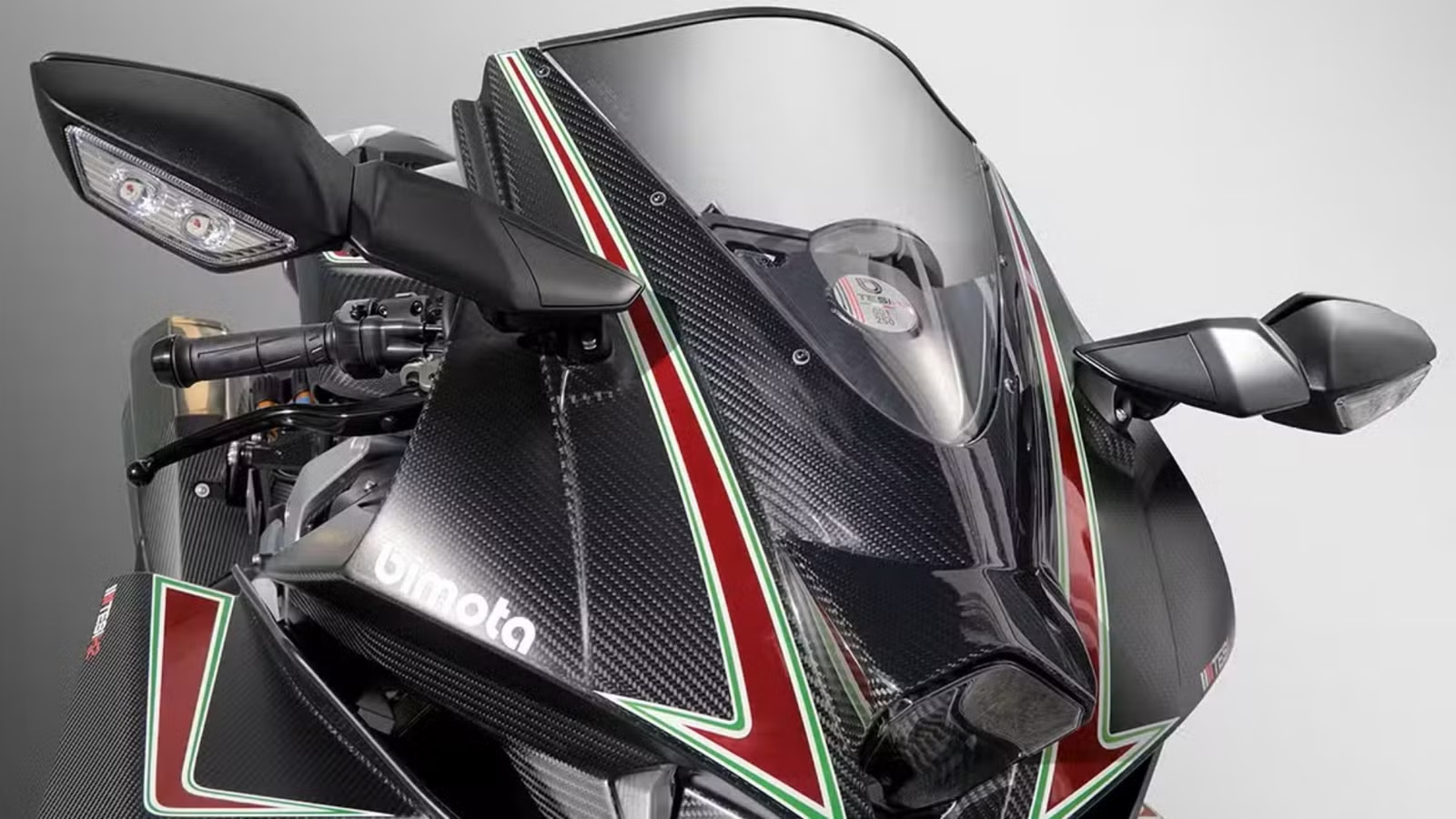
Most sports bikes are built to go fast. You can usually see that in the numbers. More horsepower, quicker acceleration, faster lap times, and increasingly advanced electronics are some of the ways manufacturers show what their latest models can do. But being fast doesn’t always make a motorcycle special. Sometimes, an exotic engine, an unusual chassis, or complicated technology can be enough to make a motorcycle stand out.

Then there are some motorcycles that have all of those things. These bikes may not be the easiest to live with, and they’re certainly not aimed at someone looking for the most sensible sport bike. Instead, they’re built to catch the attention of enthusiasts. Years later, those same quirks could be exactly what makes them desirable. That is what makes the idea of a future classic so interesting. And there’s one sports bike that has almost everything you’d expect: limited production, serious performance, Italian design, and a chassis unlike almost anything else on the road.
The Three Things That Separate A Future Classic From A Fast Bike
Trying to figure out which motorcycles will become future classics isn’t as simple as checking out the spec sheet. Because if it were, every fast and powerful sports bike would eventually become a collector’s bike. And we all know that’s not going to happen. There has to be something more to the bike that makes people remember it.

It might be the engine that makes it special or the way it looks. And sometimes, it’s the way the whole bike was put together, or even the time when it came out. Being produced in limited numbers can definitely help too. But more than anything, a future classic needs to have its own personality. It needs to stand out from the other bikes around it and give people something to talk about even years after it’s gone out of production.
Why 200-Plus Horsepower Alone Won’t Make A Motorcycle Collectible

Performance obviously matters, but that alone isn’t enough. A bike making 200-plus horsepower sounds pretty crazy today, but the thing is, there are already quite a few bikes that can do it. The same goes for all the fancy electronic rider aids, active suspension, carbon-fiber wheels, and sophisticated aero packages. All of that can make a bike incredibly capable, but that doesn’t necessarily make it memorable.
Just look at some of the sports bikes that people still want years after they first came out. There’s usually something else about them that makes them special. Maybe they were way ahead of their time or the engine was brilliant, or maybe they just looked so good that people couldn’t help but notice them. That kind of character is what really matters.
How Bimota Built Its Reputation By Ignoring The Standard Sport Bike Formula

And this is where things start getting fascinating. Motorcycle manufacturers have spent decades perfecting the basic sport bike formula. You’ve got a powerful engine, a regular frame, telescopic forks upfront, a swingarm at the back and a bunch of electronics. And honestly, there’s nothing wrong with that setup, and it works really well.
But when a manufacturer throws that formula out and tries something genuinely different, things get a lot more interesting and Bimota is a great example. The Italian company has never really been afraid to experiment with complicated chassis designs, unusual suspension systems, or expensive ways of building its bikes. With Bimota, engineering has often been just as important as outright performance. And the Tesi is probably the clearest example of that whole philosophy.
The Tesi H2 Blends Kawasaki’s Supercharged Engine And A Bimota Hub-Center Chassis

The Bimota Tesi H2 takes an already unusual bike and pairs it with one of Kawasaki’s most familiar engines. When Kawasaki became a major partner in Bimota, the whole combination actually made a lot of sense. Kawasaki had the engines, technology and resources, while Bimota already had decades of experience building exotic chassis.
The Tesi H2 was one of the big examples of what that partnership could actually come up with. And well, the Tesi H2 is definitely not a subtle motorcycle. It gets Kawasaki’s supercharged engine, but instead of dropping that engine into a normal superbike chassis, Bimota built something completely different around it.
Could The Tesi H2 Be Too Unusual To Build Again — And Does That Make It Priceless?

I think the Bimota Tesi H2 could actually get more interesting as the years go by, mainly because it’s the kind of bike that might be really hard to build again in future. These days, motorcycles are being built more and more by regulations, efficiency requirements, and what makes sense for the mass market. So, there’s something really cool about a bike like the Tesi H2, because it feels like it was built around an engineer’s idea of what a motorcycle could actually be.
And because of that, the value could change over time. It might not just be about how fast the bike was when it first came out, but more about the fact that it represents a very specific time in motorcycle engineering that we might never see again. And honestly, that’s what could make the Tesi H2 more than an old superbike someday.
The Combination Of Bimota Engineering And Kawasaki Performance

There’s something really interesting about putting these two companies together. Kawasaki’s supercharged engine is already tried and tested. The Ninja H2 family showed what Kawasaki could do with forced induction on a modern production bike, and the Tesi H2 takes that same engine and puts it somewhere completely different.
The engine puts out 231 horsepower at 11,500 rpm and 104.5 pound-feet of torque at 11,000 rpm. But honestly, those numbers aren’t even the most interesting part. The interesting part is what happens when you take that engine and put it into a Bimota. And then, there’s the fact that Bimota only built 250 Tesi H2s. That alone gives it something most mass-produced superbikes just can’t offer: genuine rarity.
At Roughly $75,000, The Tesi H2 Was Never Meant To Be A Sensible Choice — And That’s The Point

Then there’s the price. The original Tesi H2 was priced at 64,000 euros (around 74,387 USD in 2026) when it went on sale, which put it right into exotic-bike territory. And that matters, because Bimota was never trying to make the Tesi H2 a sensible alternative to a Kawasaki Ninja. The whole point was for it to be something special. And that’s an important difference.
Someone buying a Tesi H2 wasn’t just paying for horsepower. They were paying for the crazy chassis, the design, the limited production and, of course, the experience of owning something that hardly anyone else could have sitting in their garage. And that kind of positioning can make a bike much more interesting to collectors later on.
Kawasaki-Sourced Supercharged Engine Gives It Serious Performance

The Kawasaki-sourced supercharged engine takes things to another level. It’s a 999cc inline-four with a centrifugal supercharger, so you get a huge amount of performance without needing a massive engine. The early production version was already making around 228 horsepower and 104 pound-feet of torque, which is more than enough to put the Tesi H2 firmly into hyperbike territory rather than just being another exotic-looking sport bike.
But then there’s the way all that power is delivered. A supercharged inline-four also feels different from a naturally aspirated engine. There’s a strong rush as the revs climb, but there’s also enough torque that you don’t have to keep chasing the redline just to get the bike moving.
Swingarms At Both Ends: Why Bimota Threw Out The Standard Front-Fork Setup Entirely

The engine is really only half the story. Bimota built the Tesi H2 around a chassis that completely forgoes the usual front-fork setup. Instead, you get swingarms at both ends, with the front wheel connected to the steering system through a hub-center setup. And that alone makes the Tesi H2 look completely different from pretty much every other modern superbike.
There are also plenty of machined parts throughout the chassis, and the whole thing has that kind of mechanical detail you’d expect from a small Italian manufacturer building bikes in limited numbers, not a mass-production company. And that’s important, because the Tesi H2 isn’t only interesting when you’re riding it. Even when it’s just sitting in the garage, a lot is going on.
How Hub-Center Steering Separates Braking And Steering Forces — And Why That Matters

This is probably the one feature people remember most about the Tesi H2. As mentioned before, the Tesi H2 skips the usual telescopic forks up front and uses a hub-center steering system. The front wheel sits between the swingarm structure, while a separate set of linkages takes care of the steering. It’s definitely unusual, but Bimota didn’t do it just to make the bike look different.
Hub-center steering has been around for a long time, and one of the big ideas behind it is to separate the steering, braking, and suspension forces. That gives engineers more freedom to tune how the chassis behaves. That front end is actually a huge part of what makes the Tesi H2 what it is. And that’s exactly the kind of detail I think collectors will appreciate.
The Design That Won’t Age — And The Materials That Make It Worth Preserving

A lot is going on with the Bimota Tesi H2, but what really makes it interesting is the way all those fine details come together. It’s got the performance to back up the looks, but also has a character you just don’t get from most modern superbikes. And when you think about how few of these bikes actually exist, it’s hard not to see why the Tesi H2 could eventually be remembered as one of the strongest and most interesting sport bikes of its era.
It Looks Like Nothing Else On The Road

You could park the Tesi H2 next to pretty much any modern superbike, and you’d know straight away which one is the Bimota. The exposed suspension, compact bodywork and the strange-looking front end give it a shape that’s pretty hard to mistake for anything else. And that actually matters.
A bike that follows styling trends can look modern when it first comes out, but it can also start looking dated pretty quickly. But a bike with genuinely unusual proportions and all those mechanical details can age very differently. The Tesi H2 doesn’t really look like it belongs to any particular styling trend. It just looks like a Tesi. And that could become valuable as the years go by.
Carbon Fiber, Billet Aluminum, And Aerospace Bonding: How Bimota Builds A Bike In 250 Units

The other big part of this is how the bike is actually built. The company is not trying to compete with the big manufacturers when it comes to production numbers. Instead, it builds bikes in relatively small numbers and puts a lot more attention into the engineering, materials and all the little details.
The full fairing, aerodynamic winglets, and other body panels are made from carbon fiber, which helps keep the weight down. The fuel tank is carbon fiber too, and even some of the smaller shields, trim pieces, and structural sections use carbon-fiber components. Machined billet-aluminium plates hold the front and rear of the engine, providing mounting points for the swingarms, steering linkage, and suspension.

The front swingarm combines carbon-fiber sections with machined billet aluminum, bonded together with aerospace-grade materials. At the back, the swingarm uses a mix of cast and billet-machined aluminium and houses Öhlins TTX shock absorbers. Even the smaller pieces get the same treatment.
The steering links, pull-rods, pivot plates, and eccentric swingarm supports are all machined from billet aluminum. The exhaust is another nice touch, with a lightweight Akrapovič titanium exhaust system. Put all of that together, and it’s easy to see why the bike feels more like a piece of specialist engineering than something built for the masses.
Source: Bimota

Related posts



Latest Post


No Comments