
The 1966 Studebaker Daytona: Chevy V8 in Its Last Car
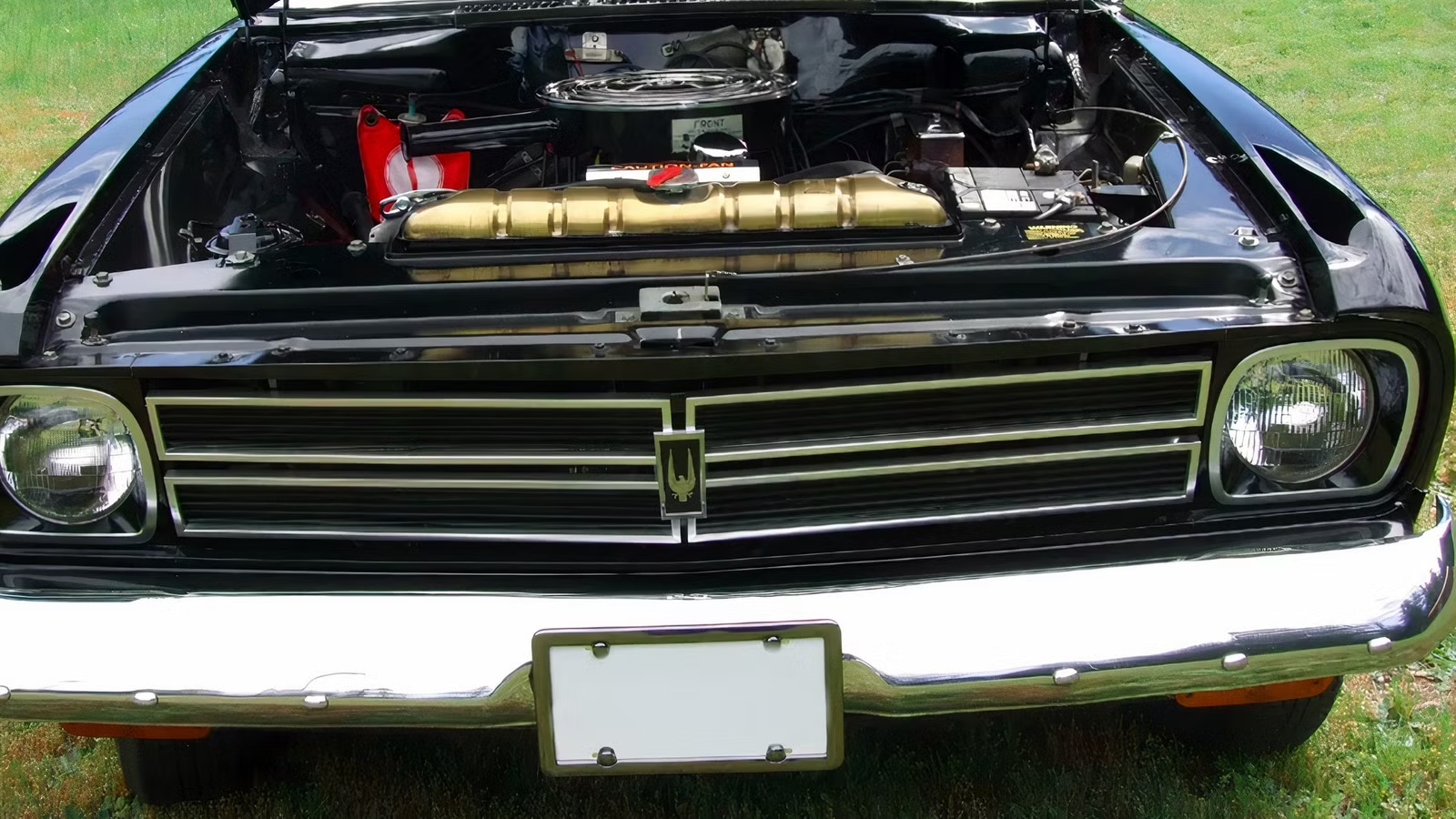
When an automaker goes under, it usually does so in one of two ways. Option one? It goes out in a blaze of controversy, scandal, and bad publicity from something or someone within the company going horribly awry. Other times, it goes out with a whimper. The company lets the glory days create a haze of distractions that let quality slip to the point its current products don’t cut it anymore. Guess which route Studebaker took in the end? Well, they managed to slip a gem in at the very end, not that most classic car fanatics even know about it.
Studebaker: Going Out Sad in the Worst Way Possible

Ask a millennial or a zoomer if they’ve ever heard of Studebaker, and the only ones liable to say yes were the ones who spent way too much time browsing Wikipedia as a child. It’s a real tragedy, because at one point Studebaker was a name synonymous with automotive greatness. Heck, the company even predated the automobile by a couple of decades, established by a group of German immigrants to South Bend, Indiana, who became a top name in the horse-drawn carriage business. Through the early 1900s, World War I, and World War II, Studebaker proved a viable alternative to the newly formed Big 3 Detroit automakers at Ford, GM, and Chrysler.
Studebaker’s bread-and-butter moneymaking strategy was offering unparalleled value for money. Cars like the value-focused Champion and the pint-sized Lark proved American cars didn’t have to be giant land barges with massive V8 engines to have genuine appeal. Elsewhere, more upmarket cars like the Golden Hawk luxury coupe and the fiberglass-bodied Avanti sports car proved Studebaker could compete with the top names in Detroit when it really mattered.

Through the early post-war years of the mid-to-late 1940s and even into the ‘50s, Studebaker’s market growth was enough to give the Big 3 genuine cause for concern. In 1950 alone, Studebaker sold nearly 350,000 cars. Off the back of ingenious designs from brilliant sketchers like Virgil Exner, the redesigned bullet-nose Champion and the larger Commander were helping South Bend become a relevant independent automaking town without becoming a fully-fledged Detroit satellite city. Yet, the good times couldn’t last forever. By this point, they wouldn’t last much more than another decade.

Desperate Times, Desperate Measures

Ironically, Studebaker’s status as a scrappy underdog rival to the Big 3, despite being far older, hurt the company in the end. As Detroit’s industrial empire expanded after the Second World War, smaller manufacturers across America simply weren’t able to keep up. For instance, in 1954, General Motors manufactured somewhere in the area of 2.8 million cars, of which well over 1 million of them were Chevrolets. That same year, Studebaker couldn’t even crack 100,000 cars built or sold across its entire model lineup.
With this in mind, it stands to reason that, that very same year, Studebaker would legally merge with another struggling American brand, Packard. In the decades since, the merger between Studebaker and Packard was seen as one of the most harebrained and disastrous corporate affairs from any industry in American history. While one was a once-prestigious luxury brand on par with Cadillac, and even Rolls-Royce or Bentley, the other was a budget brand that dared to think outside the box. It sounds like an odd couple, and it certainly was one where parts commonality between the two often began and ended at badge engineering. Worse still, Studebaker couldn’t afford to update its native line of V8 engines.

This meant, agonizingly, Studebaker had to sign a deal with Chevrolet to put its 283-cubic-inch small block V8 under the hood of its own cars. For a company that touted its own 232.6-cubic-inch V8 as one of the most advanced in the world, this was the equivalent of a humiliation ritual. At the very least, the deal allowed Studebaker to produce one more banger, right as the company went under for good.
The 1966 Daytona Sports Sedan: The End, But Quite a Brilliant One

We mentioned how Studebaker went out on a particularly sad note, and on the face of it, that’s absolutely true. In 1963, the company closed its historic South Bend production facility, unable to afford to keep the operation running. By then, the Packard side of the operation had long since gone under, producing its last car in 1958. Yet, from its last North American facility in Hamilton, Ontario, Canada, Studebaker’s last flagship turned out to be remarkable.
Enter the 1966 Studebaker Daytona Sports Sedan. Never mind that it had only two doors, as the lines of automotive nomenclature were somewhat less established 60 years ago. Designed by the Dearborn-based firm Marcks, Hazelquist, and Powers, because Studebaker couldn’t afford an in-house design firm, the Daytona had the underpinnings of the third-generation Lark, but the V8 grunt of a 283-cubic-inch “Thunderbolt” V8. Given the year it was built, the final sporty Studebaker that isn’t an Avanti could almost be classified as a muscle car. It entered the last of its dealership network at the same time the Pontiac GTO was coming into its own, so the moniker would certainly hold up.

It causes one to wonder: if Studebaker had been able to last just a few more years, could it have contributed to the muscle car era in some meaningful way? The earlier Lark and Daytona R-Series came close, but with genuine Chevy small-block power and standard front disc brakes, the 1966 Daytona Sports Sedan was arguably a better muscle car template. With 195 hp and 285 lb-ft of torque, it was a capable performer for the time. Sadly, in March of that year, Studebaker closed for good.
What Could’ve Been, and What They Tried to Revive

Studebaker marked the 60th anniversary of its demise in 2026, and in that time, we’ve seen the continuous domination of the same Big 3 that felled it, save for a brief chapter from AMC, until Tesla came around in the 2010s. Looking back, the 1966 Daytona Coupe showed the world that the firm could still produce a compelling car. More importantly, it’s a reminder that Tesla was far from the only challenger to the established Motown aristocracy.
After Studebaker’s demise, the Avanti sports car lived on, produced independently under the name Avanti II, all the way until 2006. Meanwhile, at least one person attempted to revive the brand in the 2000s, prototyping a blatant Hummer knockoff called the XUV until General Motors sued them off the face of the Earth. Meanwhile, a surviving example of one of the mere 620 Thunderbolt V8 Daytona Sedans is a true rarity.

And yet, one recently sold on Bring a Trailer for a mere $15,250. What accounts for the low price? Is modern America overlooking this bona fide piece of American history? It must be so, and like we said, have fun finding someone born post 1965 who’d be genuinely excited to see one. Sometimes, that’s just how the passage of time works. If you ask us, more Americans ought to drive classic cars — at the very least, they won’t be driving the same Ford, Chevrolet, or Dodge we’ve seen countless times over the last 60 years.
Source: Bring a Trailer

Related posts



Latest Post


No Comments