
The 150cc Motorcycle That Quietly Outsold Most Western Performance Brands Combined
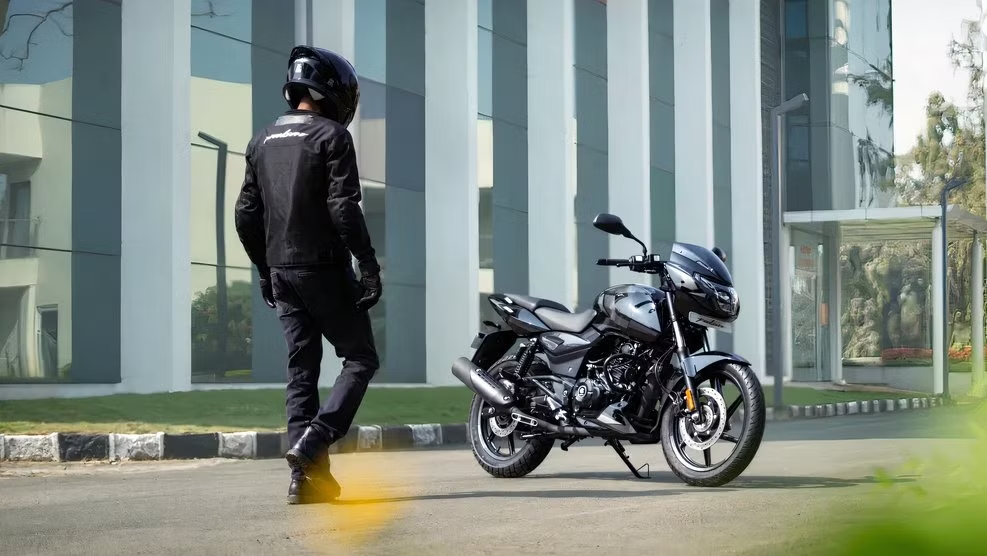
Most Western riders could go their entire motorcycling lives without giving the Bajaj Pulsar much thought. Globally, that is almost an inversion of reality. The Pulsar began with a 150cc motorcycle in 2001 and has since grown into an entire performance family. Bajaj says more than 20 million Pulsars have now been sold across more than 40 countries, making the nameplate one of the largest performance-motorcycle franchises most Western riders rarely hear about. Bajaj itself has sold more than 21 million motorcycles across more than 100 countries.

That scale matters now because Bajaj is not simply celebrating Pulsar’s 25th anniversary. It is rebuilding the motorcycles that sit closest to the nameplate’s roots while, separately, testing what appears to be a 250cc adventure bike. Taken together, those developments say more about global motorcycling than another anniversary campaign ever could. The companies fighting over the future of performance and adventure riding are increasingly doing it with motorcycles well below 300cc.
Bajaj Just Rebuilt The Bikes At The Heart Of Pulsar
On August 24, Bajaj unveiled all-new versions of the Pulsar 150 and Pulsar 125, two motorcycles positioned at the affordable end of a Pulsar range that now stretches well beyond the original 150cc formula. The changes go considerably deeper than new bodywork. Both motorcycles move to a new diamond-type frame, with the engine contributing to chassis stiffness, along with a centrally mounted gas-charged monoshock. There are new engines and gearboxes, while higher-spec technology includes a five-inch TFT display with Google Maps mirroring, selectable riding modes and Bajaj’s low-speed Crawl Tech system.

The new Pulsar 150 produces 14 PS from its 149.5cc engine, while the 124.58cc Pulsar 125 makes 12 PS. Introductory prices start at ₹115,233 ($1,210) and ₹92,900 ($975) respectively, ex-showroom Delhi. Those numbers are unlikely to excite riders accustomed to judging performance motorcycles by triple-digit horsepower figures, but that is precisely the point. Pulsar was never built around exclusivity. Its success came from making a taste of performance available at commuter-bike prices. Bajaj has been reinforcing that strategy elsewhere in the range, too. Earlier in August it launched new Pulsar N160 S and N160 SS variants with a 165cc engine, TFT instrumentation, ride modes and traction control.
Pre-launch reporting suggested the broader Pulsar overhaul could eventually encompass as many as 10 substantially new motorcycles in the 125cc-to-160cc classes. Another report put the figure at eight and described a mixture of major redesigns and smaller updates. Bajaj has not publicly detailed a complete eight- or 10-model rollout, so those figures are better treated as indications of the scale of the product push than a confirmed launch count. What is no longer speculative is the direction: Bajaj is investing heavily in the displacement classes that made Pulsar enormous in the first place. And another test bike suggests the same philosophy could soon spread into adventure motorcycles.
Bajaj’s Next Move Could Be A 250cc ADV

A Bajaj adventure motorcycle has been spotted testing with the sort of hardware that makes its intentions difficult to disguise. The test mule reportedly uses a 19-inch front and 17-inch rear wire-spoke wheel combination, long-travel suspension, upright ergonomics and a TFT instrument display. Times Now reports that the motorcycle could use a 249cc liquid-cooled engine producing around 30.6 horsepower and 25 Nm of torque, with an expected price between ₹2 lakh and ₹2.5 lakh ($2,100–2,625). Bajaj has not confirmed the production motorcycle, its specifications or its positioning, so those figures remain reported rather than official.
But the competitive set is already clear. Hero launched the XPulse 210 in January 2025 at ₹175,800 ($1,846), with deliveries beginning that March. It has since expanded the XPulse family further, including a Dakar Edition. TVS went further up the ladder in October 2025 with the Apache RTX, an adventure tourer launched from ₹199,000 ($2,090) with a TFT display, four riding modes, cruise control, traction control and a bi-directional quickshifter. So if Bajaj’s 250cc test bike reaches production near its reported price, it will not be arriving to create a category. It will be joining a fight that is already underway.
The Real Adventure-Bike War Is Smaller Than You Think

Western adventure motorcycling is easy to view from the top down. BMW’s GS family, Honda’s Africa Twin and KTM’s larger Adventure models define much of the conversation. They are capable motorcycles, but they also encourage the idea that serious adventure riding begins somewhere around the point where motorcycles become expensive, heavy and enormously powerful. Across much of the world, the equation is different.

A 200cc or 250cc adventure motorcycle can be transportation during the week, a touring bike on the weekend and an off-road machine when the pavement disappears. Purchase price matters. Fuel economy matters. Ease of repair matters. Weight matters. The result is that what can look to Western enthusiasts like an entry-level compromise can represent the center of the market somewhere else.
Pulsar’s history illustrates that disconnect unusually well. Bajaj’s 25th-anniversary material says more than 20 million Pulsars have been sold, with the nameplate helping build the company’s presence across markets far beyond India. What began as an attempt to make performance accessible became a global motorcycle franchise spanning multiple displacement classes.
Now several of India’s largest motorcycle manufacturers are applying similar thinking to adventure bikes. Hero has the XPulse. TVS has moved in with the Apache RTX. Royal Enfield continues to develop the Himalayan formula around accessible middleweight adventure riding. KTM has spent years building smaller-displacement performance and adventure motorcycles in India through its relationship with Bajaj. And now Bajaj appears to be preparing an ADV of its own. That convergence is more meaningful than any one spy shot.
Pulsar’s Next 25 Years May Matter More Than Its First 25

Bajaj is naturally using Pulsar’s anniversary to look backward. Its global My Pulsar Story campaign celebrates the millions of riders for whom the brand represented a first performance motorcycle, a first road trip or simply an affordable step beyond basic transportation. But the product activity around that anniversary makes a more interesting argument about what comes next.
The Pulsar 125 and 150 have just received substantial mechanical and technological updates. Bajaj is expanding the 160cc end of the family. And a 250cc adventure motorcycle appears to be under development at the same time that Hero and TVS are investing heavily in the same general part of the market. None of this requires pretending that a 250cc ADV will replace a liter-class adventure motorcycle. They serve different riders and different purposes.
The more useful conclusion is that the motorcycles defining global volume do not necessarily resemble the motorcycles defining Western enthusiast conversation. More than 20 million Pulsars later, Bajaj has already demonstrated how large affordable performance can become. Its next trick may be doing something similar with adventure bikes.

Related posts



Latest Post


No Comments