
Shoei RF-SR2 Helmet Review: Aero Gains, Same $499 Price
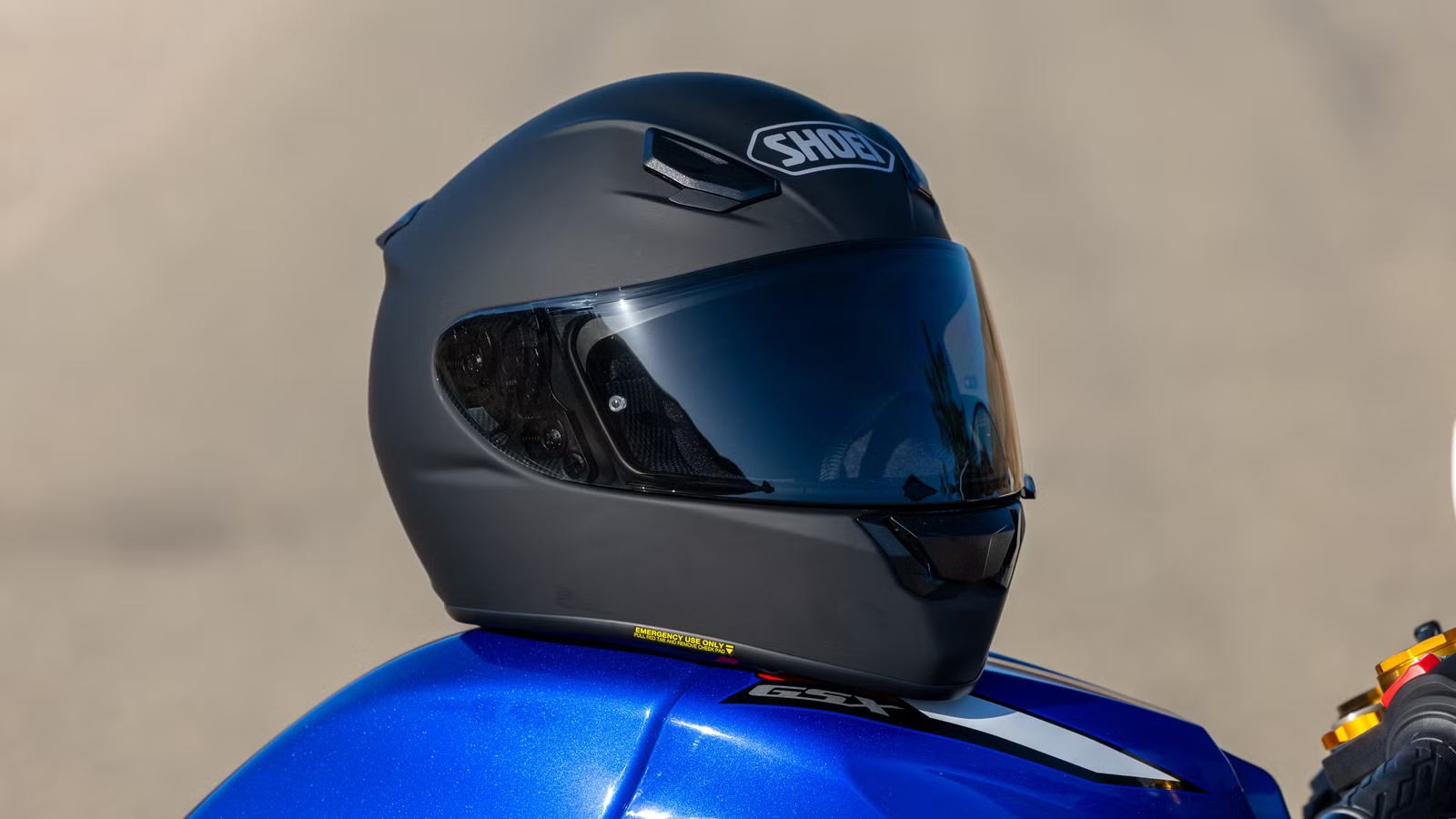
How do you improve on a helmet that already ranks among the best entry-level road lids money can buy? You innovate. For the RF-SR2, that means redefining itself around aerodynamics and leaning into the wind-tunnel-proven design seen in Shoei’s latest street helmets.

That’s a shift in design priorities for a helmet whose predecessor spent nearly a decade on dealer floors. The original RF-SR let riders sample Shoei’s premium fit, finish, and safety credentials without committing to the higher MSRPs attached to the all-around RF-1400 or race-ready X-Fifteen helmets. Of all the line items on the RF-SR2’s spec sheet, from the updated shell to the reworked ventilation, the real headline is about what hasn’t changed: the $499 price.
Fashion and Function: RF-SR2 Aerodynamics
Speaking strictly, the RF-SR2 isn’t a from-the-ground-up reinvention. The Japanese brand is sticking with what worked while taking appreciable steps forward in this second-generation helmet. The updated shell profile speaks to that goal, offering a more modern and mature shape incorporating aero-first thinking derived from the firm’s upper-tier lids. All-new recessed venting sits mostly in the shell, as opposed to being affixed to the exterior. What will draw eyes is the far larger rear spoiler, an RF-1400-influenced piece that adds both stability in the wind and some visual flair to the silhouette.

Shoei claims that the spoiler is worth a heaping 82 percent aerodynamic improvement over the outgoing helmet. Verifying that claim would require a wind tunnel, which, unfortunately, we don’t have. What we do have is logged miles aboard two bikes that sit at opposite ends of the fairing spectrum: the naked 2026 Honda CB750 Hornet E-Clutch and the fully faired 2027 Suzuki GSX-R1000R.

Buffeting is minimal, bordering on negligible, and over-the-shoulder head checks don’t yank your neck violently due to wind resistance. Between the spoiler and shell revisions elsewhere, the helmet holds a steady line on your shoulders, most noticeably on the nudist CB750 Hornet, where nothing stands between you and the air. Sit up prairie-dog style on the GSX-R1000R during a freeway slog, arms out and looking exactly as graceful as that sounds, and composure holds even as the windscreen funnels air straight into the chin bar. Lift, another area Shoei lists as improved, isn’t much of a factor with a properly fitted helmet. Is it as slippery as the X-Fifteen? No, but the RF-SR2 wouldn’t feel out of place at a track day, either.
AIM+ Construction, Snell M2025D, and a Few Honest Ounces

Underneath is the brand’s longstanding AIM+ construction, which is Shoei-speak for “Advanced Integrated Matrix Plus Multi-Fiber.” In practice, that means layered fiberglass combined with organic fibers, the same base technology found in the X-Fifteen, RF-1400, and VFX-EVO.
The new RF-SR2 clears DOT FMVSS No. 218, the U.S. minimum, alongside Snell’s current M2025D. The Snell certification is worth digging into: M2025D accounts for oblique impacts and rotational forces, as opposed to linear impacts alone. It’s a significant step forward from the testing protocols the original RF-SR was engineered around long ago.

Meanwhile, DOT hasn’t seen a substantive update in over ten years, and it was already dated then, especially compared to safety standards that weigh rotational forces, including Snell, ECE, and FRHPhe-02. There’s no ECE homologation here, simply because it isn’t offered in European markets.
Another returning feature is the four-outer-shell-size strategy, meaning XS through XXL fit real heads instead of burying the size extremes under thicker foam. In a segment where four shell sizes have a habit of quietly becoming two, that’s worth noting, because it means your helmet will be a far closer fit regardless of head size. Per usual, it’s an intermediate oval head shape. And once more: outgoing RF-SR, $499. New RF-SR2, $499.

Our medium-size lid tipped the scales at 3.54 pounds with the chin curtain and breath guard fitted, lining up with Shoei’s 3.49-pound bare claim. This section of the helmet market is fairly crowded, with the Alpinestars Supertech R7 ($679.95; 3.06 pounds [measured weight]), AGV K6 S ($639; 3.02 pounds [claimed weight]), Arai Regent-X ($659; 3.41 pounds [measured weight]), and Scorpion EXO-R1 Air ($439.95; 3.28 pounds [claimed weight]) all chasing the same buyer. The RF-SR2 lands at the affordable end while being a bit porkier than some of the featherweight competition.
The aero advancements counteract what the scale says. In the wind, the helmet doesn’t feel heavy on your head, and its cleaner passage through the air takes a real bite out of neck fatigue on long days.
Ventilation You Can Actually Feel, and the CWR-1 Faceshield

If aerodynamics is the headliner, ventilation is a worthy supporting act, with clear improvements on paper and in the real world. Shoei quotes 21 percent more airflow through the reworked upper intakes and 43 percent more through the enlarged chin bar vent, which picks up a genuinely useful half-open detent. That one earns its keep at 6 a.m. when your glasses fog up while you’re waiting at a stoplight. The upper vents move serious volume through the dual-layer, multi-density expanded polystyrene (EPS) liner and comfort padding, and you feel it grace your scalp. The redesigned sliders are also far easier to work with a gloved hand.
The faceshield carries over untouched from the RF-SR: the same CWR-1 riding the same QR-E base plate that served the discontinued RF-1200 and X-Fourteen. Both of those have almost certainly aged out of Shoei’s recommended service life, but the upside is a deep aftermarket that keeps replacement shields plentiful and inexpensive, with smoke, mirrored, and photochromic options easy to source. Age hasn’t dulled the view, either. Optical clarity remains excellent with no distortion toward the edges, and the aperture is tall and wide enough that tipping your head into a corner never leaves you hunting for the horizon. The shield also blocks 99 percent of UV.

A clear shield ships standard and a Pinlock EVO anti-fog insert is in the box. One holdout compared to most of Shoei’s road helmet lineup: the shield release tab still lives on the left side instead of the center-locking design the industry is moving toward. Shoei, AGV, Alpinestars, and Bell have all migrated toward centrally located shield locks, largely because a center mechanism is less exposed to a strike in a crash. While not a dealbreaker by any means because that’s how helmets have traditionally latched their faceshields, this is a cost-saving strategy to avoid introducing more expensive locking hardware.

The interior is where Shoei justifies the premium marketing language, delivering comfort and build quality worthy of the Japanese high bar, despite being an “entry-level” helmet. The washable, sweat-wicking pads are excellent, and this is exactly the arena where Shoei and its countryman Arai routinely leave rivals behind. Being the entry point to the street range, the liner isn’t as configurable as what you’ll find in the Hornet X2, RF-1400, or nearly endlessly adjustable X-Fifteen, though cheek and center pads are sold separately for fine-tuning.
Fit is personal, so riders who aren’t confident about sizing themselves should lean on an authorized dealer. Internally, it’s the familiar intermediate oval Shoei has long favored for our North American market. Snug and supportive, nothing in the fitment department strays from the original RF-SR. In fact, the overall fit is a little more forgiving than the RF-1400, flirting with the sport-touring GT-Air 3 helmet. Eyewear users benefit: thick-rimmed glasses slide in without hot spots, and with noticeably less fuss than the tighter RF-1400 or race-fit X-Fifteen.

Shoei’s Personal Fitting System (P.F.S.) is worth flagging as well: at authorized retailers, trained Shoei technicians take measurements with a proprietary device, then run them through Shoei’s P.F.S. software to recommend exact pad sizing and customize fitment precisely. It’s the single best way to eliminate a pressure point, change how high or low the lid sits, or dial in overall snugness. Details on that service can be found here.
Streetwise amenities are present as well, including speaker pockets and wire channels that accept the comm unit of your choosing. There isn’t a shell-integrated system like the modular Neotec 3 or full-face GT-Air 3, so you’ll be sticking an external unit to the shell the old-fashioned way. The counterpoint is that Shoei’s factory integration on those two helmets only works with the $399 SRL 3 Mesh Bluetooth Communication System by Sena, and carrying over an existing communication device will save you some coin. An Emergency Quick Release System (EQRS) lets first responders pull the cheek pads before extracting the helmet, reducing the odds of compounding an injury during treatment; it’s now near-universal across Shoei’s catalog and worth looking for at any price. Coverage is Shoei’s standard limited warranty: five years from the date of purchase or seven years from the date of manufacture, whichever comes first.
So, Is the Shoei RF-SR2 Worth $499?

In short: yep. The RF-SR2 does exactly what a gateway helmet should, allowing riders to get a taste of a brand’s philosophy and build quality without raking their wallet over the coals.
The RF-SR2’s improvements go beyond skin deep. The aerodynamic and ventilation gains are what those curious about joining the Shoei family should be most focused on testing themselves. Meanwhile, the certifications are current and reach a higher standard. The rest is the Shoei you already know: premium comfort at a decidedly un-premium $499.
Sizing, Pricing & Colors:
Sizes: XS-XXL
Price: $499
Colors: Black, Matte Black, White, Matte Blue Metallic, Matte Deep Gray, Basalt Gray
Shoei RF-SR2 Review Photo Gallery:

Related posts






Latest Post


No Comments