
The Affordable Sport Bike That Experienced Riders Still Love
Sport bikes have a funny way of making speed feel more important than it really is. The biggest machines can deliver staggering acceleration, enormous cornering ability, and enough performance to make public roads feel strangely small. Yet another side of the sport-bike world offers lower weight, manageable power, and a modest price that can make every ride more engaging. These motorcycles don’t need huge engines to feel exciting. Instead, they reward riders who enjoy carrying momentum, working through gears, and exploring what a chassis can do without constantly approaching license-losing speeds.
Why Small Sport Bikes Can Be So Much Fun
Budget Supersports Keep The Focus On Riding

More power is useful, but it does not automatically mean fun. Once a motorcycle has enough performance to overwhelm the available road, additional horsepower can become something you admire rather than regularly exploit. This is particularly noticeable on winding back roads; a lightweight bike, on the other hand, can be accelerated hard between corners, braked late, and turned in with enthusiasm without immediately reaching ridiculous speeds.
You become involved in the road because there is more to do. When you’re trying to hold up speed on a small-capacity bike, the line matters, the throttle opening, the choice of gear, the momentum — all of it matters. Experienced riders appreciate smaller motorcycles because they already know what big bikes can do. But on an entry-level bike, you get to put all of your technique to use without having to worry about getting your license suspended.
Big Bikes Are Not Always More Entertaining

Affordable sport bikes tend to keep things wonderfully direct. A big supersport can be breathtaking, but it can also make ordinary roads feel like a very small stage for a very large performance. A smaller machine gives riders more opportunities to use the engine, work the gearbox, and lean into corners without needing a racetrack to discover its limits.

This is why motorcycles like the Kawasaki Ninja 500 and the Aprilia RS 457 remain interesting, even as engine sizes continue to grow. The current Ninja 500 uses a 451cc parallel-twin and starts at $5,399, while the RS 457 brings a 47-horsepower twin and an aluminum frame to the same general category. These bikes are not simply cheaper alternatives to bigger sport bikes, but genuinely fun machines on the street when speed is only part of the equation.
Why Experienced Riders Still Love The Yamaha YZF-R3
The YZF-R3 Is The Entry Into Yamaha’s R-World

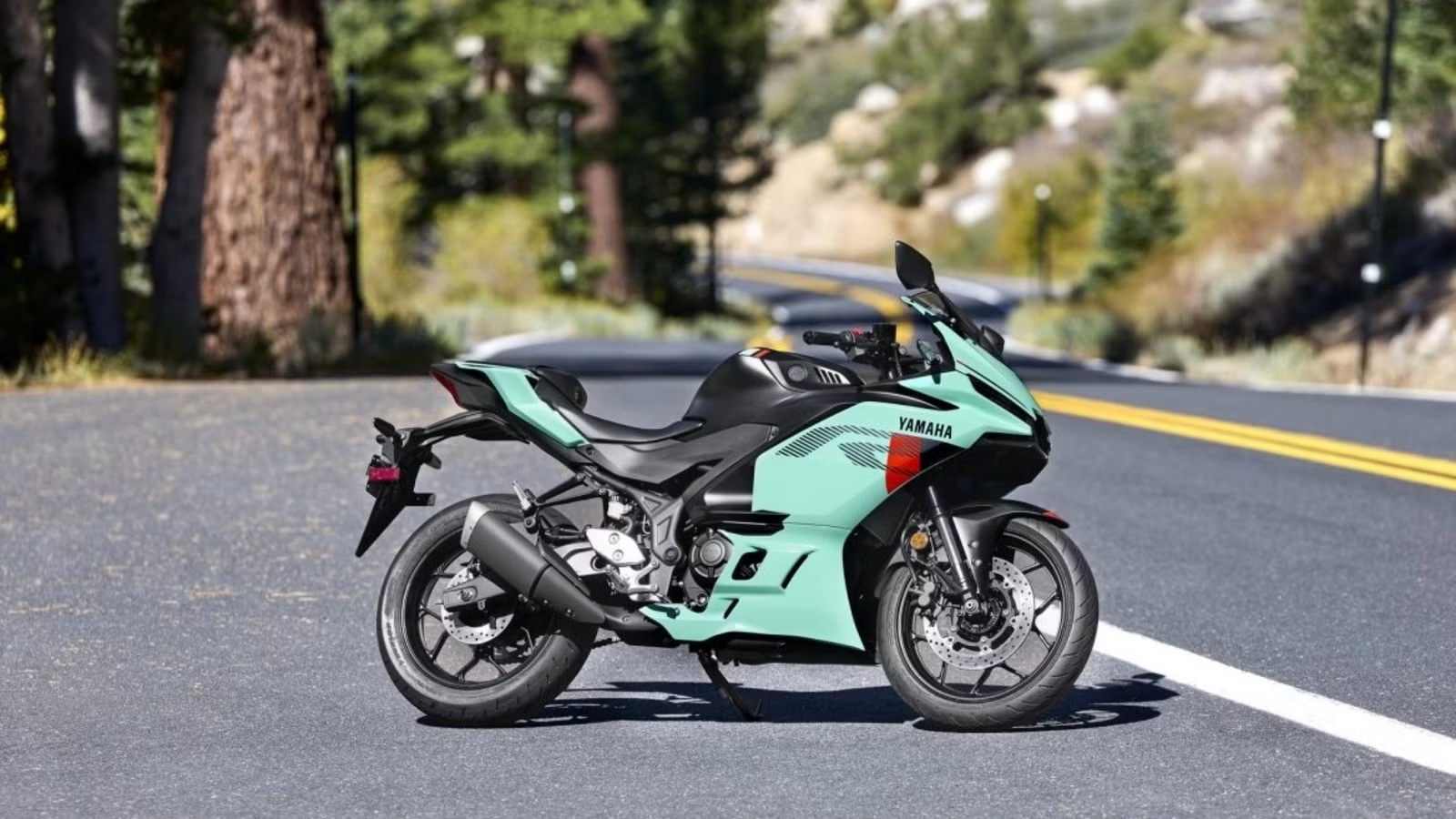
The Yamaha YZF-R3 is an easy motorcycle to overlook, surrounded by so many of its bigger “R” siblings. But where the others are focused purely on performance, the R3 tries to balance supersport capability with everyday comfort. It’s got a wonderful engine with decent specs and a sporty, yet surprisingly relaxed, riding position. Yamaha’s engineering extracts so much performance from a small engine that it directly competes with the Kawasaki and Aprilia mentioned above. The reason we chose the R3, then, is that it has proven itself to entertain experienced riders while remaining light, approachable, and inexpensive enough to use frequently.
The Baby Yamaha Has A High-Revving Twin That Rewards Enthusiasm

Powering the R3 is a 321cc liquid-cooled parallel-twin engine that uses a 68mm bore, 41.1mm stroke, and an 11.2:1 compression ratio. According to Yamaha’s European website, the R3’s engine is capable of producing 41.4 horsepower at 10,750 rpm and 21 pound-feet of torque at 9,000 rpm. The high-revving nature of the R3 and the 180-degree crank encourage the rider to explore the upper section of the tachometer rather than simply relying on low-end torque.
Yamaha also claims solid performance across the rev range, and this is possibly due to the downdraft-style combustion chamber, which enhances low- to mid-range torque. Transmission duties are handled by a six-speed gearbox with a slip-and-assist clutch. It reduces some of the guesswork around shifting gears at the right time, but adds a layer of safety by preventing wheel hop during aggressive downshifts.
The R3’s Light Weight Is Its Secret Weapon

The most important number may simply be the 373-pound wet weight of the motorcycle. This figure includes the motorcycle’s fluids and a full tank of gas, making the R3 a substantially easier bike to twist around than many of the larger sport machines. The steel diamond-type frame is suspended on an inverted front fork and a Monocross single shock at the rear. There’s not a lot of adjustability to this, but it teaches you how to tune yourself to the motorcycle rather than the other way around.
The R3 also gets a 25-degree rake and 3.7 inches of trail. Pair this with a 54.3-inch wheelbase, and you have a bike that is very willing to dive into corners at the lightest inputs. Yamaha also claims a near 50–50 weight distribution, which aids in the bike’s agility. Braking hardware comes from a 298mm floating front disc and a 220mm rear disc with ABS for safety. The compact dimensions, the relatively firm suspension setup, and the braking hardware all point to a motorcycle that is especially appealing on winding roads where technique is more important than speed.
Design Clearly Belongs To Yamaha’s R-World

The R3 may be the smaller member of Yamaha’s sport-bike family, but it does not look like an economy model wearing a fairing. The 2026 version adopts Yamaha’s latest R-series styling, with an aggressive front fairing, sleek side panels, and a compact tail section. Yamaha says that the design draws inspiration from the YZR-M1 MotoGP machine. Right now, there is also a 70th Anniversary Edition, a throwback to Yamaha’s racing heritage.
As far as technology goes, the electronics are modern, but not overwhelming. It gets a basic LCD instrument cluster that provides all the important metrics, but the R3 also gets Bluetooth connectivity via the Y-Connect app. This allows you to pair with your smartphone and view incoming calls, emails, and message notifications. It also allows you to track information such as distance, fuel consumption, acceleration, and motorcycle location through the app.
The R3’s Real Advantage Is How Much Motorcycle It Lets You Use
Price: $5,499

The most interesting thing about the R3 is not any single specification, but how they all synergize to give you a fun little machine. The 321cc twin may not sound particularly impressive compared to a 600cc supersport, but strap it to a 373-pound motorcycle and you can throw it around a sequence of corners without much effort. The R3 gives riders enough engine to have fun, enough chassis to explore proper sport riding, and enough technology to feel current. A 3.7-gallon fuel tank and a claimed mileage of 56 miles per gallon also give it a practical side. Perhaps this combination explains why experienced riders can still find plenty to enjoy here.
Source: Yamaha

Related posts

Latest Post


No Comments