
Porsche Still Builds A 9,000-RPM Flat-Six While Everyone Else Adds Turbos
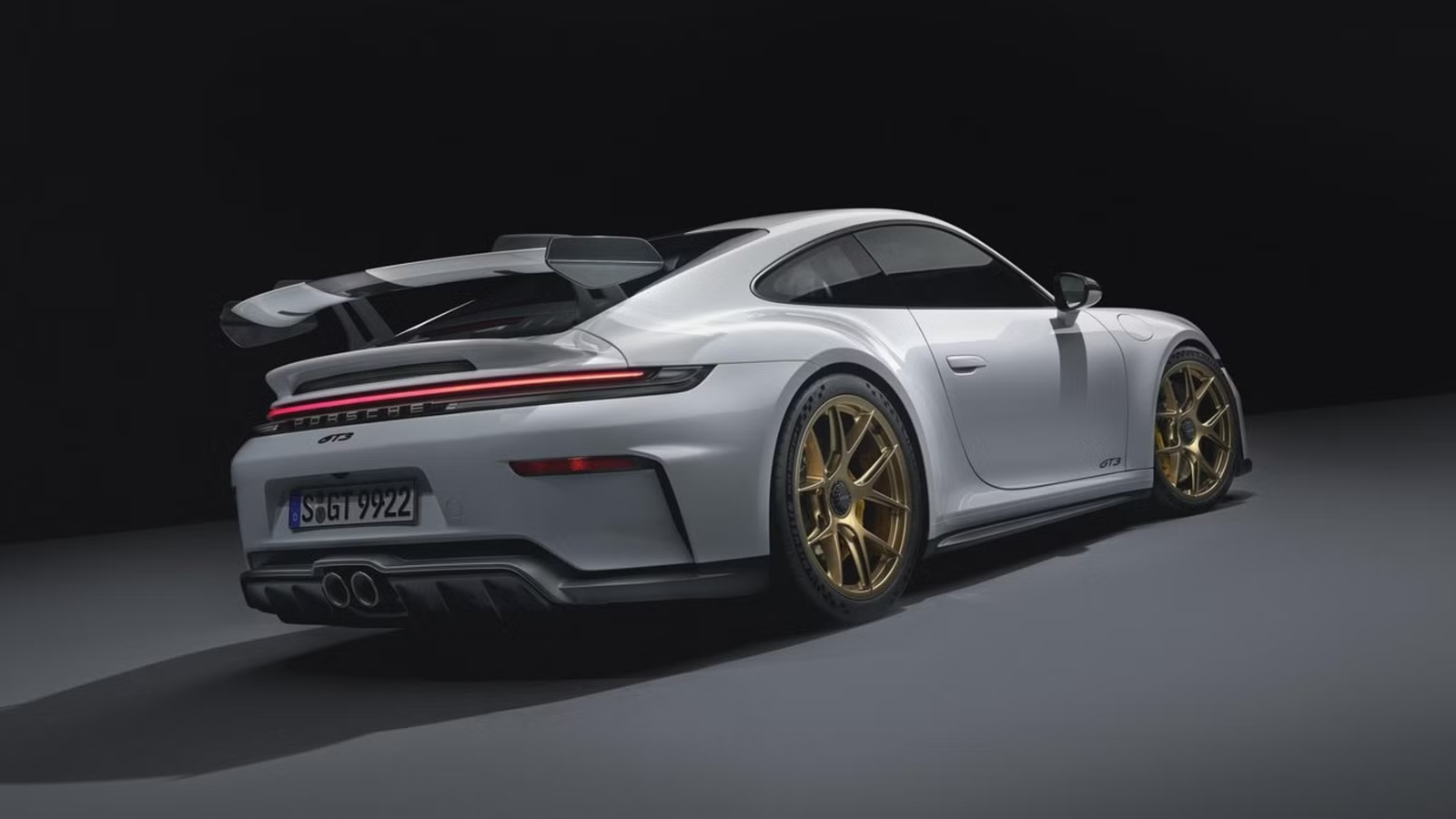
It’s easy to lose hope when it comes to performance cars. Whereas once we were spoiled for choice when it came to manual gearboxes, exotic engines, and ballistic revs, these forms of engineering bliss are few and far between. EVs and hybrids are no doubt a step forward, and a necessity, but it’s hard to argue that anything matches the sound and emotion of a wrung-out combustion engine.

But there is one manufacturer that is at the forefront of electric cars and green solutions, while at the same time being one of the few that still champions a pure 9,000 rpm 4.0-liter naturally aspirated flat-six engine — and there isn’t a turbo in sight. You have to love Porsche.
Turbocharging Is No Longer Special
Once upon a time, turbocharging was so outlandish, it would be written backwards on a front spoiler to warn drivers in their mirror to get out of the way. These days, manufacturers hardly even bother to stick a small “turbo” badge on the trunk. The reason is that almost all new ICE engines that don’t rely on hybrid assistance will have a turbo or two bolted on. No longer are turbochargers used to wring every last horsepower out of a performance car; instead, they back up small units to give them the power of a larger engine but with added fuel economy. Just look at Ford’s 1.0-liter EcoBoost powerplant. Having been brought to the market by American firms, the turbocharger has gone from rebel to mainstream, and now we crave cars that have naturally aspirated engines.
Porsche Made Its Name In Turbocharging


You could point to a lot of moments in Porsche’s near-century-long history as the one that put the Stuttgart firm on the map. The 356 that started it all, the groundbreaking 959 supercar, the starring role in the iconic 1971 movie Le Mans. But the car that most people probably think of when considering Porsche’s back catalog is the 930-era 911 Turbo. This early adopter of a turbocharger was fearsome, earning itself the nickname “Widowmaker,” with ferocious power and handling characteristics that demanded respect. Despite its reputation, the company built its top tier products around this car, with even the faster EVs still being called Turbo despite having an all-electric powertrain. Now, with turbocharging becoming the norm, you’ll need to carefully sift through Porsche’s extensive range to find the one that’s not.
The 911 GT3 Is Pure Naturally Aspirated Heaven

If you are of a certain vintage, you will remember the Geneva Motor Show launch of the Porsche 911 GT3 (996) very well. It was, after all, only back in 1999, which just seems like yesterday (showing my age now). Thank goodness for the GT3, because the 996 version of the 911 might have been best remembered for its cutesy starring role in the movie Cars. Instead, the 996 is showcased by the track-ready, 3.6-liter Mezger-engined wonder, with the GT3 fast becoming one of the most sought-after modern 911s.
Porsche knows when it is on to a good thing, and the GT3 has survived more than half a century doing what it does best. The latest 992 GT3 has a naturally aspirated (non-turbocharged) 4.0-liter six-cylinder boxer engine. This engine, which was developed for use in motorsport but modified for road use, has 502 hp and 331 lb-ft of torque. That’s more than a 996 Turbo, which made do with 420 hp. The latest GT3 will hit 60 mph in 3.2 seconds, and has a top speed of 193 mph.
The 9,000 RPM Redline Replaces Turbos

One of the most astonishing things about this unit is its ability to rev to a heady 9,000 RPM. Power comes from various places, such as large displacement and forced induction, but it is also achieved through higher revs. For this reason, it made sense for Porsche to let the GT3 rev as high as possible. Plasma-coated cylinder walls help reduce engine friction, while forged pistons and titanium connecting rods offer light weight and stability to quickly achieve higher engine speeds. Solid cam finger followers are used in place of hydraulic lifters, also helping to achieve peak engine speed of 9,000 rpm. Dry-sump oil lubrication with a separate oil tank and fully variable oil pump provides precise oil control when cornering hard.
Amazingly, along with a 7-speed PDK (Porsche Doppelkupplung, German for “double coupling”) twin-clutch gearbox, the GT3 is offered with a 6-speed GT sports manual transmission with an ultra-short throw. This gearbox also features an AUTO BLIP function that is like an automated ‘heel-and-toe’ action to rev-match during downshifting. So with the GT3 you get a naturally aspirated engine and a manual gearbox — it feels like 1999 all over again.
The GT3 Is The Warrior We Need Right Now

You can’t stop progress and change, but it’s still hard not to miss the good old days when carmakers would shove a Lamborghini-derived V10 in the front of a mid-executive sedan just for the heck of it. Turbos, hybrids, and electric motors all serve a similar purpose, allowing carmakers to meet strict government rules on fuel use and pollution, and the GT3 has so far managed to resist change. But the reality is that the next GT3 will likely be turbocharged. But let’s not panic just yet. Purists will rejoice that rather than winding down the 4.0-liter naturally aspirated engine, Porsche has just launched a new model featuring this exact mill. The brand new 911 GT3 S/C is the first drop-top with this badge, and proves that there is life in the high-revving six yet.
Getting A GT3 Isn’t Cheap — But It’s Worth It

The 911 GT3 was never going to be cheap, but we already know that, right? But $235,800 is still a huge chunk of cash for a 911, not to mention the tens of thousands you could spend on options. But it’s definitely worth it. Even on the basis that this could be one of the last in a line of naturally aspirated, hardcore 911s makes it very special. Throw in Porsche’s legendary attention to detail and the fact that this is a machine with supercar capabilities that you could pretty much daily drive and put the shopping in, and it makes it even more alluring. But how about secondhand? Well, here is the good and bad news.
There Is Good And Bad News When Buying A 911 Secondhand

The 911 is the sports car with the lowest depreciation after five years. The iconic rear-engined Porsche lost just 19.5% of its value after five years, which equates to an average of $24,428 difference from MSRP, according to a study by iSeeCars. EVs, on the other hand, lose the most value after leaving the showroom, dropping 58.8% in five years. This means that if you buy a new 911, you won’t be losing much money. If you want to buy one secondhand, then you won’t get much money off. The prices of 2024 cars hover between $250,000 and $300,000 on the used market. But with legendary reliability built in, along with engineering, prestige, and usability, if you have the money, you could do a lot worse than a Porsche 911 GT3.
Sources: Porsche

Related posts

Latest Post


No Comments