
The Corvette Couldn’t Even Catch A Pickup In 1978
Ever since Chevrolet figured out that the Corvette needed a V8, the iconic American sports car has generally been the fastest thing on the road, including the Golden Age of muscle cars. Even during the dark days of the 1970s Malaise era, when the once glorious V8s were detuned into sad parodies of their former selves, the ‘Vette was still king of the road, though decidedly less impressive than, say, a ’67 with a 427 L88. In 1978, however, suddenly the Corvette wasn’t the fastest ride on the streets as its throne was usurped by an unlikely pickup truck. It was almost like Bizarro World in ’78, as the Ford Mustang was a Pinto, the Corvette was slow, and the fastest car wasn’t a car at all.
Malaise Era Muscle Loss

After the raucous classic muscle car era, which effectively ended in 1971, strict government emissions mandates and a global oil crisis that had consumers demanding better fuel economy ushered in the Malaise Era. To hit the emissions standards, engines were detuned with lower compression, fewer carburetor barrels, and more restrictive exhausts, which added up to a serious subtraction of performance. The cars were still cool looking, at least until 1974, but after that, defining rides like the Dodge Charger became personal luxury vehicles. A 1968 Charger Hemi R/T was packing a 426 Hemi V8 with 425 hp, 490 lb-ft of torque, and could blister a quarter-mile in 13.4 seconds. A 1978 Charger with a 190-hp, 305 lb-ft of torque 400 V8 went 0-60 in 11.6 seconds and had a quarter-mile ET of 18.6 seconds, which is the complete opposite of American muscle.
Catalytic Conversion Therapy

The Clean Air Act of 1971 imposed stringent emissions standards on American cars, but those regulations got super-serious in 1975. American automakers had done all they could by pulling the horsepower out of the engines, but it wasn’t enough to clear the new hurdles. They figured out if they installed catalytic converters, which removed harmful emissions in the exhaust line, their cars could meet the standard. Unfortunately, catalytic converters further suppress the performance of vehicles, in some cases knocking a full second off of acceleration times. In a weird twist of fate, the Chevy Corvette, which is the subject of our discussion today, actually improved with the addition of a catalytic converter. A pre-CC ’74 ‘Vette 350 produced 250 horsepower and ran the quarter-mile in 15.6 seconds, while a ’78 350 had 30 fewer ponies but an ET of 15.4 seconds. The reason for this is that Chevy figured out a way to make their small-block breathe better, offsetting the disadvantages of a catalytic converter.
Dodge’s Adult Toys Weren’t X-Rated

While Dodge was a muscle car leader during the Golden Age, street machines fell out of favor in the Malaise Era, and so they shifted their focus to a new kind of recreational ride. The Dodge Adult Toys, which sounds dirtier to us now than it did back in the late ’70s, were a series of trucks, vans, and SUVs with eye-catching graphics, trims, and super-sized capabilities. From vehicles like the Macho Power Wagon 4×4 off-roader to the factory custom Street Van, these were just as fun as the classic Mopar muscle cars, though not necessarily with street assassin credentials. At the time, truck customization was getting huge and so Dodge was delivering tricked-out rides straight from the factory, saving owners time and labor for a unique pickup. At the same time, Dodge couldn’t suppress its performance legacy and developed a muscle truck that would kick the Corvette’s rear end.

Li’l Red Express Muscle Truck

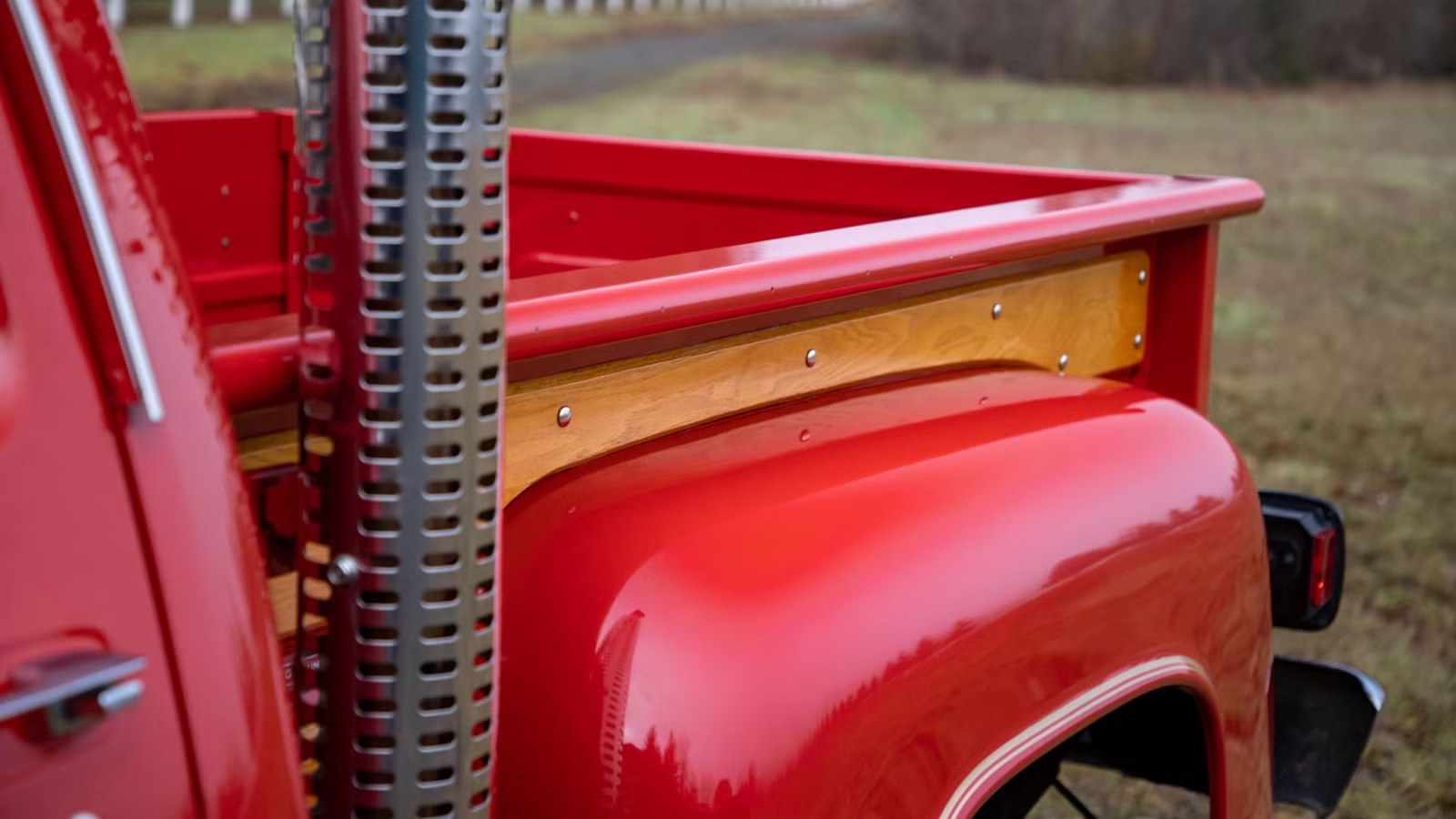
Dodge’s ultimate Adult Toy was the 1978 Li’l Red Express, based on the D150 Utiline stepside pickup. With flared rear fenders, wood inserts, killer graphics on a bright red paint job, and awesome exhaust stacks, this was one of, if not the coolest looking trucks ever built. It wasn’t just an appearance package, either, as the Li’l Red Express came with a police-spec 360 V8 with high-flow heads, heavy-duty valve springs, an 850-cfm Carter Thermo-Quad four-barrel carb, and a low-restriction exhaust system. It also had plenty of chrome, including some killer mag wheels, and was standard with the A-727 3-speed automatic transmission. Producing 225 hp and 295 lb-ft of torque, this was one of the most powerful rides of ’78, and as you’ll soon find out, the most powerful thing on the street that year.
Exploiting the GVWR Loophole

The Li’l Red Express also had a secret weapon that gave it an advantage over every other vehicle in 1978, because it didn’t have a catalytic converter restricting its exhaust. Dodge discovered a loophole in that the EPA didn’t impose emission standards on light-duty trucks with a Gross Vehicle Weight Rating (GVWR) of over 6,000 pounds. The Li’l Red Express didn’t weigh anywhere near that mark, with a curb weight of around 3,600 pounds, but the rule allowed manufacturers to list trucks with their max payload, which for this Dodge muscle truck was 6,100 pounds. Because of this creative approach, the Li’l Red Express had a free-flowing exhaust, and, by the way, those stacks made this truck extremely loud, but more importantly, it didn’t have a catalytic converter slowing it down. The EPA quickly closed this loophole, but for 1978, this truck dominated the competition.
’78’s Fastest Car Was a Truck

A bet on the ‘Vette was always a sure thing, but in 1978 it was a sucker bet. Car and Driver did a road test with all the high-performance cars of the day, including the Pontiac Trans Am, Porsche 924, Ford Thunderbird, Saab Turbo, and, of course, the Chevy Corvette, but also threw the Li’l Red Express into the mix. In a shocker, for the 0-100 MPH test, the Dodge pickup beat them all, hitting that speed in 19.9 seconds. The Corvette, as well as the other contestants, had a decided aerodynamic advantage over the pickup, but they also had catalytic converters holding them back. Some were a bit quicker in 0-60 and had top speeds that exceeded the Li’l Red Express’ 129.5 MPH upper limit, but getting to 100 MPH the fastest belonged to a truck in ’78. In another counterintuitive moment, the C&D test also showed that the Li’l Red Express had the best braking over the sports cars, which were much lighter in most cases.
Early Exit For The Li’l Red Express

Anyone with a set of working eyes can see how thoroughly cool the Li’l Red Express was, but back in the day it was not a widely successful truck. Dodge built 2,188 of these bad boys in 1978 and another 5,118 in 1979 for a grand total of 7,306 units. That was it, because it didn’t return in 1980, making for a small-batch two-year run. It’s a guarantee that if there was more demand, Dodge would have made more, and the production numbers prove it. If this had intended to be a one-off special edition, the numbers would have been rounded off like 2,000 or 5,000, but they’re not, meaning Dodge was hoping this muscle truck was going to catch fire with the public. This editor remembers, as a little kid, seeing a Li’l Red Express on a Dodge dealer lot in 1982, and the reason why that memory still holds is that it was the coolest thing of all time. What that memory also shows is that Dodge had a hard time getting rid of these babies.
The Coolest Thing Nobody Noticed

The Dodge Li’l Red Express is one of the most eye-catching vehicles Detroit ever created, but in a weird kind of way it went largely unnoticed. One of the biggest issues is that, because of its exhaust system with those killer stacks, it couldn’t be sold in California, and we have to imagine they would have moved some serious units in the Golden State. Another problem was the price, with an MSRP of $6,950 for a ’78 and $7,500 for a ’79, which was around $2,500 more than a base D100 pickup truck. The other factor in the Li’l Red Express’ modest sales was that people were still in freak-out mode over fuel economy, and this was not the most pump-friendly ride available. Also, it probably wasn’t the most practical set of wheels, a distinction that was hard to define. It wasn’t the most useful pickup on the market, plus it wasn’t a sports car or muscle car, and a lot of potential buyers weren’t really sure what to make of it.
Collectibility of the Li’l Red Express

The 1978 Dodge Li’l Red Express is the money-mobile as it’s the one that didn’t have a catalytic converter and is rarer, making it the collectors’ choice. That being said, it doesn’t actually take a lot of money to get one. Hagerty rates the value of a ’78 at $16,200 for a beater and just $48,600 for a like-new perfect condition show truck. The top auction seller actually exceeds the Hagerty value with a 9,352-mile beauty (pictured above) that dropped the gavel for $58,300 at Mecum Harrisburg 2024. That’s still not a ton of money, especially for an awesome Corvette-killer, but it’s also way above what most Li’l Red Express trucks sell for. The second highest sale at a Mecum auction for a ’78 is $39,600, and that truck appears to be in exceptional condition, while most good-to-great condition ones go in the mid-$20,000 range. The highest-selling ’78 Li’l Red Express on Bring a Trailer is a seemingly flawless example that only fetched $34,000 in 2026, so this is some rare Mopar muscle collectors can still afford.
Sources: Bring a Trailer, Hagerty, Car and Driver, Mecum, Dodge

Related posts




Latest Post


No Comments