
The Sport Bike That Feels Faster Than The Spec Sheet Suggests
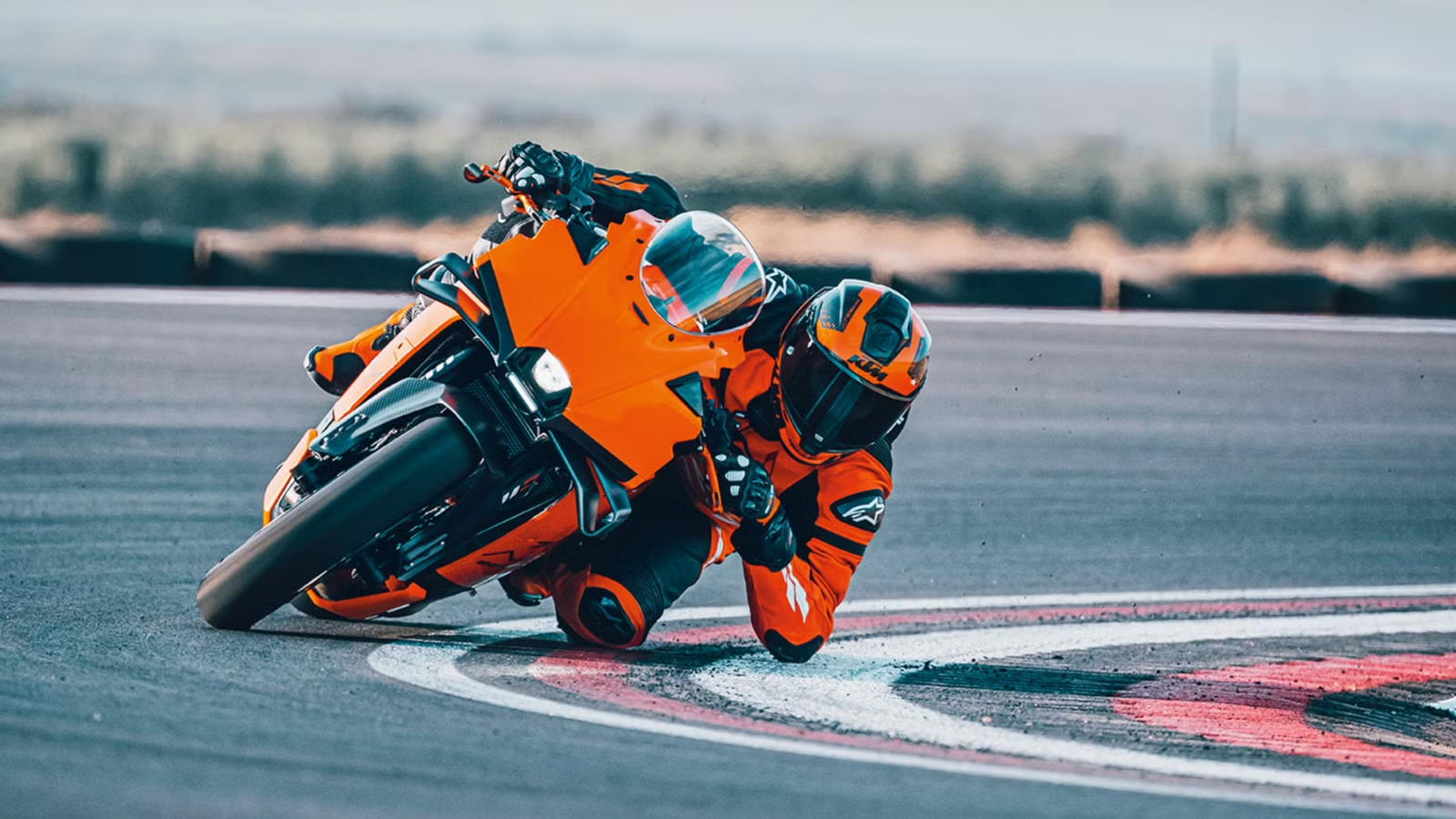
Sportbike marketing often revolves around big numbers. Manufacturers push 200-horsepower claims to grab headlines, but riding those machines on real roads is often frustrating. You spend most of your time managing fear and fighting an aggressive throttle instead of carrying speed through corners. High peak figures look great on paper, but genuine street pace comes from confidence. One European manufacturer ignores this horsepower race entirely. Instead, it focuses on predictable power delivery and transparent rider aids, allowing riders to actually use the performance on tap without fighting the machine.
The Electronic Split In The Middleweight Segment

The middleweight sportbike class suffers from an identity crisis. At the high-performance end, traditional 600 cc supersport motorcycles demand extreme revs to produce power, leaving road riders stranded in a gutless midrange during daily use. Meanwhile, the popular entry-level twins in this class cut costs aggressively with their electronics and hardware.
While bikes like the Yamaha YZF-R7 and Ninja 650 offer accessible road power, they rely on basic, non-lean-sensitive ABS or simple wheel-speed traction control. With a few exceptions like the Aprilia RS 660, the class largely omits multi-axis IMU electronics to keep pricing low. Without pitch or lean sensors, these systems cannot properly account for heavy trail-braking or mid-corner surface changes. Riders are left choosing between peaky, high-strung race replicas and cost-cut road twins with basic safety nets.
MotoGP-Derived Inertial Sensors Unlock Real-World Corner Exit Drive

The solution lies in pairing a torque-dense mid-displacement engine with a six-axis inertial platform. Real-world corner exit speed does not require a screaming top end. It needs immediate torque across the middle of the rev range and sensors that track pitch, roll, and yaw in real time.

This setup lets riders apply the throttle early without unsettling the chassis or fearing a violent break in traction. KTM developed this precise approach through its Moto2 and MotoGP programs. Instead of bolting budget electronics onto a soft chassis, the Austrian brand paired a rigid steel frame with fully adjustable WP suspension and lean-sensitive rider aids. The electronics operate transparently in the background, intervening smoothly to manage slip angles rather than cutting power like an abrupt on-off switch.
The KTM 990 RC R Delivers An Explosive Rush That Belies Modest Paper Output

The KTM 990 RC R is one of those sportbikes that deliver thrills without punishing riders. It shows that usable torque beats paper horsepower every time. Its 947 cc LC8c parallel-twin produces 128 horsepower and 76 pound-feet of torque, delivering drive right in the midrange where road riders actually need it.
A six-axis IMU manages cornering traction control, wheelie mitigation, and engine brake regulation quietly without harsh interventions. Because the chassis offers clear tactile feedback and balanced geometry, riders can push into the powerband right away. It makes 130 horsepower feel far faster and more capable than a two-wheeled missile you are afraid to open up.
Slotting Between Japanese Twins And Italian Exotica Defines The Value Equation

The 990 RC R has a price of $13,949. This puts it firmly at the premium end of the segment and below only exotica like the Panigale V2. This is all right, since KTM is not targeting high volumes right now, and it is packed full of electronics that help justify the price. This is not a mass-market motorcycle, and KTM seems to be okay with it.
The 947cc LC8c Parallel-Twin Prioritizes Instant Mid-RPM Authority

We have always had a distinction between the states of tune of an engine when it powers a naked and a supersport, but when KTM adapted the 990 Duke engine for the 990 RC R, it did not change much, and this is a surprisingly good match for the style of motorcycle. Still, it is the most powerful parallel-twin sportsbike under $15,000, with its 128 horsepower at 9,500 RPM and 76 pound-feet at 6,750 RPM from 947 cc. Like the other parallel-twin LC8c engines, the Duke engine uses a 285-degrees firing order to mimic the 75-degree V-twins of the largest KTMs.
This is an uncommon firing order, but it does offer a lot of torque across the rev range, and that big, almost 2,750 RPM difference between the torque and horsepower peaks proves how flexible this engine is, offering massive shove in the midrange that means you do not have to keep banging up and down the six-speed gearbox. Even if it has an assist and slipper clutch and a quickshifter, you can leave it in a particular gear, let the revs drop a little, and just power out of a corner anyway; this shove is a big factor in making it feel faster than the spec sheet suggests.
Tubular Trellis Rigidity And WP Apex Suspension Anchor Tactile Cornering Grip

The chassis is derived from the 990 Duke, but it is not identical. KTM has increased the steering head angle stiffness and put more weight on the front axle, as is required with sportbikes. From the outside, it still looks like the same steel trellis frame that uses the engine as a stressed member; the subframe and swingarm are made out of die-cast aluminum. WP Apex suspension is available all around, with the front a 43 mm inverted open-cartridge fork that has preload, compression, and rebound adjustment. The rear shock adds low- and high-speed compression adjustment to this.

The brakes are serious kit, with two 320 mm front discs paired with radial Brembo HyPure monobloc four-piston fixed calipers, and a 240 mm rear disc with a single-piston caliper. These are mounted on 17-inch alloy wheels with tubeless radial tires. The serious brakes and fully adjustable suspension complement the chassis well and help it nail the perfect balance of performance and comfort.
Adjustable Clip-Ons And Rearsets Offset A Tall 33.3-Inch Seat Height
KTM usually does not reveal all the dimensions for its products, but it does give out one telling stat: the wheelbase, and the 990 RC R has a wheelbase of 58.3 inches. Another telling stat is its curb weight; fully fueled, it weighs just under 430 pounds, which is incredibly light. The ground clearance is also very impressive at 6.42 inches, but the seat is also relatively high at 33.3 inches. This means that it has agility, which is its strongest asset; not just its large torque figure.
Six-Axis IMU Aids And Functional Downforce Winglets Are Standard

The 990 RC R has a very impressive electronics package that lets it deliver superbike performance without demanding superbike money, and it starts with the 8.8-inch landscape TFT touchscreen display. This is the same sort of aspect ratio that we have seen on the 390 Enduro R first, and it can be controlled via the newly designed backlit switchgear.
There are some very interesting standard features on this motorcycle as well: the winglets you see produce functional downforce, the gear shift lever can be configured into a race bike shift pattern, which is the reverse, directly at the linkage lever, and the clip-on handlebars and footpegs have multiple mounting positions that allow you to make the rider triangle more upright for daily use and a more aggressive posture for track days.
Track And Tech Packages Replace KTM’s Maligned Demo Mode

It has a by-wire throttle and a six-axis IMU, which help it feel better than a liter bike on the street. Standard features include four ride modes, out of which one is a user-configurable custom mode, lean-sensitive traction control, four ABS modes including the Supermoto+ mode, which allows you to back the bike into corners before intervening, and of course, there are add-on packages that have now replaced the much-maligned Demo Mode.
The Track Pack offers adjustability for track days. You get an additional Track ride mode and two extra customizable user ride modes. The traction control unlocks nine levels that can be changed on the fly, there are six total levels of wheelie control including off, there is launch control, and finally, it unlocks the dashboard layout that prioritizes telemetry and a lap timer. It shows live lean angle, throttle position, and lap times.

The Tech Pack is an overarching bundle that includes all the features of the Track Pack. Additionally, you get the two-way quickshifter, Motor Slip Regulation, cruise control, and the adaptive brake light that flashes the brake light during hard or emergency braking. You can also order things like just the quickshifter or cruise control, which is a commendable change from KTM.
The Aprilia RS 660, Yamaha YZF-R7, And Kawasaki Ninja ZX-4RR Also Prove Displacement Isn’t Everything

If you look at the competition in the premium middleweight supersport segment, you will get the usual suspects; instead, let us look at other sportbikes, regardless of displacement, that feel better than the spec sheet suggests. One of them is from Europe as well: the Aprilia RS 660 is another sportbike that feels faster than its numbers suggest. It reads like a typical middleweight parallel-twin motorcycle until you realize that it has a stonking 100 horsepower output and a really low curb weight, thanks to its aluminum chassis and a swingarm that mounts directly to the crankcase. It also has a very impressive electronics suite and is a premium middleweight, with a price of $11,849.

The simpler alternative to something like the KTM or the Aprilia is the $9,399 Yamaha YZF-R7, which keeps winning riders over. It recently got an update that gave it a by-wire throttle, but it has not lost that handy torque from the midrange or the snappy response that makes it so popular. It also has not lost its reliability, which makes it one of the best learning tools; you can thrash it for many miles and it will remain bulletproof.

The $9,999 Kawasaki Ninja ZX-4RR makes bigger engines feel unnecessary. It does not have very impressive specs on paper thanks to its displacement and weight, but if you get that small 400 cc engine spinning near the redline, it will surprise you with the kind of pace a good rider can extract from it. It also has quality suspension, which helps it achieve better lap times than you would expect from a 400 cc supersport.
Source: KTM USA

Related posts

Latest Post


No Comments