
Our 2028 Ford Ranchero Render Makes 800 HP Seem Reasonable
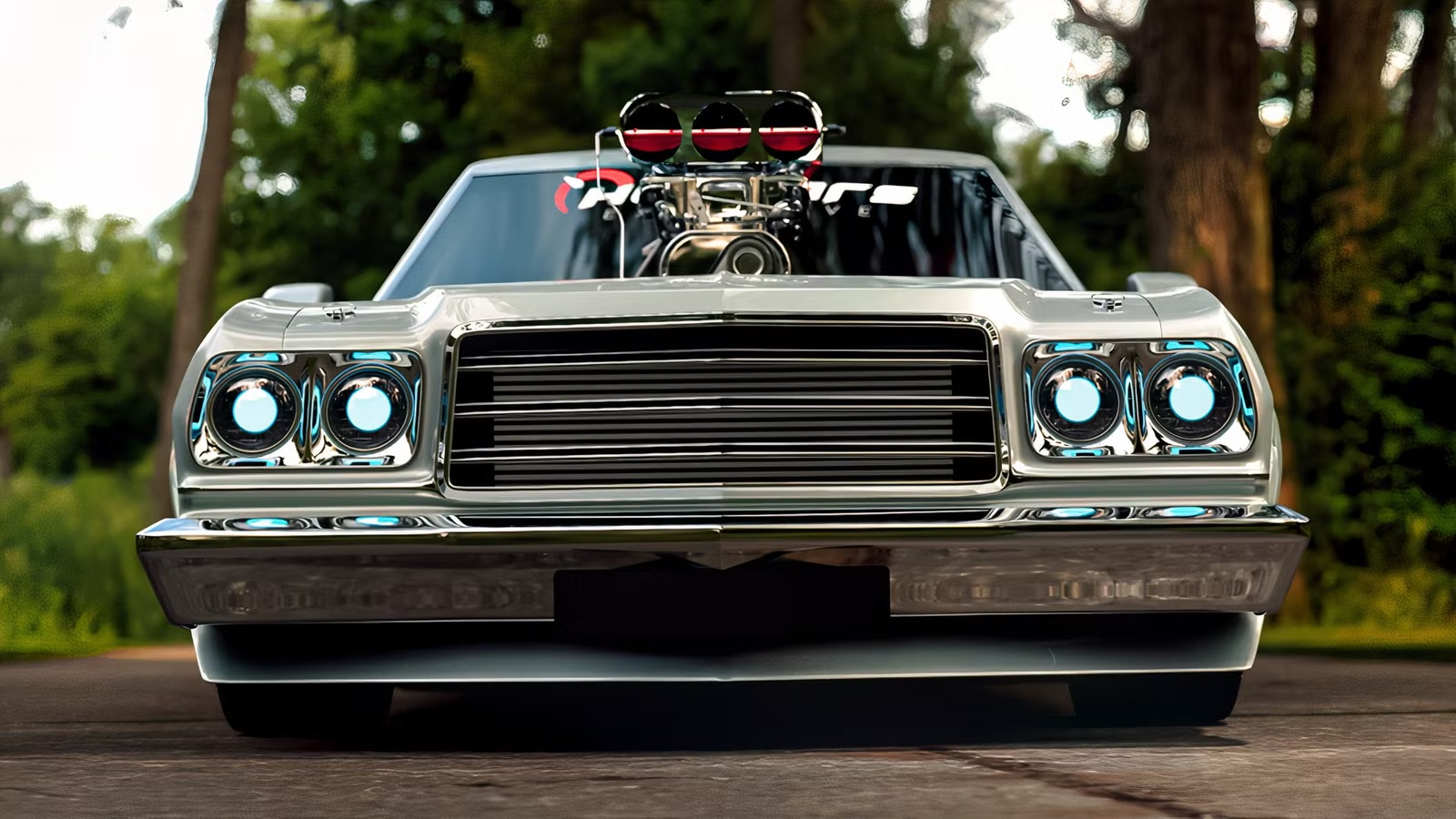
There’s a supercharger sticking out of the hood, the headlights look mildly radioactive, and the pickup bed seems about as likely to carry firewood as a Ferrari. Our rendered 2028 Ford Ranchero restomod has clearly chosen its priorities. Yet the longer you look at this outrageous take on the 1973 Ford Ranchero, the harder it becomes to dismiss the idea. Especially when the 800 hp fantasy has more basis in modern Ford performance than you might expect.
1973 Was The Ford Ranchero’s Moment In The Sun

Ford‘s Ranchero arrived for the 1957 model year, beating Chevrolet‘s El Camino to the American market by two years. Its basic trick was simple: take the driving manners of a passenger car, give it an open cargo bed, and hope buyers appreciated the compromise. Across seven generations, it borrowed foundations from the Falcon, Torino, and LTD II. The 1973 model belonged to the Torino-based sixth generation, making it a cool starting point.
More than 45,000 Rancheros were built for 1973, the nameplate’s highest-volume year. People could select the workmanlike 500, sportier GT, or woodgrain-covered Squire, which offered country-club theater with a tailgate. Under the hood, choices stretched from a 250 inline-six to a 429 V8. Federal bumper requirements had reshaped the nose, while tighter emissions standards and net horsepower ratings made the muscle-car era’s numbers considerably less exciting. The raw ingredients, however, were still unmistakably American.
Our 2028 Ford Ranchero render uses those ingredients without pretending to restore the recipe. It retains the 1973 truck’s long hood, broad grille, two-door cab, and integrated bed, but adds blue-lit quad headlights, polished five-spoke wheels, red accents, and a pavement-scraping stance. Thin vertical taillights finish the job. Some angles are genuinely gorgeous; straight on, the chrome, blue lighting, and giant blower look like three different custom shops were given the same deadline. Somehow, the result still hangs together.

800 HP Sounds Ridiculous Until You Check Ford’s Own Garage
The most outrageous detail is that supercharger rising above the hood, but a modern engine swap needn’t be pure fiction. Ford’s naturally aspirated 5.0-liter Coyote V8 makes 480 horsepower in a modern Mustang GT. More tellingly, the 2026 Mustang Dark Horse SC develops 795 horsepower from a supercharged 5.2-liter V8. That doesn’t make an 800-hp Ranchero an easy build, but it does establish an important point: Ford already knows how to produce that sort of output without consulting a drag-racing wizard.
For this hypothetical 2028 Ford Ranchero restomod, a forged Coyote V8 with a properly matched supercharger could target roughly 800 horsepower. It would need serious fuel delivery, cooling, calibration, and a transmission built for the punishment. A strengthened 10-speed auto makes practical sense for acceleration, although a heavy-duty manual would probably win more arguments at a weekend car meet. Either way, a modern LSD and reinforced driveline would have to join the shopping list before unleashing it.
All About That Theater

Performance would depend less on the headline horsepower figure than on rear-tire grip. With the right suspension geometry, appropriate weight distribution, and drag-focused rubber, a well-developed Ranchero might plausibly reach 60 mph in the three-second range. That’s a theoretical target, but it sounds tasty. Tires, gearing, and launch control would matter as much as engine output. The original 1973 Ranchero wasn’t intended for launches like that, and its body-on-frame underpinnings would need careful reinforcement before becoming a credible modern street machine.
Then there’s the visible blower, which makes perfect sense if the objective is to announce your arrival from the next ZIP code. It makes rather less sense when turning left across traffic. A less theatrical induction setup would improve visibility, engine packaging, and reliability. But it would also remove the image’s best joke: somebody apparently decided 800 horsepower wasn’t attention-grabbing enough unless pedestrians could inspect the intake hardware at eye level.
The Pickup Bed Is Still The Best Part Of The Punchline

Unlike a Ford Mustang restomod, this Ranchero can at least claim the rough outline of utility. Its open bed recalls why buyers considered the original, and gives the design an edge over another low-slung muscle coupe. It also offers a useful visual counterpoint to the modern Ford Maverick, a compact pickup that approaches everyday practicality differently. One exists to move people and their stuff efficiently; our fictional Ranchero seems engineered primarily to move its driver’s eyebrows.
Living with it would require compromises. That extreme ride height threatens driveway clearance, the massive wheels leave little room for suspension travel, and carrying heavy cargo could spoil the handling. Proper brakes, modern steering, chassis bracing, and enough tire clearance would matter far more than the blue headlight accents. Even the tailgate might see little action once the owner realizes a scratched cargo floor could cost more to repair than whatever was being hauled.
One Last Stab

Still, the appeal’s obvious. The 1973 Ford Ranchero was already a peculiar answer to a question most Americans solved by buying either a car or a truck. Our 2028 Ford Ranchero render turns that eccentricity into an advantage, replacing modest emissions-era performance with the prospect of supercharged V8 power. Given that, the old Ranchero deserves one more ridiculous chapter.

Related posts




Latest Post


No Comments