
The Japanese Motorcycle That Refuses To Become Outdated
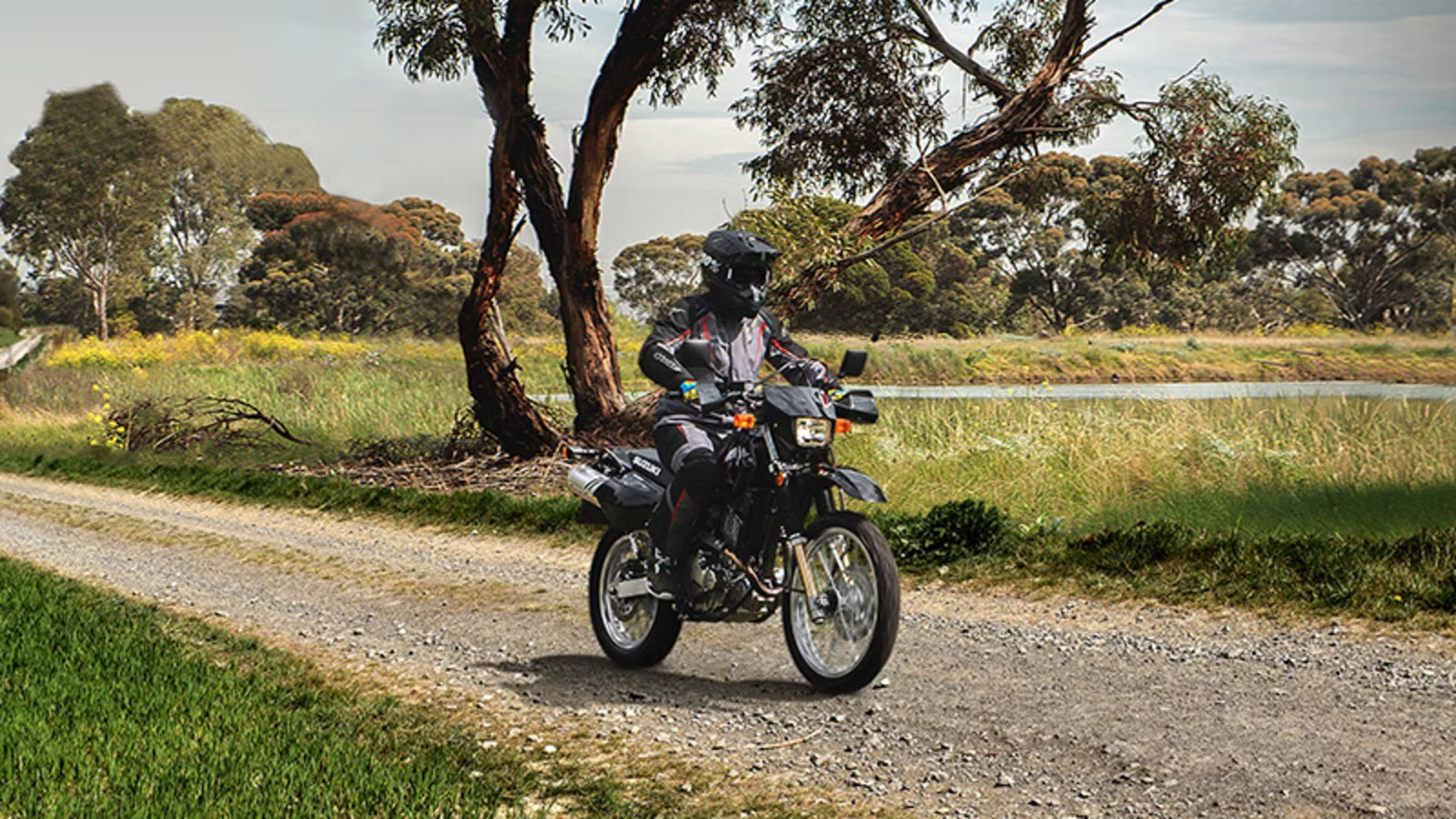
If you ask any motorcycle enthusiast what the common denominator among motorcycles today is, the answer most likely is technology. Be it a 250cc motorcycle or a liter-class superbike, modern motorcycles have almost every conceivable technology, like crisp TFT screens, smartphone connectivity, ride-by-wire, traction control, and even riding modes. However, among these tech-saturated motorcycles, there still remain a handful of two-wheelers that use old-school tech. These motorcycles feel like an anomaly but are revered for their unadulterated, completely analogue riding experience, in a motorcycling world filled with digital intervention and electronic nannies. There are no menus to scroll through, no riding modes to select, and no sensors that can act up in the worst possible scenario. These are glorious, mechanical fossils that feel like a long-lost beacon of pure yesteryear motorcycling before electronics took over. A prime example of this analogue motorcycle culture is Suzuki’s air-cooled dual-sport motorcycle.
Some Motorcycles Don’t Need To Change To Stay Relevant

Progress in the motorcycle world usually means adding more. More power, more electronics, more screens, and increasingly sophisticated rider aids arrive with every new generation. A motorcycle that goes years without a major update can quickly look neglected by comparison. Yet there is a difference between a machine that has simply grown old and one whose original formula remains useful enough that changing it could actually undermine its appeal.
That’s particularly true for motorcycles designed to venture far beyond paved roads. Out in the backcountry, outright performance and sophisticated electronics can matter less than low weight, durability, and the ability to keep moving when civilization is miles away. A simple machine that can be understood and repaired with basic tools has an advantage that doesn’t necessarily show up on a specification sheet.
One Japanese dual-sport has built much of its reputation on precisely that philosophy. Rather than chasing the increasingly complicated adventure motorcycle market, it has remained stubbornly mechanical, rugged, and refreshingly straightforward for decades. That refusal to follow the industry might make it seem outdated on paper, but to generations of riders, it has become one of the DR650’s greatest strengths.

Suzuki’s Ultimate “Bush Tractor”

To understand why the Suzuki DR650S is universally revered, you need to go back in history, to the start. The Suzuki DR series comes from a long line of decades-old rugged trail bikes, but its turning point arrived in 1996. It was the year that Suzuki introduced a completely new DR650 along with the lighter and sportier SE models that remain virtually unchanged to this day. Over the years, Suzuki loyalists coined endearing terms for it — “Bush Pig” or “Bush Tractor” — thanks to the DR650’s penchant for riding through deep sand, thick mud, and even rocky riverbeds without skipping a beat or breaking apart.
|
Specifications |
Suzuki DR650S |
Kawasaki KLR650 |
Honda XR650L |
KTM 690 Enduro R |
Husqvarna 701 Enduro |
|
Engine |
644cc, single-cylinder, air-cooled, and carbureted |
652cc, single cylinder, liquid-cooled, and fuel-injected |
644cc, single-cylinder, air-cooled, and carbureted |
693cc, single-cylinder, liquid-cooled, and fuel-injected |
693cc, single-cylinder, liquid-cooled, and fuel-injected |
|
Weight (pounds) |
366 (curb) |
456 (curb) |
346 (curb) |
357 (curb) |
357 (curb) |
|
Seat height (inches) |
33.2 to 34.8 |
34.3 |
37 |
36.8 |
36.8 |
|
Price |
$7,299 |
$6,999 |
$7,599 |
$13,399 |
$13,399 |
The secret behind the DR650’s legendary durability was its old-school mechanical platform. At the center of it all was a 644cc single-cylinder motor that used Suzuki’s Advanced Cooling System, a technology that used both air cooling and a heavy-duty oil cooler to keep engine temperatures in check. Fueling was handled by a single Mikuni CV carburetor, unlike most of its competitors, which use fuel injection. This low-tech engine platform means there are very few things that could go wrong when you are riding in the middle of nowhere. And if something did go wrong, unlike modern motorcycles that require complex diagnostic software simply to check what error code stalled the bike, a DR650S can be repaired anywhere using simple hand tools.
Besides simplicity, every part of the DR650S feels overengineered for durability. The single overhead cam valvetrain uses simple screw and locknut adjusters, allowing owners to perform valve adjustments in their own backyard using a basic feeler gauge. Other parts, such as the rugged steel frame and a simple suspension setup consisting of telescopic forks and a monoshock, have proved their durability over time and feel built to take long-term abuse. The Suzuki DR650 feels like an indestructible mechanical mule that prioritizes reliability and durability over heady horsepower numbers.
Bucking The Modern Adventure Bike Trend

Modern middleweight adventure motorcycles have evolved into tech-heavy, high-horsepower motorcycles. Compare those to the spartan spec sheet of the Suzuki DR650S and its intent and focus become clear. While most 650cc adventure motorcycles like the KTM 690 Enduro R and Husqvarna 701 Enduro come loaded with massive fairings and a large electronic suite consisting of cornering ABS, cornering traction control, rider modes, and other electronic aids, the DR650S is devoid of all of it, even ABS. This makes a world of difference when you are exploring the backcountry.
When you are doing a solo hardcore trail ride, weight can be your biggest enemy, and here’s where the DR650S shines. The lack of the aforementioned electronic safety net means the DR650S tips the scales at just 366 pounds, making it far easier to wrestle through a tight, dense trail, or drag out of a sand bog, than a 500-pound twin-cylinder adventure tourer. Even if you drop your DR650S in the middle of a remote dry riverbed, you should be able to pick it up yourself without straining your back.
Beyond weight, Suzuki has another trick up its sleeve to make the DR650S accessible to most riders. Seat height is another intimidating factor for riders, especially while riding off-road. To counter that, the DR650S gets factory-built-in seat adjustability. By lowering the front fork internals and using the alternative mounting points on the rear shock absorber link, riders can reduce the DR650’s seat height from 34.8 inches to 33.2 inches.
It is precisely this adaptability that makes the Suzuki DR650S more accessible than other old-school Japanese dual-sport options, such as the top-heavy, and liquid-cooled, road-biased Kawasaki KLR650, and the tall, dirt-focused Honda XR650L. The DR650 offers a fantastic middle ground between the two. It is more nimble than the KLR650 when riding off-road, yet it is far more comfortable and composed on highway rides than the XR650L.
A Cult Icon That Outlives Its Critics

For the past three decades, critics have harped about air-cooled and carbureted singles being obsolete tech, yet even today, the Suzuki DR650S is hailed by motoring journalists and adventure riders alike. Automotive enthusiasts who appreciate the classic air-cooled wail of old Porsche 911s find an identical charm in the mechanical, heat-beating nature of the DR650.
A reason for the worldwide love is the DR platform’s phenomenal real world reliability. There have been many globe-trotting expedition riders who have covered over 100,000 miles on the DR650S without ever opening the engine, and that includes crossing remote deserts, traversing South America’s huge mountain passes, and crossing continents entirely on their own. Another highlight is the easily available and dirt cheap parts thanks to the DR650 remaining virtually unchanged since 1996.
This long shelf life has also spawned a huge aftermarket ecosystem. DR650 owners can transform their motorcycles into anything they want. If they want long-range touring, they can opt for massive Safari fuel tanks that push their range to well over 300 miles. If they are looking for improved throttle response, the answer is Mikuni flat-slide pumper carburetors. From premium suspension to heavy-duty skid plates, custom seats, and rugged luggage solutions, the DR650 is a blank canvas that can be tailored into a bulletproof continent cruiser.
Suzuki’s Unkillable Philosophy
The rationale behind Suzuki still selling a decades-old motorcycle that uses 1990s technology in today’s digital world might seem baffling at first, but the deeper you dive into it, the clearer the answer is. First is the pragmatic commercial reason. Decades of continuous production means Suzuki has covered the R&D, engineering, and tooling costs for the DR650S. This means there are almost zero overhead costs for the DR platform. This allows Suzuki to sell a brand new, full-sized dual sport motorcycle at a price point that undercuts almost every modern competition.
Then there is demand. There remains a massive base of riders that crave mechanical simplicity. These motorcyclists shun digital screens, delicate sensors, and electronics that can stop them in their tracks, with just a small splash. They want a machine they can understand and repair themselves with tools carried in their backpack.
This old-school approach aligns with Suzuki’s global philosophy of keeping classic mechanical motorcycles in production for decades, as long as there is demand for them. We can see the same engineering philosophy in Suzuki’s smaller DR-Z400S and DR-Z400SM, which dominated the lightweight dual-sport and supermoto categories for over two decades thanks to their simple, reliable mechanical build. Similarly, the Suzuki SV650 V-twin is another long-running model that has built a cult following thanks to its sweet handling, accessible, and simple mechanical formula, in the face of complex modern competitors.
The Suzuki DR650S does not impress riders with heady specs or high-tech hardware. It is still relevant simply because it focuses on one thing better than most: delivering an undiluted, unbridled motorcycling experience with the solid safety net that comes with simplicity.

Related posts



Latest Post


No Comments