
Norton’s Wankel Superbike Cost More Than The RC30 For About 94 HP
Some bikes find performance by searching for marginal gains in what everyone else is doing. By tinkering and toiling away to eke out the fractions of a percentage left, they become engineering marvels for their focus on the minute details. Others take an entirely different approach, eschewing the conventional and taking a radical new path to the same destination. This bike did just that, but not necessarily to success.
The Golden Age Of Japanese Superbikes Left Little Room For Experimentation

The late 1980s and early 1990s were the golden age of superbikes, as Japanese manufacturers took racetrack technology to the streets. Helped by the launch of the Superbike World Championship in 1988 and its homologation requirements, bikes like the Honda RC30 and Yamaha OW01 combined race-derived technology with premium price tags and the other adjustments required to tame a snarling competition machine enough to let it loose on the street.
But to succeed in the industry required more than just impressive engineering. With each new model the bar was raised, flagships became more sophisticated, and buyers expected more. Japanese manufacturers had the resources to refine their offerings and build reputations for reliability, making life harder for European rivals trying to challenge their dominance. Standing out was easy; being enticing enough to convince buyers to pick something unconventional was the tough part.
British Rotary Racing Proved The Unconventional Could Beat The Best


The prototypical superbike formula was fairly simple: four cylinders, a fairing, and an impressive stat sheet. Japanese manufacturers had turned it into an art. Norton, however, was pursuing something entirely different: a rotary engine.
Norton had used rotaries in its bikes before, both in sporting applications and on the road with the Norton Interpol 2 (a rotary-engined British police and fleet bike). But while the road bike was a limited success, it was on the track that Norton really wanted the rotary to work.
British engineer Brian Crighton had played a crucial role in Norton’s rotary racing program. Introducing innovations like a venturi exhaust ejector and helping to bring Norton championship success, Crighton proved that the considerable heat output of a rotary could be managed and used to success. But while proving it on track was one thing, translating that into a dependable, affordable road bike was another thing entirely.
The Norton F1 Turned Rotary Racing Ambition Into An Expensive Road Bike

With a British Formula One Championship courtesy of the rotary-powered RCW588 under its belt already, Norton brought the powertrain to the road in 1990 with the F1. Far from being a gimmick intended to capture headlines and potential sales, or a return to Norton’s F1-engine-powered bike, though, the distinctive superbike promised something genuinely different in a world dominated by four cylinders. Unfortunately, “different” doesn’t always mean “better.” Let’s start with the positives, though.
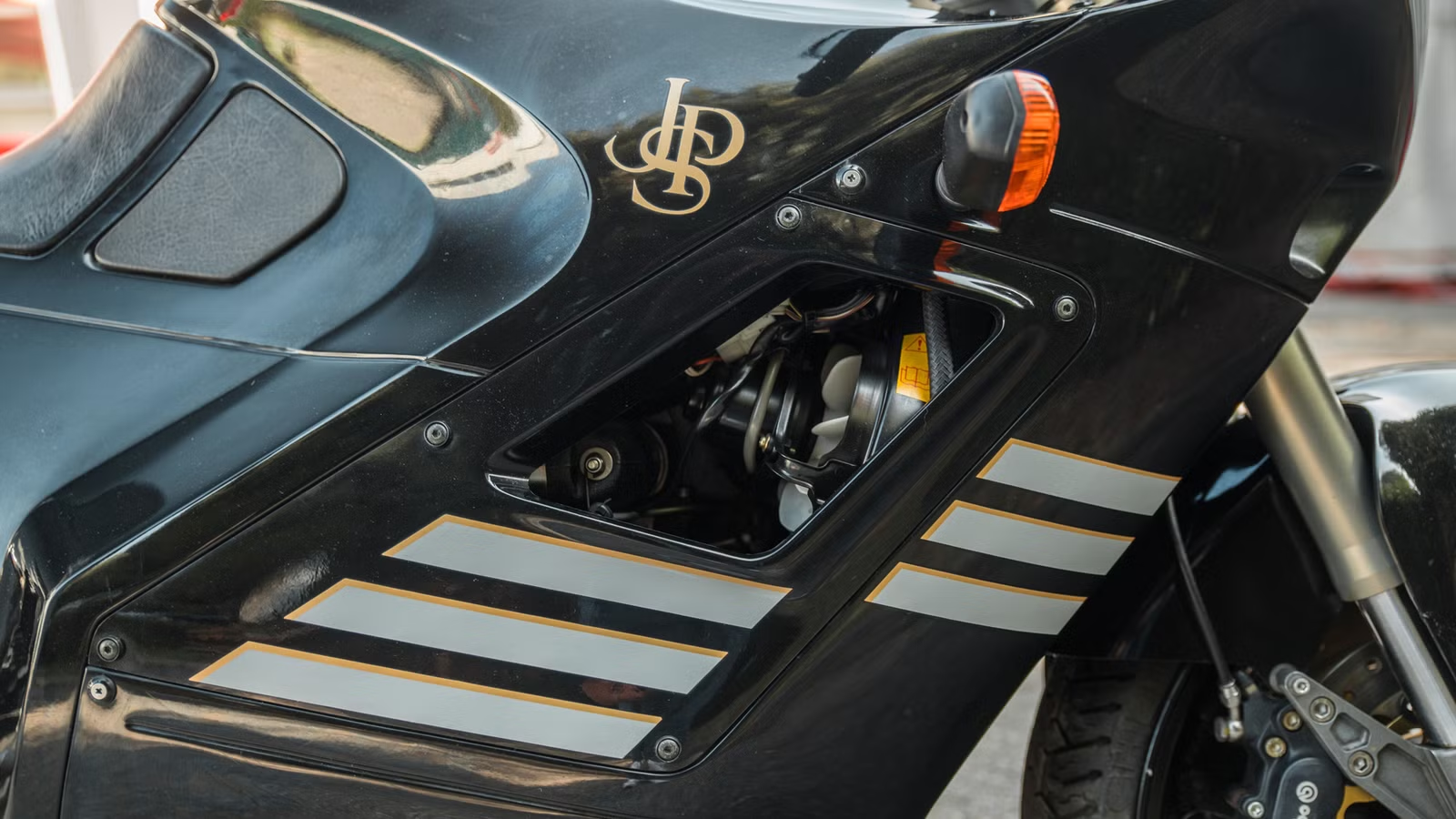
The F1 had a 588cc, water-cooled, twin-rotor Wankel engine that made 94 HP at 9,500 RPM and produced around 60 lb-ft of torque. It also had a rather fetching John Player Special livery, with the iconic black and gold color scheme tying it to the factory racers. Okay, positives sorted. Onto the negatives.
To start, the F1 was not cheap. At £12,700 in 1990 (roughly $20,800), the F1 was considerably more expensive than the RC30 (roughly $17,400), though slightly cheaper than the OW01 (around $22,500). But the two Japanese bikes were proven WSBK race winners, the RC30 even taking the first two championships. The F1 needed something other than a different engine to validate its position among the most exciting homologation specials of its time. That wasn’t going to be power, though.

With 94 HP at 9,500 RPM, the F1 was considerably less powerful than the RC30 and OW01, both of which made around 120 HP. Top speed was also slightly down, with around 145 MPH compared to 153 MPH for the RC30 and 160 MPH for the OW01. Dry weights were similar, all coming in around the 400 lb mark. But a power deficit wasn’t the only thing that the F1 had to contend with, as heat was a considerable challenge.
Rotaries can naturally create more heat than cylinder-based engines, and the F1’s enclosed bodywork ensured that this heat stayed within the bike itself. Crighton’s venturi exhaust ejector cooling system had helped Norton’s race bikes, but road riding puts a different type of strain on a bike. As such, the engine reportedly consumed a liter of oil every 1,000 miles.
As Norton faced issues both with the bike and with cashflow in general, only around 140 examples were made between 1990 and 1992, with approximately 70 F1 Sport models coming afterward. Norton did continue with the rotary engine as part of its racing program, winning the 1992 Senior Isle of Man TT with Steve Hislop and the 1994 British Superbike Championship with Ian Simpson, but its road-going rotary was abandoned, never to return.
Why Racing Pedigree Wasn’t Enough To Make The F1 A Superbike Success

The Norton F1 had an incredibly difficult job from the outset: it had to convince buyers that its unconventional engineering was deserving of a place alongside genuine winners from the world stage. The RC30 had championship success, while the OW01 was a direct connection to Yamaha’s factory racing team. Both offered riders Grand Prix machinery for the road.
The F1, meanwhile, was a different proposition. Sure, its engine set it apart, but it made it a very conscious choice that riders had to make. For more money than an RC30, they could have something that had less power, went slower, and came with a very different set of issues to what they’d be used to. Its limited production gave it an air of exclusivity, even compared to the homologation specials of its day, but the F1 ultimately went down as a bike that had genuine ambition, but which struggled to turn that into widespread appeal.
The Norton F1’s Legacy Is Bigger Than Its Road-Bike Shortcomings

Today, the F1 is arguably revered for what it represents more than what was on its spec sheet. Its rarity means that remaining bikes are serious collectibles, with one 28,000-mile example going under the hammer in November 2026 expected to sell for over $30,000. Its legacy is also inseparable from its Isle of Man and domestic victories, both being evidence that, in the right circumstances, the rotary can still hold its own against four-pots. But while it might have been outpaced by its Japanese counterparts, the F1 remains a fascinating example of how the unconventional can still leave a lasting mark, even when commercial success eludes it.
Sources: Crighton Motorcycles, Bennetts, Motorcyclist, Iconic Auctioneers

Related posts



Latest Post


No Comments