
How A Dealer Turned An Entry-Level Chevy Into One Of Today’s Most Valuable Muscle Cars
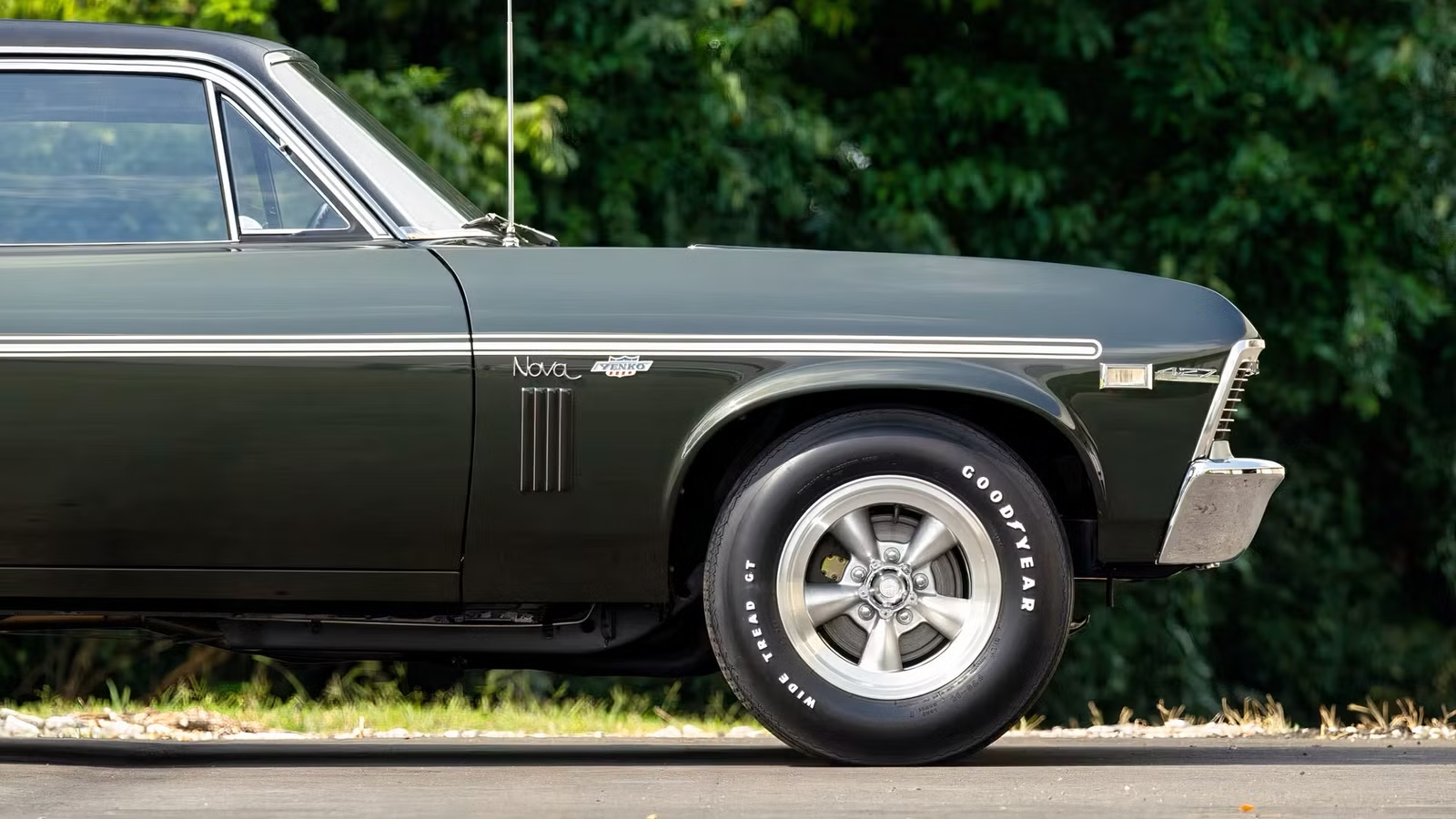
In 1969, the cheapest Nova on a Chevrolet lot started at $2,237. On January 17, 2026, one wearing Don Yenko’s stripes sold for $852,500 at Mecum’s Kissimmee auction, roughly 380 times that figure. The difference comes down to a 427-cubic-inch V8 that Chevrolet refused to install, and a Pennsylvania dealer who decided to do it himself.
The Nova Was Chevy’s Sensible Shoe

The 1969 Nova was the Chevrolet you bought when the budget said no to a Camaro. Most of the roughly 251,900 built that year were six-cylinder commuters, and the base four-cylinder car made a modest 90 gross hp. Check the right boxes on the order sheet, though, and the same plain body could leave the factory with a 396-cubic-inch big-block rated at up to 375 gross hp. About 17,600 buyers ordered a Nova SS in 1969, so even the fast Novas were a minority.

That hidden talent caught the eye of Don Yenko. He ran Yenko Chevrolet in Canonsburg, Pennsylvania, and had raced Corvettes long before he started building his own performance Chevys. His shop had already been swapping 427s into Camaros, and for 1969 he could order Camaros with the L72 427 already installed through Chevrolet’s Central Office Production Order system. COPO was meant for fleet and special orders, and Yenko treated it like a side door into the engine catalog.
A compact Nova with that same big-block was the obvious next move. It was cheaper than a Camaro, it looked about as threatening as a dentist’s commuter car, and it had a 396-ready chassis underneath. Yenko had already turned the humble Corvair into his Stinger race car, so making an economy Chevy fast was familiar territory. All Yenko needed was for Chevrolet to say yes.

Chevrolet Said No, So Yenko Did It Himself

Chevrolet didn’t say yes. The company was willing to build 427 Camaros and Chevelles through COPO, but it drew the line at putting the L72 in its compact, and product liability is the usual explanation. Yenko himself later called the finished car”barely legal at best,” which tells you plenty about what he built anyway.
His shop did it the hard way, buying Nova SS 396 cars, pulling the factory big-block and dropping in an L72 427 with 11.0:1 compression and solid lifters. Chevrolet rated that engine at 425 gross hp and 460 lb-ft of torque, while Yenko’s advertising called it 450 hp. That number wasn’t pulled from thin air. Chevrolet itself had quoted 450 hp for the L72 in early 1966 Corvettes before trimming it to 425, so Yenko simply went with the bigger figure.
The rest of the package backed the engine up. Each car ran an M21 close-ratio four-speed, a 12-bolt rear with 4.10 Positraction gearing, and heavy-duty suspension, plus Yenko stripes and badges so nobody mistook it for a parts-runner. Under the paint, though, it was still a modest compact. It didn’t need extravagant styling to make its intentions clear, and that was the whole joke at a stoplight.
Built By The Dozen, Survived In Single Digits

Nobody agrees on the exact production count, which is fitting for a car that was assembled outside the factory paperwork. Registry figures usually say 37, while valuation records list 38. Either way, Chevrolet built about 251,900 Novas in 1969, so a genuine Yenko works out to roughly one in every 6,800.
The survival rate is worse. Fewer than ten are thought to exist today, and some counts put the known cars as low as seven. Big-block power, skinny tires and young owners were never a recipe for long life, and plenty of these cars spent their best years at the drag strip. That rarity makes Yenko one of the most cloned names in muscle cars. An ordinary Nova with a 427 and a set of decals is not a Yenko, no matter how good the stripes look. Real cars rely on documentation tracing them back to Yenko Chevrolet, which is why provenance matters as much as the engine when one crosses an auction block.
How A $2,237 Starting Point Became $852,500

The Kissimmee car has the kind of history collectors chase. It was finished in Fathom Green, sold new at Yenko Chevrolet and campaigned at Pennsylvania drag strips under the name “My Piggy Bank,” before a full restoration brought it back. Given where the bidding ended up, the nickname aged remarkably well.
At $852,500, it set a record auction price for a Yenko Nova. It also highlights an odd twist in the Yenko story. The supporting act now out-values the headliner. To be fair, nobody drove a Yenko home for $2,237. Yenko started with SS 396 Novas rather than four-cylinder strippers, and his cars cost far more than the base model. They still shared the basic body and compact-car platform of Chevrolet’s entry level Nova.
Chevrolet said no to the 427 Nova, and that refusal is exactly why there are so few of them. Had it gone through COPO like the Camaro, there would almost certainly have been hundreds, and the auction results would look very different. More than half a century later, that rarity helped one documented example sell for $852,500. The most valuable version of the 1969 Nova was the one Chevrolet wouldn’t offer from the factory.
Sources: Classic.com, Mecum, Hagerty

Related posts


Latest Post


No Comments