
The Honda Prelude’s Return Is Splitting The JDM Community—And The Argument Is Worth Having
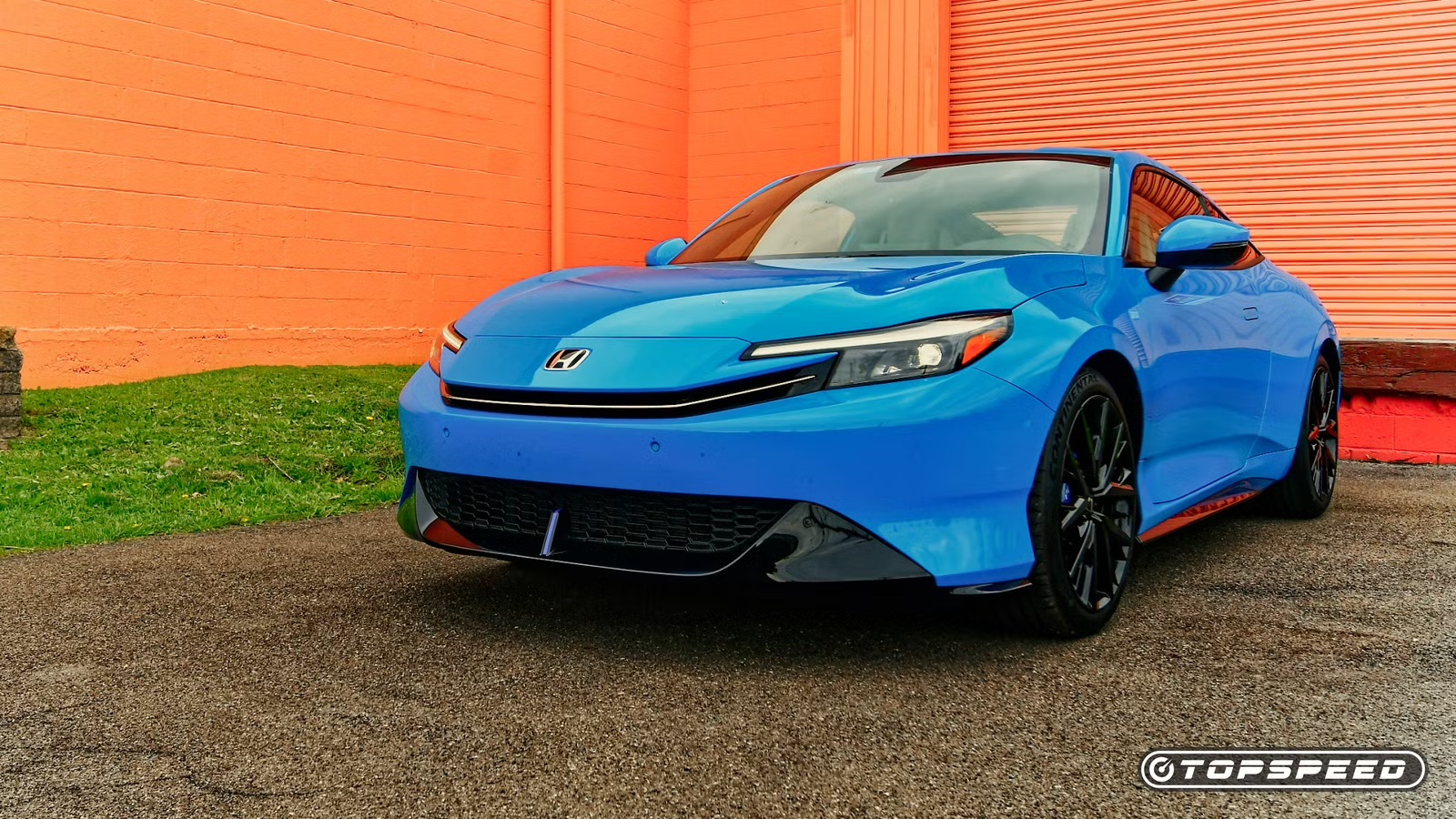
The 2026 Honda Prelude is back after a 25-year absence, and the reaction from the JDM community has been anything but unified. Road & Track called it an oddity in a crossover-dominated world. The Drive spent weeks with it and found genuine affection from everyday drivers. And somewhere in between those two reads, a real argument has broken out among Honda loyalists about what the Prelude name actually stands for—and whether this new hybrid coupe deserves to carry it.

The tension isn’t trivial. The Prelude had a specific identity: a front-wheel-drive sport coupe that Honda used to push the engineering envelope, generation after generation. The fifth-gen car’s Active Torque Transfer System—ATTS—was a mechanical torque-vectoring setup that felt genuinely exotic for a production Honda. VTEC engines across the lineup delivered rev-happy power that rewarded drivers who knew how to use them. That’s the car people are measuring the 2026 model against. And a hybrid powertrain, however sophisticated, isn’t what the purists had in mind.
What The Original Prelude Actually Was

Five generations ran from 1978 through 2001, and the Prelude spent most of that time as Honda’s driver-focused halo coupe—the car that sat above the Civic and Accord in terms of sporting intent. The third generation introduced four-wheel steering. The fourth brought the H22A VTEC engine, which made around 190 to 200 horsepower depending on market, in a car that weighed under 2,800 pounds. The fifth and final generation added ATTS on the Type SH trim, a system that used a planetary gear set to actively shift torque between the front wheels mid-corner—a trick that most manufacturers still haven’t matched mechanically.


None of that was cheap to engineer. None of it made mass-market sense. That was the point. The Prelude existed to prove Honda could build a driver’s car that didn’t need rear-wheel drive or a big engine to feel alive. When Honda discontinued it in 2001, the official reason was slow sales. The real reason, most enthusiasts would tell you, was that the market had moved on and Honda wasn’t willing to keep subsidizing a niche coupe.
The Purist Case: This Isn’t A Prelude; It’s A Badge

The skeptics aren’t wrong on the facts. The 2026 Prelude is built on Honda’s hybrid platform—the same e:HEV architecture underpinning the Accord Hybrid and CR-V Hybrid. There is no VTEC engine in the traditional sense, no mechanical torque-vectoring system, and no manual transmission option. For a generation of Honda fans who grew up chasing VTEC crossover points and reading dyno sheets, that’s a hard sell.

The deeper complaint is about nameplate integrity. Bringing back “Prelude” on a hybrid coupe that shares its bones with a family sedan feels, to some, like Honda is borrowing nostalgia it hasn’t earned. The argument goes, if you want to sell a hybrid coupe, sell a hybrid coupe. Don’t attach a name that carries 25 years of specific engineering expectations and then deliver something fundamentally different. That’s not a tribute — it’s marketing.
The Pragmatist Case: A Hybrid Prelude Is The Only Prelude That Could Exist

The counter-argument is harder to dismiss than the purists would like. Honda isn’t going to build a naturally aspirated, VTEC-powered, ATTS-equipped sport coupe in 2026. The regulatory environment, the development costs, and the sales volumes simply don’t support it. If the choice is between a hybrid Prelude and no Prelude at all, the pragmatists will take the hybrid every time.
More importantly, the new car isn’t a cynical rebadge. Honda’s e:HEV system is genuinely responsive—the electric motors deliver instant torque in a way that changes how the car feels off the line and through corners. Road & Track noted that an affordable coupe is a strange thing in 2026, which is precisely the point: Honda is still making the coupe when almost no one else will. The Drive’s extended time with the car found that real-world drivers—not forum commenters—responded to it warmly. That’s not nothing. The original Prelude was also, at its core, a car that regular people could buy and enjoy. The spirit of accessibility and driver engagement might be more intact than the purists are willing to admit.
What ‘Honoring A Nameplate’ Actually Requires

This is where the debate gets genuinely interesting. Nameplate revivals always carry an implicit promise, but nobody agrees on what that promise covers. Does “Prelude” mean VTEC specifically, or does it mean Honda’s commitment to building a coupe that prioritizes the driver? Does it mean mechanical torque-vectoring, or does it mean a car that handles better than it has any right to at its price point?

The honest answer is that the 2026 Prelude honors some of that legacy and abandons other parts. It keeps the coupe body, the driver-focused positioning, and Honda’s willingness to build something the market doesn’t strictly demand. It drops the high-revving engine character and the mechanical complexity that made the fifth-gen car feel special. Whether that trade-off constitutes a betrayal or an evolution depends entirely on which parts of the original you valued most—and that’s a question worth arguing about rather than one with a clean answer.
The JDM community’s split over the 2026 Prelude isn’t really about one car. It’s about what enthusiasts are owed when a nameplate comes back, and whether nostalgia is a debt Honda has to repay on the original’s terms. Both camps have a point. The purists are right that something specific was lost. The pragmatists are right that something specific was saved. The Prelude is back—just not entirely the one anyone remembers.
Sources: The Drive, Road & Track

Related posts


Latest Post


No Comments