
The Inline-Six Touring Motor That Pulls Hard From 1,500 RPM
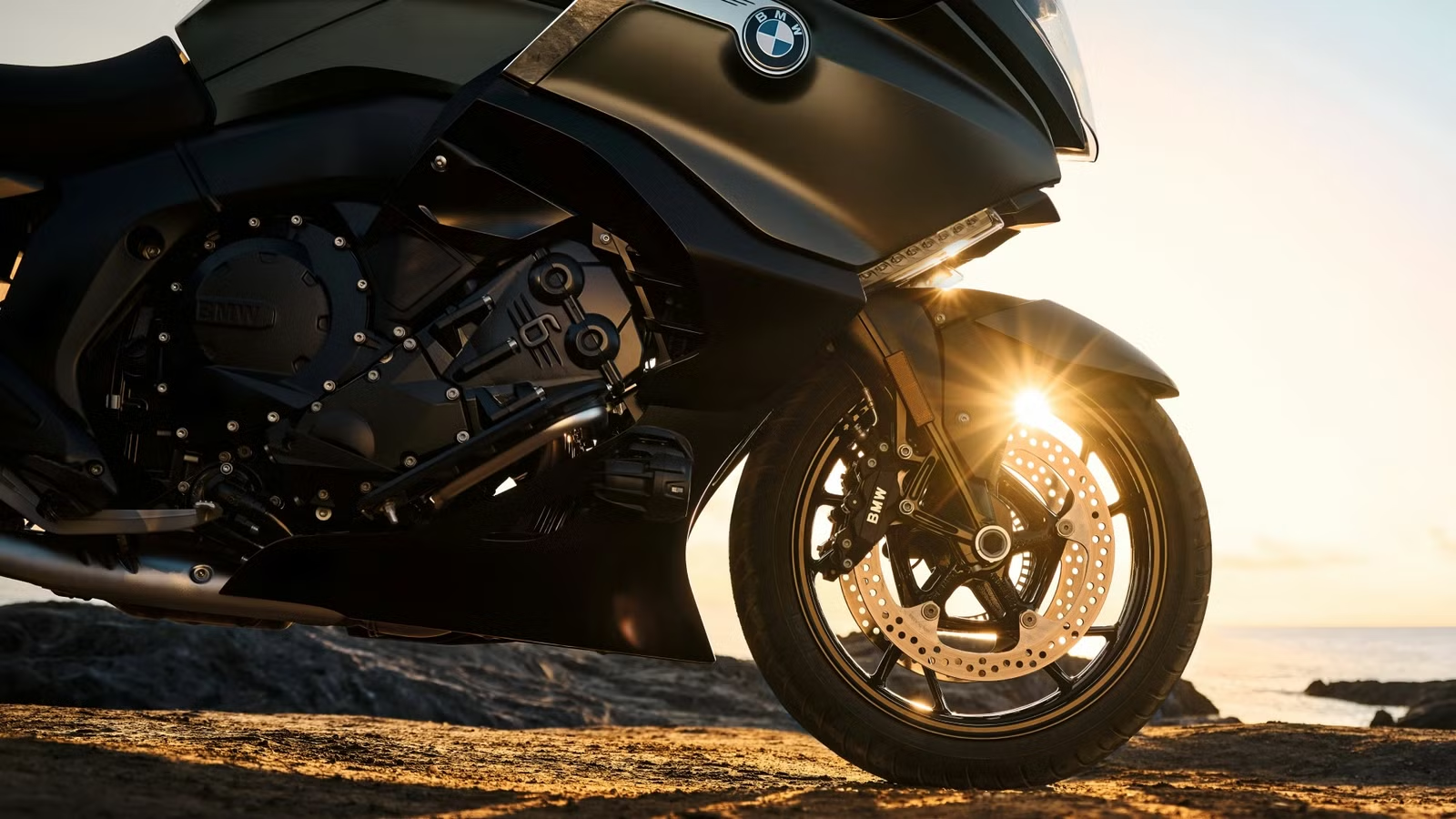
While six-cylinder motorcycle engines are rare today, they have a rich and varied history. From screaming six-cylinder race bikes to luxury tourers, manufacturers have used and experimented with them across many motorcycle styles. Six-cylinder engines are special because their construction offers perfect mechanical balance and delivers exceptionally smooth power without added effort or extra parts.

The only downside is size, as packing six cylinders onto a slim two-wheeler platform makes the build quite hefty. But it can be masked to an extent on a touring bike. BMW does just that with its fabled K 1600 lineup. Furthermore, clever engineering decisions have also helped BMW create the most compact flagship-grade inline-six mill in the world. Here we delve deeper into this engine’s mechanical secrets and what makes it so special.
Six-Cylinder Motorcycle Engines Are A Rare Breed
The earliest six-cylinder motorcycle engine to cause quite a stir was the Honda RC166 racebike. This 1966 motorcycle is a hand-built masterpiece; its engine was a puny 250 cc, but it revved beyond 18,000 RPM, producing a distinct jet-turbine shriek and roughly 60 horsepower. The major advantage of this six-cylinder engine is its reduced reciprocating mass, which helps it beat two-stroke rivals with ease. Then, after a hiatus, came the superbike era, when Japanese and European manufacturers experimented with powerful inline-six motorcycle engines.

The 1974 Benelli 750 Sei was the world’s first production six-cylinder motorcycle engine. Its engine wasbased on the Honda CB500 with two cylinders grafted onto either end. This Benelli produced 76 horsepower at 8,000 RPM and had a top speed of 127 mph. Perks over inline-four counterparts included amazing smoothness and a blood-curdling exhaust note from six individual headers and mufflers. A later 900 cc engine was introduced in 1979, but it was short-lived.
Japanese motorcycle makers soon joined the six-cylinder trend with the 1978 Honda CBX1000 and the 1979 Kawasaki Z1300. The former has gained popularity over the years thanks to its timeless UJM design. Its 1,047 cc air-cooled mill produced 105 horsepower at 9,000 RPM and 52.27 pound-feet of torque at 6,500 RPM.

The Z1300 was Kawasaki’s answer to Honda’s CBX1000. The Kawa packed a superior engine: a water-cooled six-cylinder engine producing 120–130 horsepower and 85 pound-feet of torque. Liquid cooling and fuel injection gave it superior refinement and instant performance. The performance delivery was smooth, and the exhaust note was enticing.
But motorcycle makers soon understood that the inline-six layout was a tough choice for sportiness and nimble riding appeal. The layout added unnecessary weight and packaging challenges to an otherwise lightweight, slim profile. That is where the touring angle came into play, and Honda proved its worth.
Honda Went Flat-Six for Balance — BMW Went Inline And Had To Solve A Harder Problem

Honda updated its Gold Wing touring bike with a six-cylinder engine. However, Honda opted for a flat-six layout, which made more sense and helped improve the center of gravity and weight distribution. The gamble paid off, as the current-gen Honda Gold Wing still features the unique flat-six layout, contributing significantly to its surprisingly versatile character.

BMW stands out by packing the only inline-six-cylinder production motorcycle engine. It overcomes the shortcomings of a transverse six-cylinder mill with clever engineering features to make it as compact as technically possible. But packing an inline-six into a motorcycle frame that doesn’t ride like a freight train required BMW engineers to solve a packaging problem nobody had cracked before — and the solution is more radical than it looks.
How BMW Engineered The World’s Most Compact Inline-Six Into A Motorcycle That Actually Handles

BMW introduced its first-ever inline-six motorcycle engine in July 2010 as part of the Concept 6 study, before putting it into production on the 2011 BMW K 1600 GT and GTL models. All inline-six motorcycle engines before this were riddled with chassis geometry, weight distribution, and center-of-gravity issues because of their large dimensions.
BMW wanted to eliminate these issues while retaining the benefits of an inline-six on a motorcycle. BMW achieved this with flying colors with the 1,649 cc inline-six engine on the K 1600 GT and GTL models before expanding the platform to more luxury-oriented touring bikes.
This 1,649cc Six-Cylinder Is Barely Wider Than A Liter-Class Inline-Four

BMW is credited with creating the lightest and most compact serial production inline-six engine on a motorcycle. The 1,649 cc engine is about 100 mm narrower than most previous series-production inline-six engines used on motorcycles. BMW achieved its compact dimensions and reduced width by opting for a 72 mm bore and a 67.5 mm stroke, along with a very small cylinder center distance of just 77 mm.

This leaves just 5 mm between the cylinder sleeves. The whole engine weighs just 226.19 pounds, including the throttle valve, intake system, gearbox, and alternator. The weight and dimensions of BMW’s six-cylinder engine are actually closer to those of a liter-class inline-four engine.
To achieve its space-saving construction, BMW made several clever engineering modifications. It shifted the electrical ancillary units and their drive unit behind the crankshaft into the free space above the gearbox. This also helped create a drivetrain that concentrated most of its mass at the motorcycle’s center.

The total width of this engine is 560 mm, which is only slightly wider than a current-generation liter-class inline-four engine. Furthermore, because an inline-six layout naturally provides perfect mass balance, BMW didn’t have to add a compensation shaft and the required drive elements. This reduces weight and improves smoothness.
Helping with a lower center of gravity is a cylinder axis that is tilted forward by 55 degrees. This helps create a more balanced weight distribution of 52 to 48 percent front to rear. The engine tilt further creates space for an aerodynamically optimized intake system that sits directly above the engine.
Smooth And Early Surge Of Performance

The first-gen inline-six engine, introduced in 2011, is already quite a marvel, producing 160 horsepower at 7,750 RPM and 129 pound-feet of torque at 5,250 RPM. More than 70 percent of peak torque is available from as low as 2,000 RPM. This early surge of torque and linear power delivery comes from low-friction, lightweight components, a narrow design that keeps the intake runners short and direct, and a suite of electronic features that help it run smoothly and responsively.
Notable technology features include ride-by-wire and an advanced digital engine control unit that optimizes combustion efficiency to deliver performance without compromising fuel economy. Furthermore, despite its high compression ratio of 12.2:1, the BMW six-cylinder engine is well tamed thanks to an optimized four-valve-per-cylinder setup that ensures high thermal efficiency and strong cylinder pressure right off idle. BMW refined it further with its EU-5 revision in 2022, which bumped the torque rating to 132.7 pound-feet at 5,250 RPM and delivers most of the peak torque lower in the rev band, from just 1,500 RPM.
Why Riders Can Cruise All Day At 3,000 RPM Without Fatigue Or Vibration

BMW’s 1,649 cc six-cylinder engine is a touring masterpiece because it combines turbine-like smoothness with massive, effortless pulling power. The engine’s naturally balanced design produces virtually no high-frequency vibrations in the handlebars and footpegs, improving refinement and reducing rider fatigue on all-day rides. Furthermore, its strong performance across the rev range supports its versatile character.

With nearly 70 percent of peak torque available at low rpm, riders can roll on the throttle in high gears at low speeds and pull away cleanly without hesitation or downshifts. Its compact, canted design improves weight distribution and lowers the center of gravity. This helps balance the heft of its touring chassis and added components, adding to surprisingly agile dynamics and manageable low-speed runs.

Effortless highway cruising is part of the package, with the engine cruising comfortably at highway speeds while humming lazily at just 3,000 RPM. BMW deploys its six-cylinder engine effectively across the K 1600 lineup, from the sporty K 1600 GTL and GT to the more relaxed K 1600 B bagger and Grand America full dresser. But no matter how good its current six-cylinder engine is, the lineup has begun to stagnate. BMW recognizes this and has offered a glimpse of the future of its famed inline-six engine.
The Vision K18 Previews A Wilder, 1,800cc Successor With Six Individual Exhausts

At this year’s Concorso d’Eleganza Villa d’Este, BMW unveiled a striking concept: the Vision K18. It is BMW’s take on fusing technical excellence with emotional and dramatic appeal. At the heart of this concept is a traditional 1,800 cc inline-six engine, most likely the spiritual successor to the current K 1600 inline-six.

This concept is all about power and acceleration, and its mechanical components match that character. Notable design cues include raw aesthetics inspired by supersonic aircraft like the Concorde, expressed through an arrow-shaped, low-slung profile. The bodywork is constructed from hand-formed aluminum panels and dark forged carbon fiber. Its most distinctive component is the set of six individual headers and six mufflers, which are integral to the design.
Source: BMW Motorrad

Related posts




Latest Post


No Comments