
The Only Surviving Factory LT1 COPO Nova Don Yenko Never Touched
GM’s infamous 1963 big engine ban that forbade its divisions from equipping V-8s over 400 cubic inches on the cusp of the muscle car explosion of 1964 is one of the most baffling moves in automotive history. Not only did it keep their cars, which were otherwise impressive-looking, from achieving their full potential, it conceded almost all of the Golden Age of American Muscle to Mopar, which had street-dominating 426 Hemis and 440 Six Packs. Former race car driver and then-Chevy dealership owner Don Yenko recognized this issue and started dropping 427ci V-8s under the hoods of Camaros, giving them the power they deserved. After GM’s silly ban was lifted in 1970, he turned his focus on juicing up the Chevy Nova through the COPO system, but it turns out he wasn’t the only one to get the special order LT1 package, and there exists to this day a single example that Yenko never got his hands on.
COPO And Seethe: Breaking GM’s Big Engine Ban

As we mentioned, GM guaranteed that their cars were going to be in second place against Dodge and Plymouth muscle cars during the classic age with a pointless big engine ban. In 1969, many Chevy dealerships discovered the COPO (Central Office Production Order) system that allowed them to special order non-standard equipment straight from the factory. The COPO system was supposed to be for fleet vehicles and law enforcement applications, but it could also be used to get an otherwise forbidden 427ci V-8 equipped in a Camaro. Straight from the dealer, a COPO Camaro ran in the low 13s, but with slicks and headers, it could be an 11-second ride, which was way better than the 14+ second ETs of a stock 396 version. 1,066 COPO Camaros were ordered in ’69, with coincidentally enough, 69 aluminum block ZL1 race engines, which are million-dollar rides now.
Yenko Chevrolet Super Cars

Long before dealers discovered the COPO system, Yenko Chevrolet in Canonsburg, Pennsylvania, was hand-crafting 425-horsepower supercars. Starting in 1967, Yenko would order 396-equipped Camaros from the factory and swap the engines out for Corvette 427ci V-8s, then upgrade the suspensions, cooling systems, and other equipment, branding them Yenko Super Cars, which were stylized as “sYc.” He also included a stripes and decals appearance package celebrating the sYc brand. Yenko made 54 S/Cs in ’67 and another 64 in ’68, before discovering the COPO system in ’69, when he ordered 198, straight from the factory. Yenko also built 99 427 S/C Chevelles in ’69, giving the Chevy muscle car the speed and swagger it should have had since its introduction in 1964.
Terrifying ’69 Yenko Nova 427

Hooking the intermediate Camaro and Chevelle up with the kind of power they deserved was a service to Chevy fans, but Yenko also went recklessly off the deep end when he COPOed some 427 Novas in 1969. The compact, lightweight Nova with a 427ci V-8 that was officially rated at 425 horsepower but was likely 450+ ponies strong, was an 11-12-second car, which sounds awesome. The problem is, it was that fast with a pro behind the wheel, but since those were the days before anything resembling a modern safety feature, a noob would literally kill him or herself trying to tame this beast. Yenko ordered 37 of these cars, 28 of which were 427 death traps, and nine with the 396, which was still too much for this model.

Post-Ban 1970 Yenko Deuce

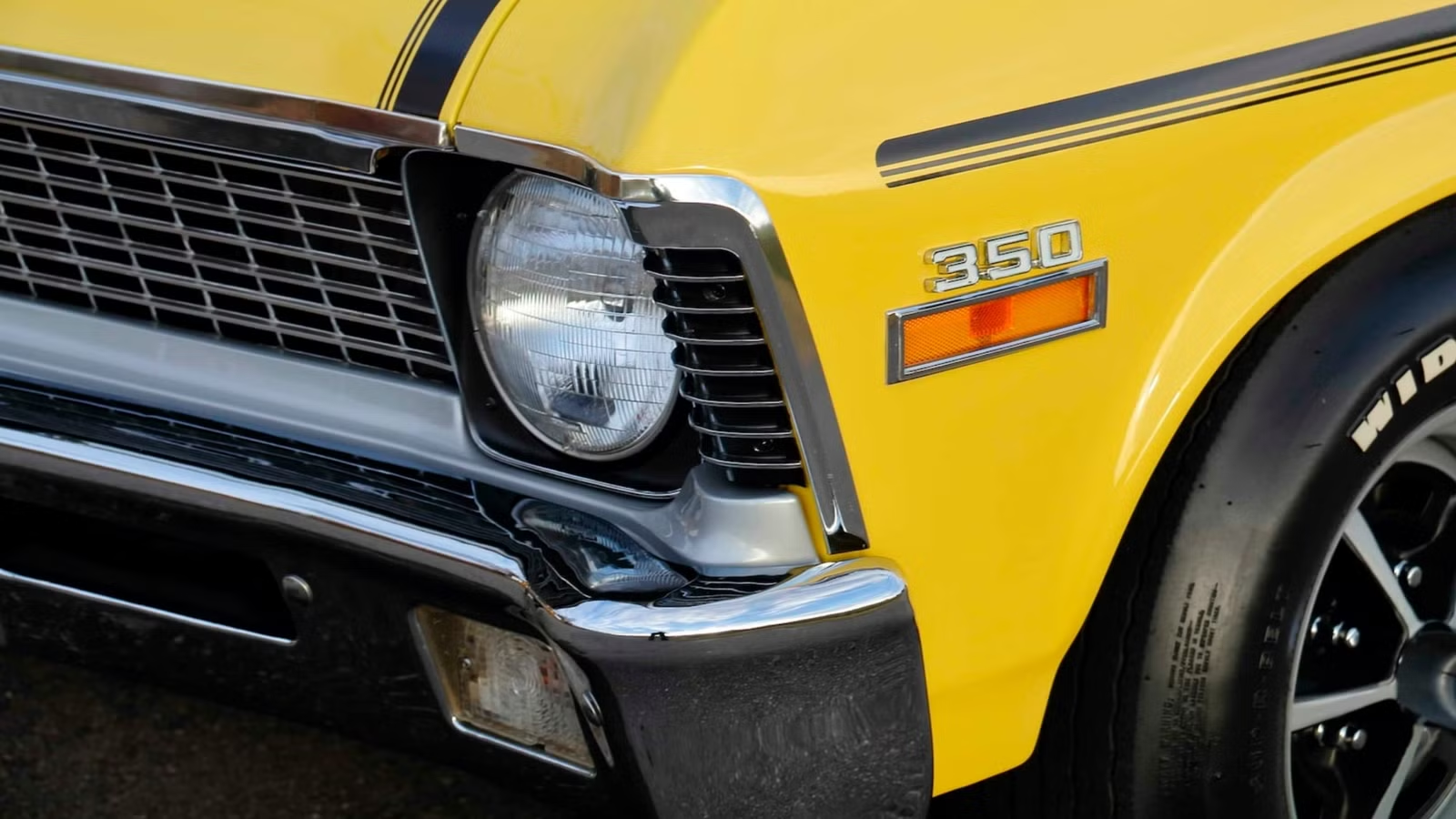
After GM lifted its big engine ban in 1970, there was no longer a reason to COPO Chevy muscle cars, so Yenko came up with a new scheme. Big-block muscle cars were facing soaring insurance premiums, with some being uninsurable, so Yenko came up with a car that wouldn’t trigger a policy cancellation, but still had some street credibility. The 1970 Yenko Deuce was a Nova with a 350ci V-8, rated at 360 hp and 380 lb-ft of torque which, despite its comparatively weaker output, was a 13-second car. A 375-hp bone-stock ’70 Nova SS 396 could run a quarter-mile in 13.9 seconds while the Yenko Deuce, with a 15-hp disadvantage, hit it with a 13.3-second ET. Yenko ordered 175 COPO LT1 Novas in ’70, before abandoning the ultra-cool project the next year.
The COPO LT1 Novas That Got Away

Ordering a ’69 COPO 427 Camaro was a no-brainer as it was a car desperately in need of a power upgrade and dealerships like Berger Chevrolet from Grand Rapids, Michigan and Nickey Chevrolet out of Chicago, Illinois joined Yenko Chevrolet as the highest volume dealers. When it came to the 1970 COPO 350 Nova, most dealers didn’t see the point, since the car was already available with an RPO 396. It is assumed that Yenko was the only one with the genius to recognize the potential of this special order, but actually 10 were slated for delivery to Canada, of all places. Somehow, only two ever made it to Canada. It’s unclear if the other eight were directed somewhere else or were simply never built, but two did make it across the border.
Sole Surviving ’70 LT1 Nova

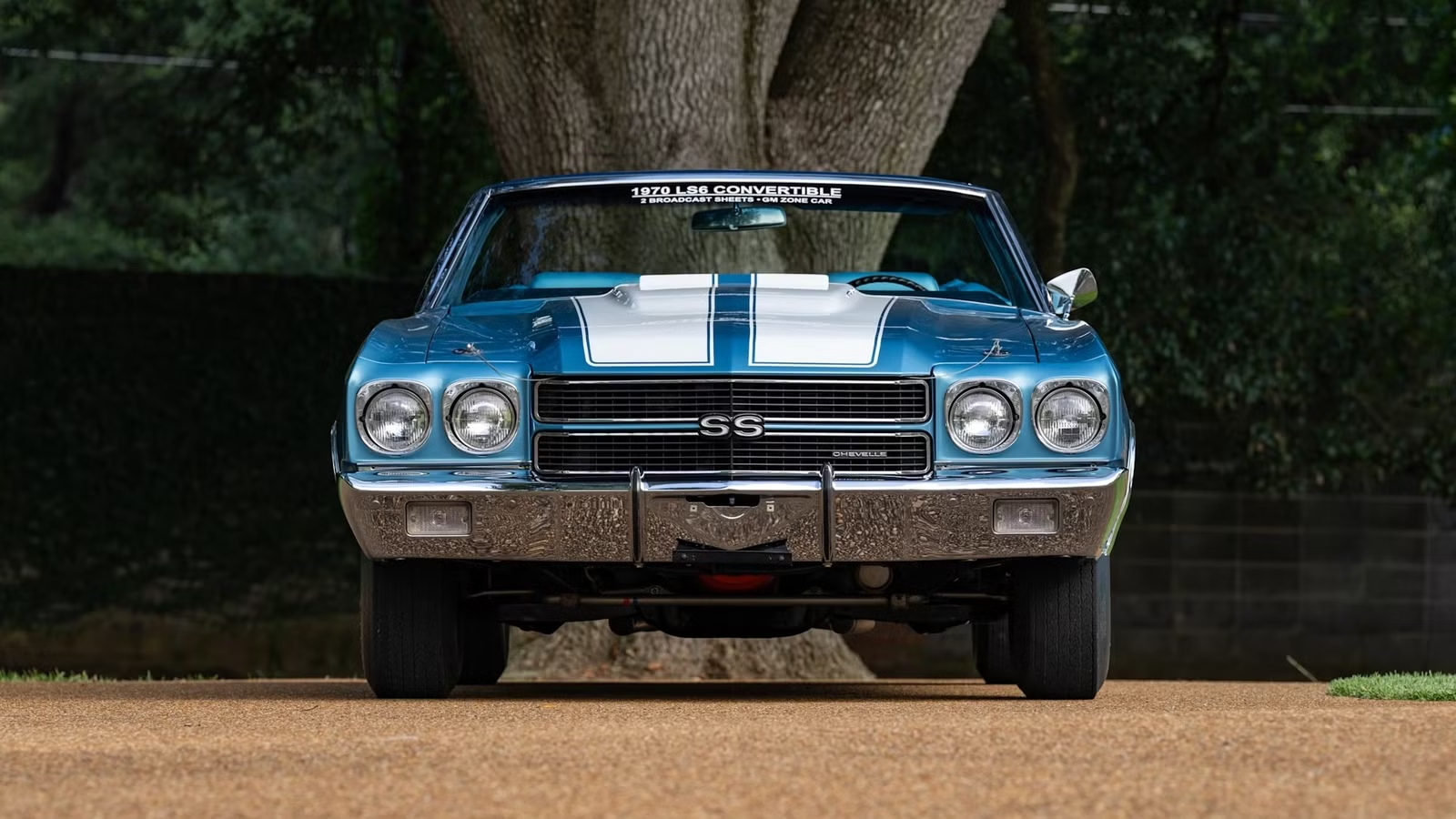
Of those two North of the Border LT1 COPO ’70 Novas, one was green and the other silver. The picture of the car above and the one in the previous section are not the Canadian cars, but rather SS 396s, because we wanted to give you something to look at. According to Hemmings, the green LT1 Nova had a date with the car crusher, which we can’t wrap our heads around because, no matter how damaged it may have been, a car that rare is always worth restoring. The silver one, however, still exists and is the last remaining LT1 that didn’t get Yenkofied. Anyone with a ’70 Nova 350 could claim it’s a COPO LT1, but the current owner, a man by the name of Pete Simpson, has an intact Protect-O-Plate proving his car is the real deal.
Unleashing The Power Of The LT1 Nova

As we previously mentioned, a Yenko Deuce with a 360-hp 350ci V-8 was a 13.3-second car all day long. That is quicker than any regular production GM muscle car in 1971, and is competitive with the 425-horsepower 426 HemiDodge and Plymouth street dominators of the Golden Age. Mr. Simpson, owner of the last non-Yenko LT1 in existence, however, has some even more impressive performance numbers to report. He has a timing slip for a 13.22-second ET with the original specs car, and with some racing slicks, destroyed the quarter-mile in 12.90. For the record, a regular production ’70 Nova SS 350 could run a quarter-mile in 14.7 seconds, and even the 396 was still in the 14s, so there was some magic with the LT1, Yenko or otherwise.
Value of a Pair of Deuces

Hagerty assigns the value for a 1970 Chevy Nova SS 350 between $26,100 for a mediocre model to $62,000 for an exceptional example, and the range for a 396 car goes from $49,700 to $101,000, which is astonishing for a compact car most collectors ignore. It turns out that eye-popping high value is actually modest compared to the ’70 Yenko Deuce, which ranges from $70,000 for a distressed example to $156,000 for a car that will have collectors at car shows drooling. To put that into perspective, there have been genuine Hemi-equipped classics that have sold for less, including a near-perfect, numbers-matching ’70 Dodge Charger Hemi R/T that brought the gavel down for $137,500 at a Mecum auction. Granted, there were only 175 Yenko S/C Novas in 1970, but there were just 112 Charger Hemi R/Ts in ’70, and they were far more impressive than anything Chevy could muster.
Deuce Bigalow: Auction Block Gigolo

The Hagerty prices for the ’70 Yenko Deuce are spot on as Mecum has sold 12 for over $100,000 and two that exceeded the Concours condition value. That yellow Deuce pictured above crossed the block at Mecum Kissimmee 2023 for an astounding $165,000, and besides appearing to be in terrific shape, there is nothing that makes this car any more special than the others. Another ’70 Yenko Deuce set a record back in 2016, selling for $176,000 and, again, without any particularly impressive provenance that would give it that kind of boost at auction. Then again, all it takes to put a car into the stratosphere is two bidders who really want it, and that’s probably what happened with these cars. It’s also a testament to how awesome and rare these dealer specials are, that a ride which would normally sell for around $50,000 is suddenly a six-figure auction king with the Yenko touch added.
Yenko’s Last Hurrah: Viva Lost Vegas

In a way, GM ending its big engine ban in 1970 robbed Don Yenko of his purpose, but he still managed to come out with something amazing and iconic. The Deuce, unfortunately, was Yenko’s last awesome car as the Malaise Era of detuned engines took over and consumers were more interested in fuel economy than freakishly powered street machines. He did make one last attempt with the Yenko Stinger Vega, which put a little more performance into Chevy’s subcompact hatchback, but it never made an impression like his S/Cs and the Deuce. Normally, anything with the Yenko name on it is gold, but we can’t find evidence that anyone ever tried to list a Stinger Vega for auction. The car pictured above is just a regular Vega, because as we told you earlier, we wanted to give you something to look at.
Sources: Hagerty, Mecum

Related posts



Latest Post



No Comments