
Nelson Racing Outlaw 427: 1,200 HP Crate Engine on Pump Gas
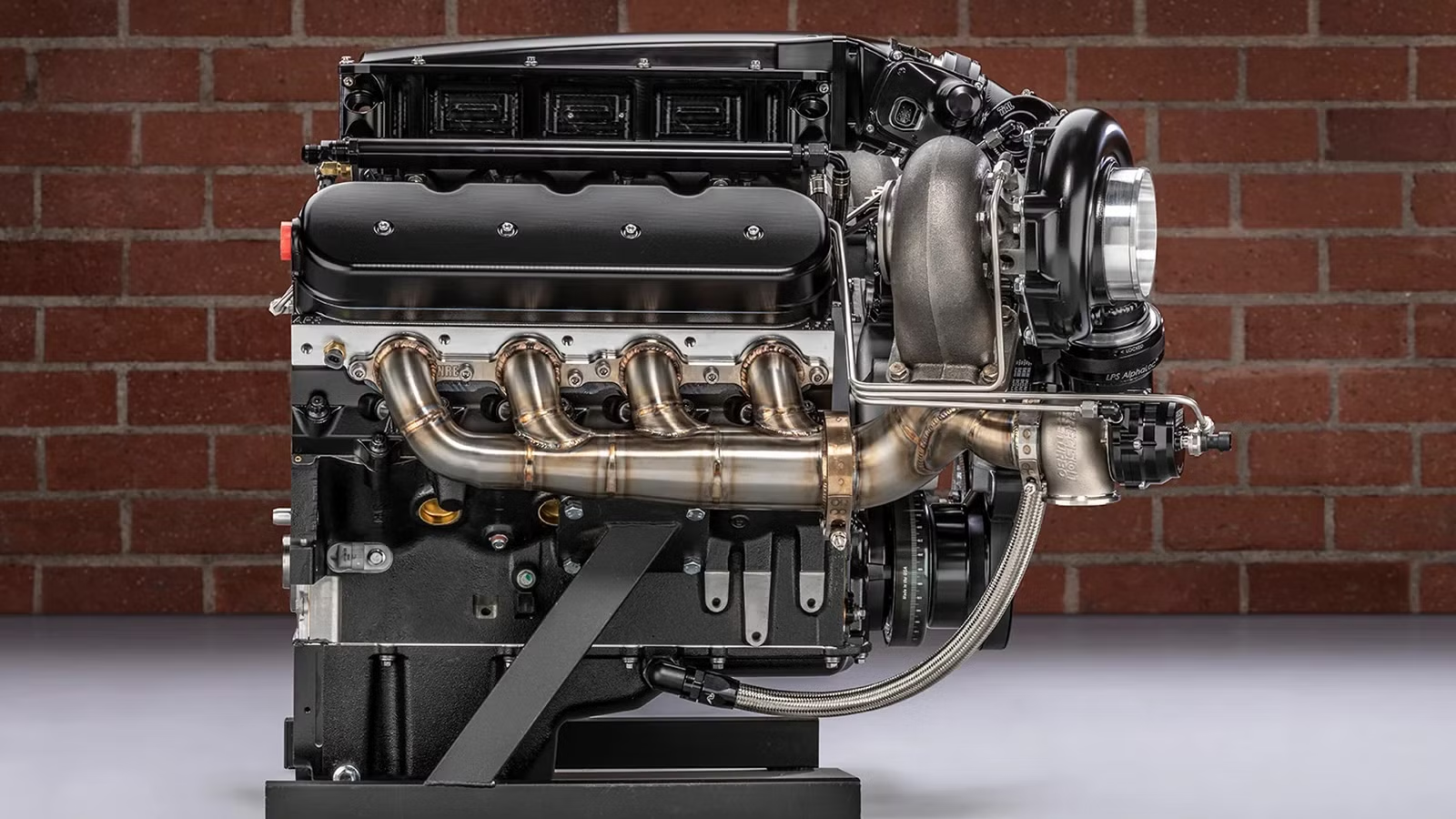
Four-digit horsepower from a crate engine has always come with a catch: race fuel, exotic maintenance, and a fuel system that turns a weekend project into a full-time job. Nelson Racing Engines just removed most of those obstacles. The company’s new Twin-Turbo Intercooled Outlaw 427 makes 1,200 horsepower at 7,200 rpm on regular 91-octane pump gas — no race fuel required — with headroom to 1,500 hp when you step up to higher-octane race gas.

Announced this week, the Outlaw 427 is a complete, LS-based 427.7-cubic-inch V8 built to order at Nelson Racing’s 16,000-square-foot facility in Chatsworth, California. Every engine is dyno-tested before it ships. Starting price is $41,999.
What’s Inside the Outlaw 427
The foundation is a Concept Performance LSR aluminum block with ductile iron cylinder sleeves and a six-bolt-per-cylinder head pattern — a meaningful upgrade over the production LS four-bolt arrangement that gives the block substantially more clamping force under boost. Bore is 4.125 inches on a standard 9.240-inch deck height, paired with a Dart billet crankshaft swinging a 4.0-inch stroke. That combination produces the 427.7 cubic inches (7.0 liters) the name references.

The rotating assembly uses Boostline forged 4340 I-beam connecting rods and custom CP pistons forged from 2618 aluminum alloy. Compression sits at 9.0:1 — deliberately modest for a forced-induction build, which is exactly the point. A lower compression ratio gives the turbos room to pile on boost without pushing the engine into detonation territory on pump gas.
Cylinder heads are Air Flow Research 260cc LS3-pattern rectangular-port castings in six-bolt form, fully CNC-ported and secured with ARP fasteners over Cometic MLX multi-layer steel head gaskets. The valvetrain runs a custom hydraulic roller camshaft, GM lifters, a Comp Cams shaft-mount rocker system, and Manton pushrods.
The Mirror Image Turbo Setup That Makes Pump Gas Work

Boost comes from a pair of Nelson Racing’s own 72mm Mirror Image Generation 2 turbochargers — a system rooted in a patent Tom Nelson filed in 2007 and was granted in 2009. The design runs the two compressor wheels in opposite directions, allowing the turbos, manifolds, and charge plumbing on each bank of the V8 to be built as true mirror images. The result is balanced boost delivery and symmetrical packaging.
The turbos breathe through NRE-built 304 stainless exhaust manifolds and are regulated by TiAL V60 wastegates, with TiAL Q blow-off valves on the charge side. A Tick Performance billet upper plenum with an integral intercooler core sits on a Holley Lo-Ram manifold with a 90mm drive-by-wire throttle body, which eliminates the need for an external intercooler in the engine bay — the installer adds an inline water pump, plumbing, and a heat exchanger instead. Fuel delivery runs through flow-matched Deatschwerks 1,500cc injectors managed by a Holley Terminator ECU with a 60-2 crank trigger.
What Builders Need to Plan For

The Outlaw 427 handles the hard part — the engine itself arrives tested and ready to make its rated power. But getting 1,200 horsepower to the ground is a separate engineering project. Any serious build will need a transmission rated for the output, upgraded axles and differential components, appropriate fuel delivery infrastructure, and a cooling system sized for the heat a 7.0-liter twin-turbo V8 generates under sustained load. The integral intercooler core in the upper plenum simplifies the charge-cooling side, but the installer is still responsible for the external heat exchanger and water pump circuit.
The LS-based architecture works in builders’ favor here. The platform has decades of aftermarket support behind it, and the engine’s LS3-pattern heads mean parts availability is broad. A Corvette or Camaro foundation makes an obvious starting point for a dedicated build, but the architecture is equally at home in a classic truck bed or a custom chassis — the kind of swap projects the LS swap community has been executing for years. Nelson Racing outputs roughly four engines per week from the Chatsworth shop, and the Outlaw 427 is ordered directly through the Nelson Racing Engines website.
The pump-gas threshold is what makes this engine genuinely newsworthy for the build community. Race-fuel-dependent crate motors have always existed at the extreme end of the market; what Nelson Racing has done is push four-digit horsepower into territory where a builder can fill the tank at any gas station. At $41,999, the Outlaw 427 is serious money for an engine alone — but for a project where 700 hp stopped feeling like enough, there’s now a tested, bolt-in path to 1,200.

Related posts



Latest Post


No Comments