
10 Most Reliable Sports Cars Enthusiasts Need To Put On Their Radar Now
An exhilarating driving experience doesn’t always have to come at the cost of a troublesome ownership experience. While many sports cars over the years have been riddled with build quality quirks and complex electronics, there is still a promising group of contemporary two-door performance cars that have no trouble reaching high numbers on the odometer.
10
Mazda MX-5 Miata (ND2)
Reliability Rating: 76/100

The Mazda MX-5 Miata proves that simplicity is key. The brand’s iconic lightweight roadster avoids the complexities of forced induction and convoluted suspension tech, which lends it a solid reputation for reliability. The ND2 iteration of the MX-5 is propelled by a naturally aspirated 2.0-liter Skyactiv-G four-cylinder, and Mazda extensively upgraded the engine to support a higher 7,500-rpm redline than the earlier ND1. The improvements included lighter pistons, a revised crankshaft, strengthened connecting rods, and a redesigned oil control system.
Mazda also substantially tweaked the six-speed manual with stronger internal components and a dual-mass flywheel, which addressed the ND1’s durability concerns under hard driving. While the ND2 Miata has since been succeeded by yet another iteration of the ND platform, the ND3, it offers a slightly more affordable price tag in the used market while steering clear of the early production flaws found in the older ND1.
9
Subaru BRZ
Reliability Rating: 76/100


The second-generation Subaru BRZ was born out of a continued collaboration with Toyota, in which Subaru contributed a boxer four-cylinder fitted into Toyota’s co-developed chassis. Like its first-generation predecessor, the BRZ follows a straightforward philosophy, pairing a tried-and-true naturally-aspirated powertrain with a simple rear-wheel drive architecture. As a result, the Japanese sports car remains impressively purist-focused for its modern-day status, and it abstains from complex features such as active dampers, all-wheel drive torque vectoring, or four-wheel steering. Regardless of whether the BRZ will continue for a third generation, the current model is sure to offer a thrilling driving experience for years to come.
8
Toyota GR Supra
Reliability Rating: 78/100

The GR Supra blends Toyota’s signature build quality with BMW‘s robust B58 3.0-liter turbocharged inline-six engine, paired with an equally stout ZF eight-speed automatic transmission, or in later models, a six-speed manual. Toyota’s decision to source the beating heart of its new-age sports car from a German automaker initially raised many eyebrows, but the B58 was torn down and scrutinized by engineers before launch, and it underwent the same rigorous durability testing as Toyota’s own components.
The GR Supr GR Supra’s ZF automatic gearbox is also known for handling increased power well, turning the Supra into a promising platform for modifications. Even though the sports car’s European internals might raise alarm at first glance, a careful selection of components has resulted in a sports car that is still worthy of its Toyota badge.
7
Toyota GR86
Reliability Rating: 79/100

Like its aforementioned Subaru sibling, the Toyota GR86 is built on a simple philosophy that draws on engineering expertise from two historically dependable Japanese automakers. The sports car features a 2.4-liter naturally-aspirated boxer four-cylinder, which steers clear of any added heat or stress from forced induction. Power is sent exclusively to the rear wheels, carefully avoiding the complexities of torque-vectoring all-wheel drive systems. Without intricate electronics standing in the way, the GR86 manages to deliver a charmingly trouble-free ownership experience that fully lives up to its Toyota branding.
6
BMW Z4
Reliability Rating: 85/100

The Z4 is among BMW’s simplest contemporary models. It manages to steer clear of the electronic complexity of flagship two-door models such as the 8-Series, instead favoring a blissfully straightforward build. Under the hood, the Z4 joins the roster of models that are powered by a B58 3.0-liter inline-six, which has garnered a solid reliability reputation thanks to its overbuilt internals. BMW shared the basic architecture of the Z4 with Toyota’s GR Supra, meaning that its powertrain is mated to a nearly identical ZF-sourced eight-speed automatic or six-speed manual.
While the Z4 was always a low-volume model, its suspension and drivetrain components are borrowed from more common models such as the 3-Series, 1-Series, and various Mini models, which means that owners will not have to worry about rummaging for obscure parts in the future.
5
Ford Mustang (S650)
Reliability Rating: 85/100

While the latest generation of the iconic Ford Mustang is just three years old, it is already developing a solid reliability reputation. Its 2.3-liter EcoBoost and 5.0-liter Coyote engine choices use the same core architecture as the units found in the previous S550 Mustang, as do its ten-speed automatic and newly V8-exclusive six-speed manual transmission. By building on the tried-and-true foundation of the previous model rather than risking the teething problems that come with a ground-up redesign, Ford managed to give drivers peace of mind alongside a traditional muscle car driving experience.
4
Porsche 718 Cayman
Reliability Rating: 86/100

The Porsche Cayman descends from a lineage of accessible mid-engined sports cars that began with the first 986 Boxster in the late 1990s. While it technically sits below the lauded 911 in the German automaker’s lineup, it does not fall short in terms of build quality. Many of the two-door coupe’s internal components, including the suspension, brakes, and cooling systems, were developed by Porsche with track use in mind. As a result, they can easily handle normal street driving with minimal wear. The 718’s array of engine choices is also derived from the core architecture of the 911’s tried-and-true flat-sixes, even including the entry-level flat-four, which is derived from the 9A2 flat-six. As a result, the Cayman properly delivers the signature Porsche driving experience without a bad temper.
3
Chevrolet Corvette (C8)
Reliability Rating: 89/100

The first iteration of the mid-engined Chevrolet Corvette is currently entering its eighth model year on sale, meaning that the C8 generation has had plenty of time to prove its dependability. The V8 positioned behind the seats is known for being robust across the board, and that is especially true for the naturally-aspirated variants at the lower end of the lineup, such as the Stingray’s LT2. All C8 Corvettes are fitted with dry-sump oil systems, which ensure continuous lubrication during more aggressive driving. Chevrolet has continued to tweak its iconic sports car with refinements to its software, further ensuring that the Corvette can climb the odometer with ease.
2
Porsche 911 (992)
Reliability Rating: 91/100

The current generation of the Porsche 911 continues the brand’s reputation for providing a surprisingly dependable ownership experience for a German performance car. The 992 represents the latest evolution of the 911 lineage, and it is powered by a robust array of flat-six engines. It also offers the brand’s PDK automatic transmission, which has proven to be very mechanically robust, and this includes under aggressive track driving.
The 992 generation of the 911 scored an impressive 91 out of 100 in JD Power’s Quality and Reliability rating, further proving that this latest evolution of the massively popular sports car has managed to iron out any quirks that previous generations may have suffered from.
1
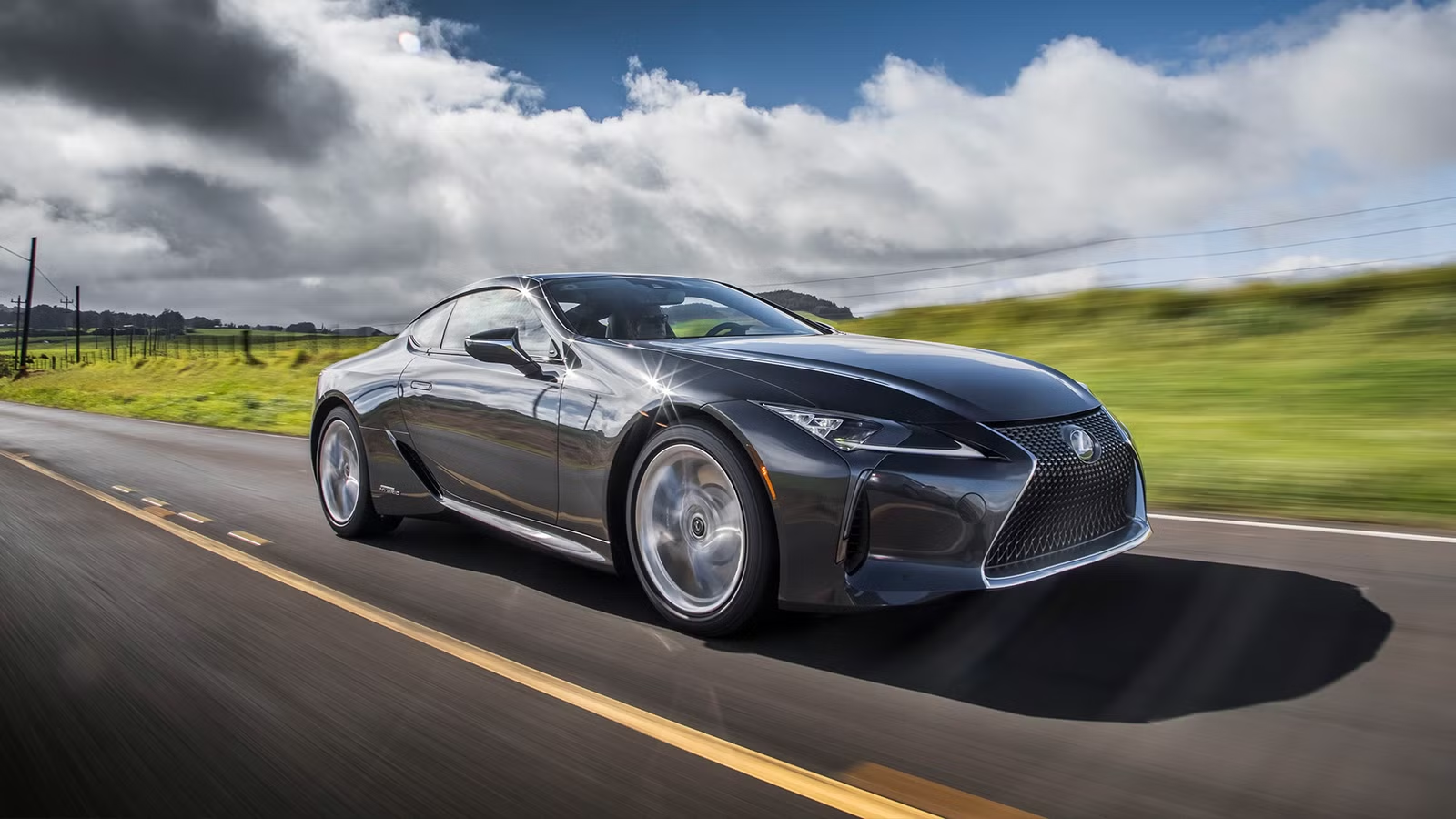
Lexus LC 500
Reliability Rating: 92/100

The Lexus LC 500 is a grand tourer that steers clear of the mechanical fragility that its European rivals are often notorious for. Under the hood lies Lexus’s robust 2UR-GSE 5.0-liter naturally-aspirated V8, which is shared with high-performance F series models and delivers a menacing exhaust note. The powertrain has become known for its highly overengineered components, and it avoids the heat and pressure of forced induction. The LC’s eight-cylinder heart is mated to a smooth ten-speed automatic transmission.
Lexus built the LC 500 at its renowned Motomachi plant, which is known for highly strict build quality standards with extensive inspections. The facility has been responsible for building many of Toyota’s most famously dependable offerings over the years, including the opulent Century sedan and the Lexus LFA supercar.
Sources: JD, Power, BMW, Chevrolet, Ford, Lexus, Mazda, Porsche, Subaru, Toyota

Related posts





Latest Post


No Comments