
Mopar’s Most Reliable Engine Of The Muscle Car Era Wasn’t a V8
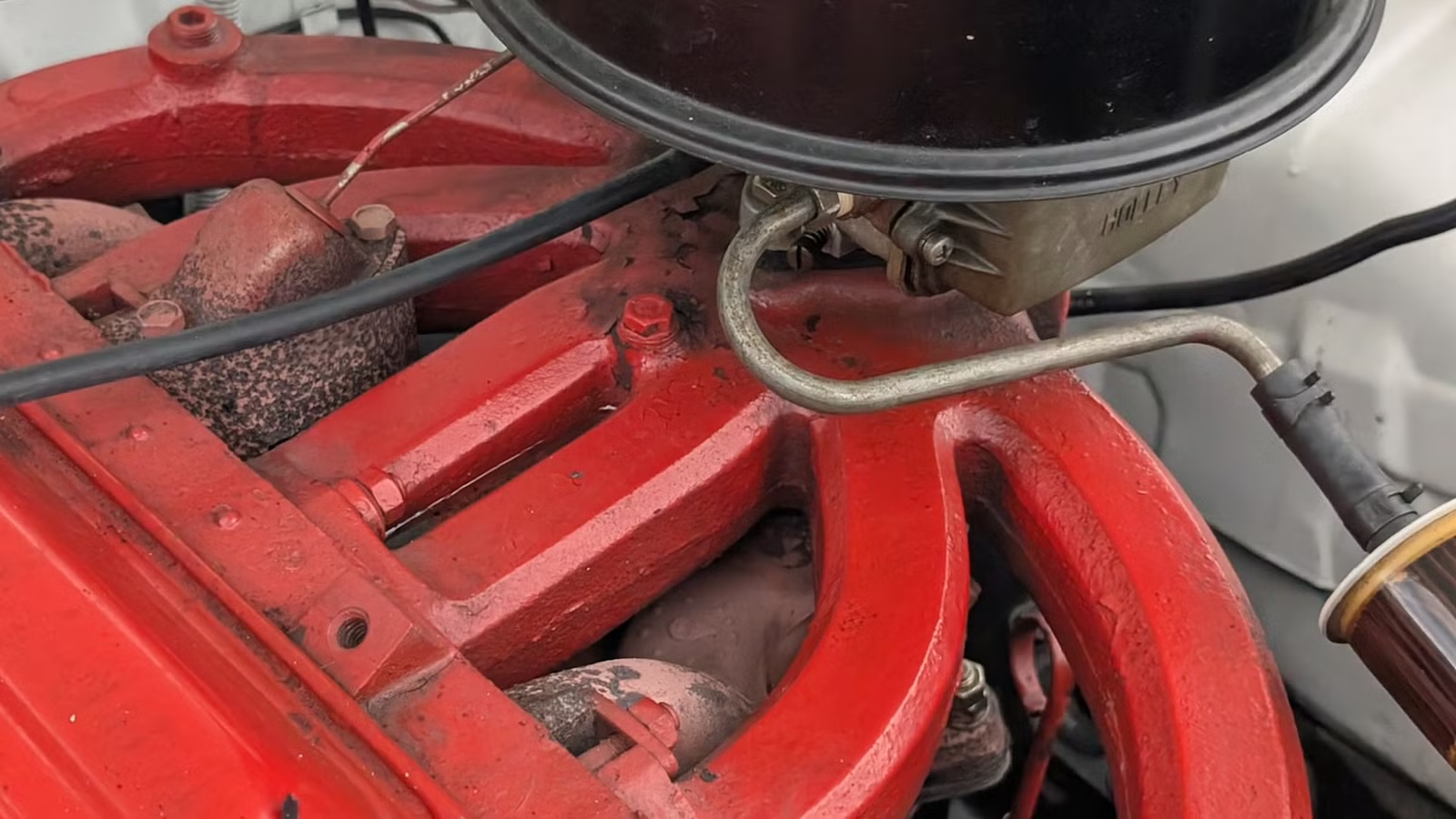
It totally makes sense that giant V8 engines are typically the most sought-after options of the muscle car era. What could be bad about going for the Chrysler, Plymouth, or Dodge model with the most power? Well, a few things. For example, they can throw off the balance and may face reliability issues. The most reliable Mopar engine from the peak raw performance era is not even a V8. It’s actually a smaller option that’s built with bulletproof durability to survive the test of time, even under high stress conditions.
Chrysler Needed To Replace Its Aging Flathead Engine

In the late 1950s, it was time for Chrysler to replace its older flathead (side-valve) inline-six engine. The old 230 cubic-inch (3.8-liter) unit did its duty of powering passenger cars from 1942 until 1959 and even lasted into the late 1960s for industrial and heavy-duty truck applications. It churned out between 100 and 132 horsepower and 190 to 205 lb-ft of torque depending on the year and configuration.
But after a few decades of use, it became highly inefficient. Plus, the engine is tall and bulky, as it tips the scales at 600 to 700 pounds. The engine is known for having poor breathing and inefficient airflow because the side-valve layout forces intake and exhaust gases to make abrupt 90-degree turns through the block and combustion chamber, limiting high-RPM airflow.

Modifying the engine with larger valves to solve this breathing problem would involve using larger pockets in the cylinder head that would reduce compression ratios even more and impact thermal efficiency. Chrysler wanted to build upon its success by providing a compact, low-profile engine to power compact cars while delivering more power and plenty of low-end torque.

Also, Chrysler wanted to replace the old flathead with an affordable alternative to gigantic V8 powerhouses designed to dominate drag strips. It was time to build a tough, economical option for practical buyers that could keep up as post-war vehicles became heavier and highway speeds increased.
The 225 Slant Six Was Built To Solve Problems

Mopar gained the legendary 225 Slant Six engine in 1960, and it was an immediate hit with multiple applications across Dodge Ram pickup trucks, vans, the Plymouth Valiant, Chrysler New Yorker, Dodge Challenger, and many other passenger cars. The 224.7 cubic-inch (3.7-liter) inline-six delivers 105 to 145 hp and 185 to 215 lb-ft of torque depending on year and application.
The Chrysler Slant Six was designed from a blank sheet with a 30-degree tilt to reduce the engine’s overall height and fit in passenger cars with sleek, low hood profiles. This tilted design provides space for long intake runners, giving its manifold the ‘bunch of bananas’ title. It improves airflow as it enhances fuel atomization and low-end torque.
Also, the water pump was shifted from the front to the side to reduce its length by several inches. This dependable engine weighs in at between 475 and 525 pounds, making it much lighter than its predecessor. Depending on the vehicle and its weight, the 225 engine gets about 15 to 20 mpg in the city and up to 20 to 25 mpg on the highway.

Meanwhile, the hefty 230 flathead engine got about 12 to 15 mpg in the city and 18 to 21 mpg on the highway at speeds around 55 mph. Then the second-generation 426 Hemi V8 engine was getting about 8 to 12 miles per gallon in the city and 12 to 15 mpg on the highway, but some would argue that it’s worth it for 425 hp.
The 225 Will Last For Decades

The best part about the 225 Slant Six engine is the fact that it’s bulletproof. It features an overbuilt deep-skirt cast-iron block and a robust seven-main-bearing crankshaft that makes the bottom end nearly impossible to destroy. The tough build dampens vibration and resists cracking. Plus, the leaning cylinders prevent strain on the engine while boosting low-end torque.
This engine has durable forged steel crankshafts to endure high mileage and rough abuse. Putting the water pump on the side improves coolant flow efficiency for optimal cooling and lubrication. Also, the 225 is known for its ability to tolerate neglect, with the ability to survive missed oil changes, low fluid levels, and stress when used in delivery, police, and taxi fleets.
Well-maintained Slant Six engines are known to last between 200,000 and 350,000 miles. However, many examples easily push beyond 400,000 to 500,000 miles before needing a rebuild. Many owners report owning Dodge Dart cars, D100 trucks, and Duster cars with 300,000 to 500,000 miles on their 225 engines. They often survive for several decades and outlast the car bodies found around them in barns and junkyards. It has earned its 300,000 motor nickname because of its reputation for lasting forever.

Its survivability is reflected in its massive production span from 1960 until 1987 in America and up until 2000 in Mexico. The 225 is one of the longest running engines in history. It met its end once it became too large to fit sideways into more modern Mopar cars with front-wheel-drive layouts and compact engine bays, as emission standards continued to tighten.
Here’s Why Builders Pick The 225 Slant Six Over V8s

Of course, hot rodders pick the 225 Slant Six to take advantage of its proven reliability, but the decision to use it over more powerful V8 engines goes deeper than that. For example, it fits into tight engine bays while leaving plenty of room for servicing accessories. Plus, the simple layout leads to more affordable tune-ups and easier access to spark plugs and other components.
The engine is easy to upgrade; adding a two-barrel carburetor setup, aftermarket headers, and a mild RV camshaft can boost power to 150 to 175 hp. Also, it can be heavily modified or turbocharged to produce 250 to 500 hp. But going for that amount of power requires internal reinforcement.

While it’s more efficient on gas, it has plenty of low-end power thanks to the 4.125-inch stroke, which provides instant twisting power off idle for a thrilling punch in lighter cars. Plus, this engine stands out with a unique style thanks to the ‘bunch of bananas’ manifold, drawing attention at car meetups in a sea of oversaturated LS swaps.
Chrysler didn’t publish an official production count for this engine, but historical estimates report that millions were built. In fact, there may have been over 13 million produced, meaning it’s easy to find. They have a high survival rate and can be purchased for between $100 and about $3,000 depending on condition.
Source: Chrysler, For A Bodies Only, Houston Mopars

Related posts




Latest Post


No Comments