
Maserati Design Boss Rejects AI Car Design at Goodwood 2026
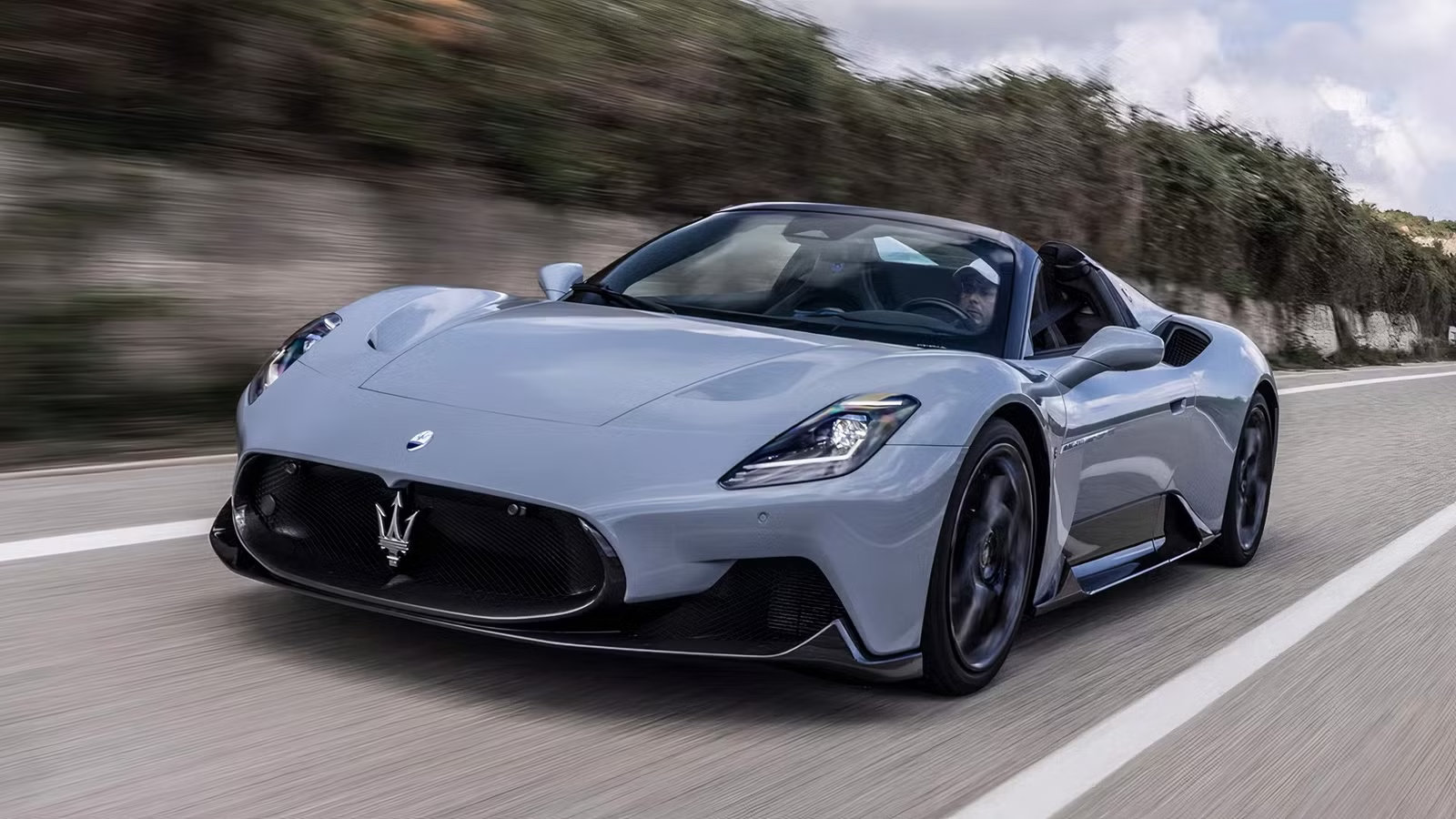
At the Goodwood Festival of Speed this past weekend, Klaus Busse — Maserati‘s head of design since 2015 — drew a line in the clay. AI will not design a Maserati. Not now, not in the next generation of cars, not while he’s holding the pencil. It’s a bold stance in an industry increasingly comfortable letting algorithms sketch the first draft, and coming from the man who shaped the MC20, the Grecale, and the brand’s current design language, it carries real weight.

Busse’s argument isn’t rooted in technophobia. It’s rooted in what Maserati is actually selling. When someone spends six figures on a car with a trident on the grille, they’re not just buying transportation — they’re buying the accumulated craft of Italian designers who understood the Ghibli‘s fuselage lines, the Merak’s mid-engine proportions, and why sculptural restraint communicates more luxury than chrome badges ever could. That story cannot be generated by a prompt.
What Busse Actually Said at Goodwood
Speaking with CarBuzz at the Festival of Speed, Busse framed Maserati’s design history as a conversation between two forces: societal expectation and technological possibility. “When you look between the fuselage 50s, the dandy 60s, the progressive 70s, the pragmatic 80s, and the brutalist 90s, every chapter was driven by two things,” he said. “The expectations of society and the possibility of technology.”

That framing matters because it positions technology as a tool within a human-led creative process — not as the process itself. Busse acknowledged being open to AI in general terms, but was explicit that it won’t serve as a generative design engine for new Maserati models. “You need to show what the brand stands for,” he said. “You need to show the people and the creators, especially in this age of AI.” The emphasis on *people and creators* is deliberate. For Busse, the human authorship behind a Maserati is part of the product’s value proposition — not a behind-the-scenes detail the buyer never sees.
The GM Contrast Makes the Argument Sharper

General Motors has been one of the more vocal advocates for AI in the design studio. The company uses generative tools to convert 2D sketches into 3D models faster, run aerodynamic simulations in seconds rather than weeks, and give designers more iteration cycles per project. Bryan Styles, GM’s Director of Design Innovation and Technology Operations, described it as augmentation rather than replacement: “We’re applying it in a way that enhances the skills that we’re already good at. We’re thinking about it from the perspective of augmenting and accelerating processes.” GM calls AI a “force multiplier for human expertise.”
That framing works for a mass-market manufacturer optimizing across dozens of models and hundreds of trim variants. Speed and iteration efficiency matter when you’re designing a Silverado work truck and a Corvette in the same fiscal year. But Maserati’s situation is fundamentally different. The brand produces a handful of models, each expected to carry a century of design lineage forward. Faster iteration isn’t the goal — emotional resonance is. And Busse’s argument is that no algorithm has yet learned to feel the difference.
Craft as the Product, Not Just the Process

Busse’s most pointed observation at Goodwood was about what luxury buyers are actually purchasing. Maserati positions itself as a half-luxury, half-sports car brand — a combination that demands restraint in the design language. The current lineup avoids aggressive aero addenda and oversized badges, leaning instead on small sculptural details: the trident grille, the fender vents, the body surface tension that rewards a slow walk-around rather than a quick glance.
That kind of detail work is where human craft becomes legible to the buyer. The analog watch comparison holds up well here. A quartz movement and a hand-wound mechanical movement both tell time accurately, but one of them asks you to appreciate the engineering behind the face. Maserati buyers, Busse suggests, are making the same choice — and they know it. Undermining that story with an AI-generated body panel, even a technically superior one, would quietly devalue what they paid for.

It’s worth noting that Maserati isn’t running from AI entirely. The brand recently released a marketing video titled *Never Stop Dreaming* built entirely from AI-generated content. The distinction Busse draws is specific: AI as a marketing production tool is one thing; AI as a design author is another. The car itself remains a human artifact.
Whether the rest of the luxury segment follows Busse’s lead or drifts toward GM’s efficiency model will say a lot about what premium car brands think their buyers are actually paying for. For now, Maserati is betting that the answer is craft — and that the human hand behind a design is a feature, not an inefficiency worth optimizing away. Gearheads who care about the story behind the shape should be glad someone at that level is still making that case.

Related posts




Latest Post


No Comments