
The Mopar Barn Find Every Muscle Car Collector Would Sell Everything For
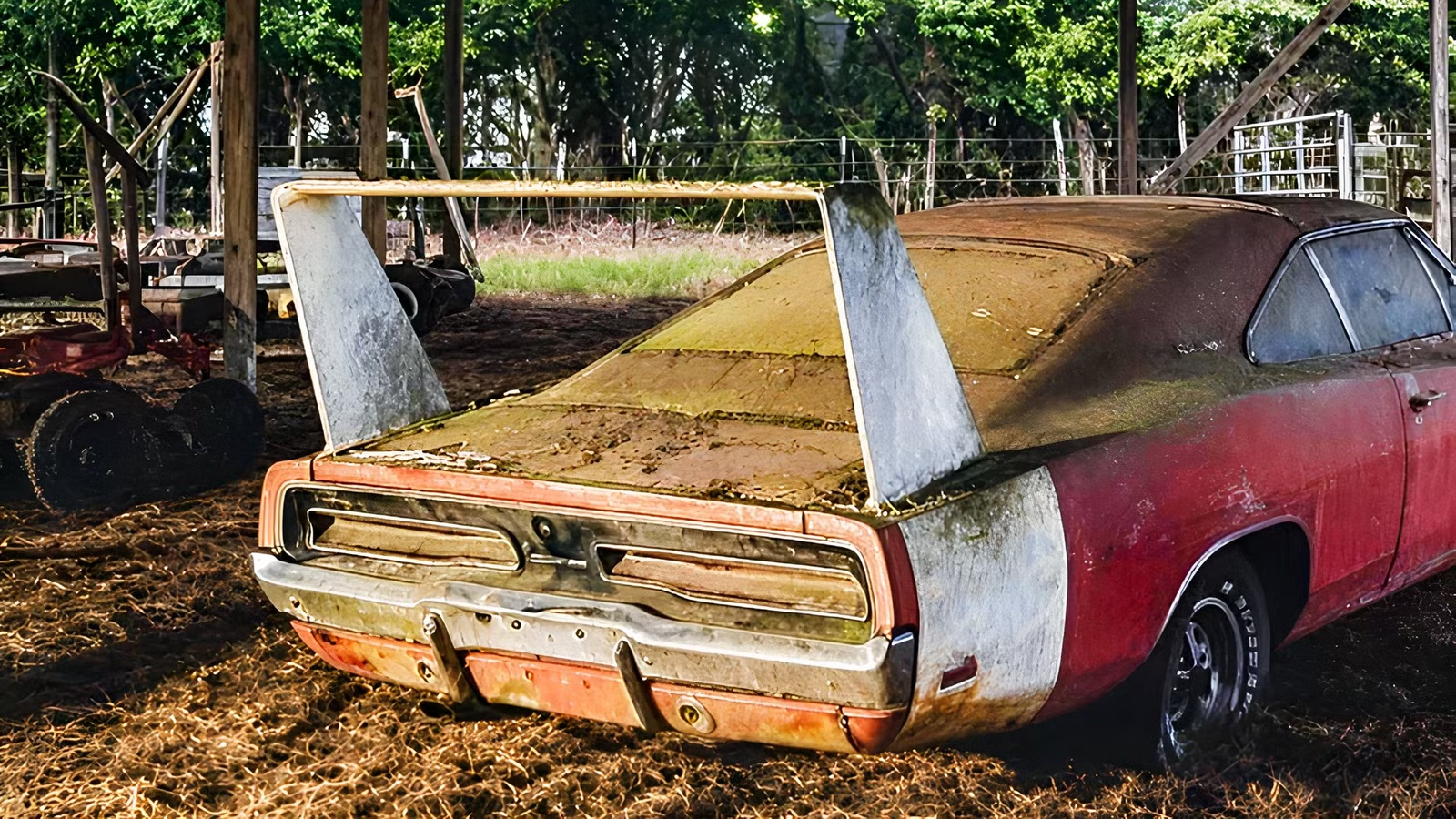
Over 50 years ago, some teenage kid pulled up to someone’s driveway, dropped meager money on a now-classic Mopar that people practically could not give away in those days, probably put obnoxious flame decals along the flanks, and then parked it in a flimsy carport where it sat abandoned in the humidity for decades. That teen couldn’t have fathomed it at the time, but that beater secured financial freedom dozens of years down the line. Why? Because that old daily driver was something beyond the ordinary. Nowadays, it’s one of the most valuable classic Mopars that ever existed.
Homologation: Forcing Race Cars Onto The Street

Homologation is easily one of the greatest loopholes in automotive history. Sanctioning bodies around the globe originally created these rules to stop manufacturers from showing up to production car series with dedicated, multimillion dollar prototypes. The concept was entirely simple. If an automaker wanted to race a specific chassis, engine, or aerodynamic profile on Sunday, they had to build and sell a set number of identical copies to the general public on Monday. It was a rule strictly designed to keep the starting grid tethered to reality.
Instead, it sparked an era of complete corporate lunacy. Automakers quickly realized they could just build pure, unadulterated track weapons first and then figure out how to slap license plates on them later just to satisfy the rulebook. From the legendary monsters of Le Mans to the brutal, high-revving pony cars of the Trans Am series, homologation regulations inadvertently forced Detroit and European OEMs alike to sell actual race cars to average commuters who had absolutely no business driving them.

As a general rule, these homologation cars were simply the same racing chassis and powertrain with a little bit of chrome, leather, and a radio installed at the factory to satisfy requirements of various racing sanctioning bodies. Suffice it to say, OEMs absolutely hated homologation. It made racing programs even more expensive than needed and put a strain on dealerships that could use that inventory space to sell normal cars Americans actually wanted to buy. Still, it certainly did serve a purpose later on.

Bringing NASCAR to the Road in the Late 1960s

To understand how a genuine unicorn ends up becoming a high-rise apartment for mice and possums in the Deep South, you have to look back at how desperate Detroit was to win on Sunday and sell on Monday. Back in the late 1960s, the NASCAR Cup Series was a brutal high-speed arms race between the Big 3 Detroit OEMs, plus stragglers like AMC. The good ol’ boys had finally figured out that sheer horsepower was hitting a brick wall against aerodynamic drag. The only way to crack the 200 mph barrier consistently was to build cars that could slice through the air like an arrow.
There was a massive catch. NASCAR mandated that if you wanted to race a specific body style on the track, you had to sell a minimum of 500 identical copies to the general public through regular dealerships. But applying that same logic to massive American land yachts meant producing street-legal aero warriors that were completely ridiculous for everyday driving.

More often than not, this led to these polarizing spaceships sitting unsold on dealer lots while desperate salesmen practically begged people to take them at a massive discount. No, seriously, don’t be surprised if you learn they got on their hands and knees and begged people to buy them. Typically, that tactic didn’t work, and that means NASCAR homologation specials are ultra-rare nowadays.
Dodge Charger Daytona: How Did Nobody Want These?!

That brings us back to the teenage kid who managed to scrape together $1,800 in 1974 for a used car. The vehicle he dragged home to rural Alabama was none other than a genuine 1969 Dodge Charger Daytona. It was the ultimate NASCAR homologation special, purposely built with a towering rear wing and an extended aerodynamic nose cone designed strictly to dominate the high banks of Talladega. Dodge built exactly 503 of these Charger Daytonas to satisfy the NASCAR rulebook, and as we established, they were way too impractical for an American populace not yet acquainted with the concept of hypercars to desire.
Underneath that sheet metal, this specific car hid a highly desirable, numbers-matching 440 Magnum V8. Instead of preserving a piece of automotive history, the kid did what any teenager in the 70s would do. He slapped an eye-bleach-inducing set of custom-painted flames down the sides, drove it hard enough to smash in that trademark aerodynamic nose cone, and eventually parked it under a flimsy carport.

It sat completely abandoned to the brutal Southern humidity for over four decades. When the moss-covered shell was finally dragged out into the daylight in 2015, it looked like an absolute horror show. Yet underneath the rotting interior, it remained a completely untouched, numbers-matching survivor from the wildest era of American motorsports.
There’s More Out There, But Where

Today, a well-preserved Charger Daytona easily commands half a million dollars or more. That certainly explains why the automotive world lost its collective you-know-what over this rotting Alabama relic of rusted steel. The auction house predictably hyped the 2015 discovery to the moon. They even went so far as to stage the car with fake hay bales on the auction block, leaning entirely too hard into the romanticized barn find aesthetic. To capitalize on the madness, they slapped an absolutely absurd $150,000 pre-auction estimate right on the dirty windshield.
That is modern Mercedes-AMG or M-Division money for a car that had not run in decades, stank like Alabama mildew, and looked like it was halfway to the crusher by the time anyone else laid eyes on it. Somehow, with context, that doesn’t seem so unreasonable if you think about it. Later on, the car sold for a somewhat more reasonable $90,000, with the word “reasonable” being used very loosely.
Source: Mecum Auctions

Related posts





Latest Post


No Comments