
The Porsche That Could Be One Of The Smartest Performance Buys Used
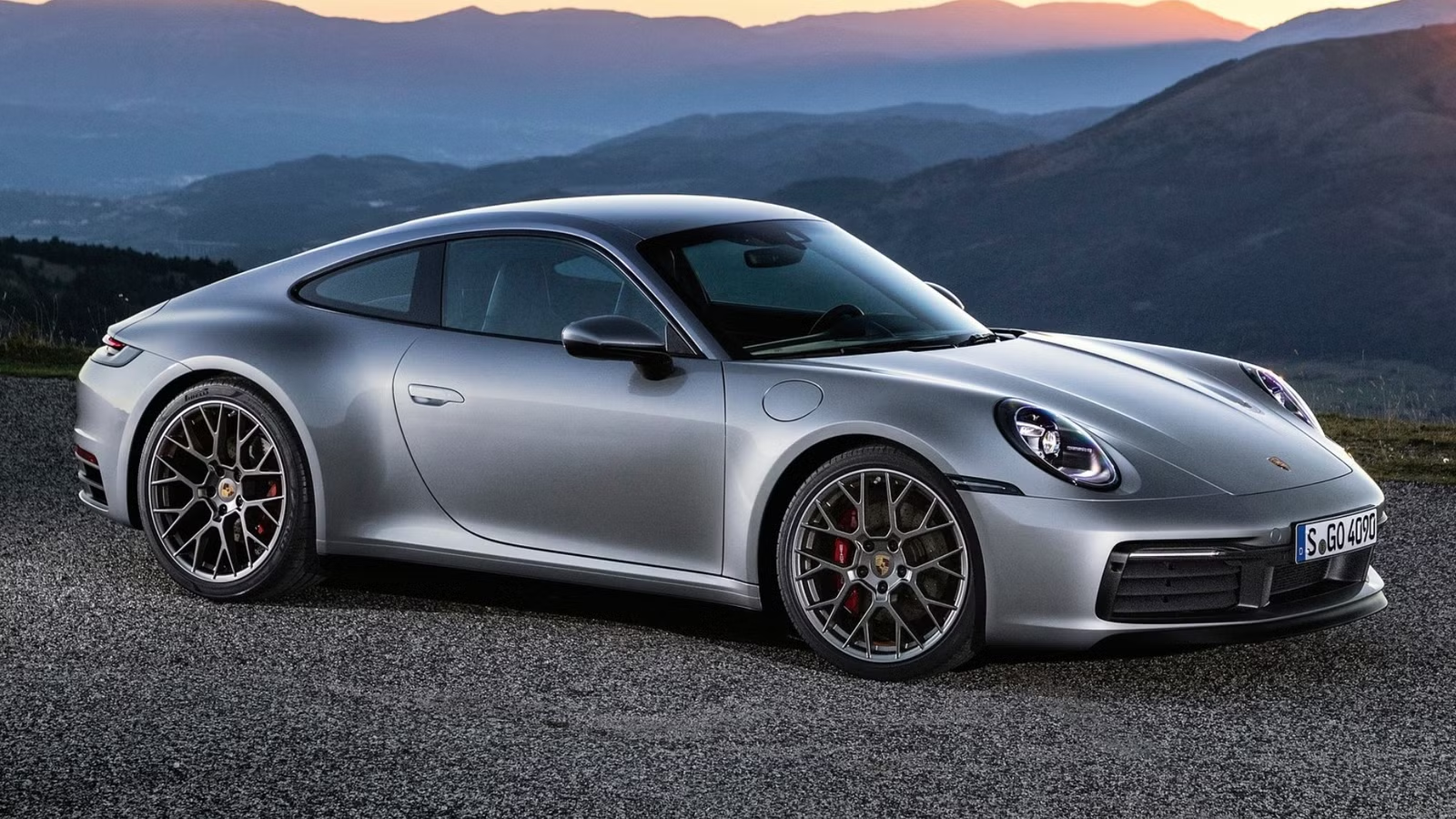
Porsche’s 911 has never been cheap, but the 991-generation car, built from 2012 through 2019, has reached the point in its life cycle where math finally works in the buyer’s favor. It’s modern enough to drive every day without feeling like a compromise, available with engines ranging from screaming naturally aspirated flat-sixes on early 991.1 models to punchy turbocharged ones on later 991.2 units, and it has now absorbed most of its depreciation. It has now absorbed most of its depreciation. For anyone chasing genuine sports-car credentials on a budget that doesn’t require a second mortgage, the 991 deserves a serious look.
Why The 991-Generation 911 Still Feels Like A Modern Sports Car

The 991 was the biggest structural leap the 911 had taken in decades. Porsche stretched the wheelbase by nearly four inches, widened the track, and switched to an aluminum-steel composite body that shaved weight while adding stiffness. The result is a chassis that feels planted and composed in ways the tauter, twitchier 997 never quite managed—a 911 that could finally be trusted at the limit by drivers who weren’t professional racers.

Inside, the 991 introduced the cabin architecture that would carry Porsche through the following decade: a raised center console, the PCM touchscreen infotainment system, and switchgear shared with the Panamera and Cayenne of the era. Later 991.2 cars even picked up Apple CarPlay, making a 10-year-old 911 genuinely livable as a daily driver rather than a garage ornament. Combine that with adaptive PASM dampers, a standard Sport Chrono option with launch control, and a cabin that doesn’t feel dated next to a new Camry, and the 991 doesn’t read like a used car so much as a slightly older version of the car Porsche still sells today. That’s rare in this price bracket, and it’s the reason the 991 doesn’t feel like a compromise the way many decade-old performance cars do.
The Sweet-Spot Engines That Make The 991 So Desirable


The 991 generation spans two genuinely different engine philosophies, and it’s worth being specific about them rather than lumping the whole run together. Early 991.1 cars (2012–2016) used naturally aspirated flat-sixes: a 3.4-liter making 350 horsepower in the base Carrera and a 3.8-liter making up to 400 horsepower in the Carrera S. These are the last “old-school” 911 engines before turbocharging took over. They rev to 7,800 rpm, deliver power in a linear surge, and produce the wailing, mechanical flat-six sound purists associate with the badge. They’re also the engines most likely to attract collector interest down the road, since Porsche has since gone all-in on turbocharging every Carrera variant.

The facelifted 991.2 (2017–2019) switched to a turbocharged 3.0-liter flat-six—370 horsepower in the Carrera, 420 in the Carrera S—built around a redesigned 9A2 architecture. Turbo lag is nearly nonexistent, torque arrives as low as 1,700 rpm, and the car is noticeably quicker in real-world driving despite feeling more muted at high revs. It also addressed a mechanical weak point of the earlier engine, discussed below.
Neither engine is the wrong choice; they’re just different products for different buyers. Someone chasing the emotional, high-revving 911 experience and long-term collectibility should look at a 991.1 Carrera S. Someone who wants the most usable, low-maintenance-risk performance per dollar should lean toward a 991.2. Both land in the same used-market price bracket today, which is what makes this generation such an interesting shopping decision.
How Depreciation Turned A Porsche Icon Into A More Attainable Performance Buy

Numbers tell the story better than sentiment does. A 2013 Porsche 911 Carrera S carried a base MSRP of roughly $99,900, and a well-optioned example—PDK, Sport Chrono, PASM, premium leather—could sticker for well over $120,000, with heavily loaded cars pushing past $140,000 out the door. Today, according to Classic.com’s market data, the average sale price for a 991.1 Carrera S sits around $84,260, and Kelley Blue Book pegs private-party values for base-condition examples in the $48,000-$56,000 range. That’s a car that’s shed 40-50% of its as-optioned value while remaining thoroughly usable, well-supported, and mechanically sorted.

That decline hasn’t continued unchecked, either. Market trackers now describe the 991.1 and 991.2 as entering a stabilization phase rather than a freefall. Recent 12-month data shows 991.1 Carrera S values actually ticking up around 2.8%, while GTS variants have posted similar gains. In other words, the steepest part of the depreciation curve is already behind this car—someone else absorbed it—and the used-market price has effectively found a floor. Buying now means paying close to what the market considers this generation genuinely worth, rather than catching a car mid-freefall.
The Everyday Usability That Sets The 991 Apart From Other Sports Cars

Part of what makes the 991 such a smart used buy is that it doesn’t ask for the usual sports-car sacrifices. There’s a usable front trunk for a weekend bag, a pair of rear seats that fold flat for extra cargo even if they’re not built for adult passengers, and a ride quality, especially with PASM in Comfort mode, that won’t rattle fillings loose on an ordinary commute. Visibility out of the cabin is excellent by sports-car standards, and the seating position is low without feeling like a chore to climb into.

Running costs are also more reasonable than the car’s performance suggests. Fuel economy on 991.2 turbocharged models is meaningfully better than the naturally aspirated cars they replaced, and because Porsche built hundreds of thousands of these over a seven-year run, parts availability and independent-specialist support are far better than for lower-volume exotics. A well-maintained 991 can be driven through a Minnesota winter or a cross-country road trip without drama, something that can’t be said for a lot of cars in its performance class.
What To Check Before Buying A Used 991-Generation 911

This is where the 991 rewards a careful buyer and punishes a careless one. A few specific items deserve attention before signing anything. Bore scoring is the single biggest mechanical concern on 991.1 cars. The 9A1 engine’s Alusil cylinder bores can wear unevenly, particularly on cars that have seen infrequent oil changes or short, cold-engine trips, leading to excessive oil consumption and, in worst cases, engine failure. A pre-purchase inspection should always include a borescope check of the cylinder walls; it’s a cheap test that can save a five-figure repair bill. Porsche addressed this with the 991.2’s redesigned 9A2 engine, which uses a thin, wear-resistant Sumebore cylinder coating. Buyers who want to sidestep the issue entirely should lean toward a post-2017 turbo car.
Buyers coming from older 911 lore may also ask about the notorious intermediate shaft (IMS) bearing failure. It’s not a concern here: Porsche eliminated the IMS shaft entirely back in 2009, several years before the 991 even launched, so every 991-generation car is free of that particular risk.

Transmission choice changes the maintenance conversation, too. PDK-equipped cars need fluid and filter service roughly every 40,000 miles and should be checked for smooth, hesitation-free shifts during a test drive. Manual cars carry their own wear items; clutch condition and the dual-mass flywheel are worth inspecting, since replacement isn’t cheap. Beyond the drivetrain, check for rear main seal oil weeping, inspect PASM shocks for leaks or sagging, and, on cabriolets, cycle the convertible top to confirm the hydraulics operate cleanly. It’s also worth confirming any outstanding recall work has been completed, including the door-handle wiring fix issued for early 991 models.
None of this makes the 991 fragile; it makes it a car where documented service history and a proper PPI matter more than horsepower figures. Buy one that’s been cared for, and it’s hard to find a better performance-per-dollar argument in the used sports-car market right now.
Sources: Porsche U.S., Kelley Blue Book, Classic.com

Related posts


Latest Post


No Comments