
Lotus Esprit Type 135 Hybrid: Weight-First Engineering Explained
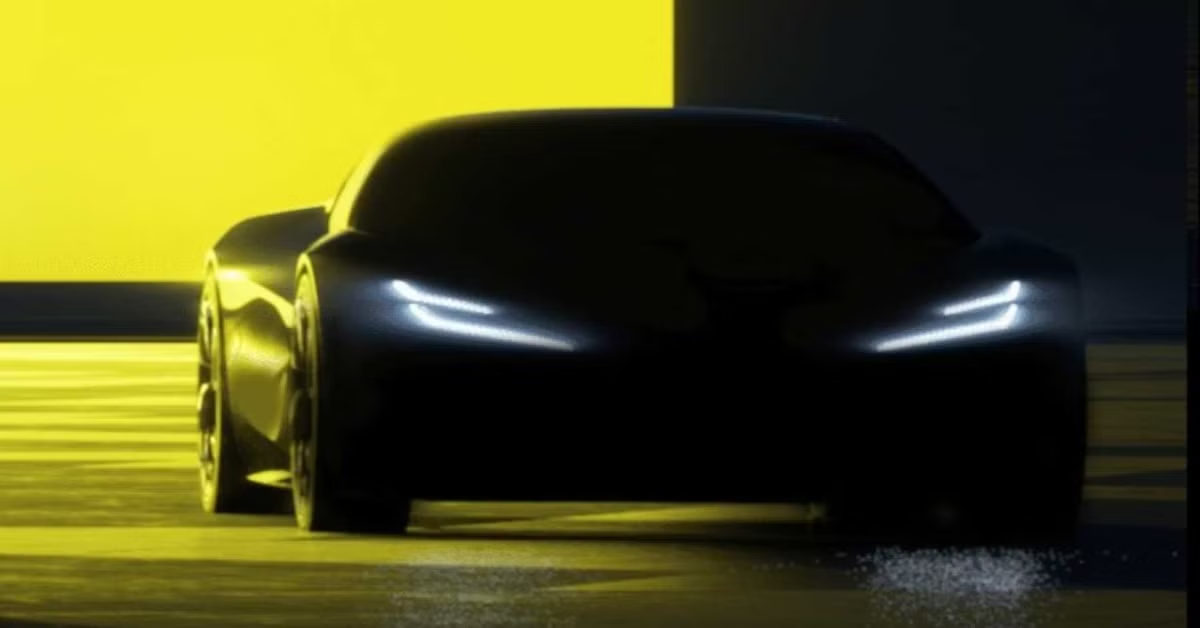
Lotus confirmed this week that its upcoming Type 135 supercar — almost certainly the reborn Esprit — will target more than 1,000 horsepower from a hybrid V8 while holding total weight to around 1.5 metric tons (3,307 lbs). Those numbers alone would make it a serious machine. But the more interesting story is the engineering logic behind them: Lotus is selecting every component in the hybrid system based on mass first, not output.

That’s a meaningful inversion. Ferrari and Porsche use hybrid hardware primarily as a power multiplier — the electric motor exists to push the number higher. At Lotus, the question being asked of each component is different: how light can we make it? CEO Feng Qingfeng laid out the philosophy during an August 27 earnings call, and Motor1 subsequently confirmed the approach directly with Lotus’s engineering team. Colin Chapman’s “simplify, then add lightness” doctrine, it turns out, translates to the electrified era without much translation at all.
F1 Technology Brought a 150-kW Motor Down to 20 Kilograms
The headline engineering achievement so far is the electric motor. A 150-kilowatt motor of the kind used in most hybrid supercars typically weighs between 75 and 95 kilograms (165–209 lbs). Lotus says it applied Formula 1-derived technology to bring that figure down to just 20 kg (44 lbs) — less than a quarter of the conventional weight for equivalent output. That’s not a rounding error; it’s a fundamental rethink of how the hardware is constructed.

The transmission is getting the same treatment. Lotus is co-developing an eight-speed dual-clutch gearbox with Horse — the powertrain joint venture owned by Geely and Renault — specifically engineered to handle the high torque of a hybrid V8 while keeping mass to a minimum. The 800-volt electrical architecture rounds out the hardware picture. High-voltage systems typically enable faster charging and more efficient power delivery, but Lotus is also leaning on the architecture’s ability to support lighter cabling and smaller components throughout the car.
In-House Powertrains for the First Time in Lotus History

Feng was direct about something Lotus has historically skirted around: the company’s reliance on outside suppliers for engines has been its “most significant handicap.” The current Emira illustrates the point — it uses either a Mercedes-AMG four-cylinder or a Toyota supercharged V6, depending on spec. Neither engine was developed with Lotus’s weight targets in mind.
The Type 135 changes that. By co-developing the V6 and V8 hybrid powertrains with Horse, Lotus retains creative control over the mass budget from the start of the engineering process rather than inheriting a supplier’s finished unit and working around it. Geely’s resources, global supply chain, and manufacturing scale handle the cost and production complexity; Lotus focuses on lightweight construction, aerodynamics, and chassis calibration. It’s a division of labor that plays to both partners’ strengths, and it’s the first time Lotus has had anything close to in-house powertrain development since the original V8 Esprit went out of production in 2004.
Electrification as Engineering Problem, Not Marketing Opportunity

Lotus is candid that hybrid power on the Type 135 is, at least in part, a regulatory necessity. Global emissions standards — particularly in Europe — make it increasingly difficult to homologate a large-displacement combustion engine without some form of electrification. Lotus isn’t pretending otherwise.
What separates the Type 135 approach is that Lotus refuses to treat the hybrid system as a power-inflation tool just because it has to include one. The target weight of 1.5 tons is being held as a hard constraint, not a stretch goal. Achieving it with an 800-volt architecture, a hybrid system, a V8, and electric motors on board is, by Feng’s own admission, “not easy.” A GT3 race car will accompany the road car when the Type 135 debuts in 2028, which means the weight discipline has to survive a motorsport program as well — there’s no soft version of this target.

The car will slot between the Emira and the Evija EV hypercar in Lotus’s lineup, and production is confirmed for the Hethel plant in Norfolk. That UK manufacturing base also matters for U.S. market access: cars built in Hethel sidestep the regulatory complications that have prevented the China-built Eletre and Emeya from reaching American buyers.
Chapman’s doctrine has survived badge changes, ownership shuffles, and now the hybrid era. Whether Lotus can hold the 1.5-ton target through to a 2028 production car is the real test — but the engineering discipline being applied to get there is exactly what Lotus fans have always wanted to see from a company with Geely’s resources behind it.

Related posts





Latest Post


No Comments