
10 Forgotten Muscle Cars That Still Look Dangerous
Walk up to any local classic car gathering this weekend, and you can predict the grid with terrifying accuracy. You’re going to see a sea of ’69 Camaros, a handful of pristine ’70 Chevelle SS 454s, and enough late-model Mustangs. The reason for this is obvious: those cars won the history books. They’re the muscle car icons. But if you’re the type of gearhead who hunts for the weird, angry-looking metal lurking in the corner of the lot, you know the history books left out some of the best hidden gems.

There was a brief, glorious window—roughly between 1969 and 1971—where Detroit went full-send before the EPA and insurance auditors caught up. Automakers were throwing massive blocks into anything, slapping on functional hood scoops, and spraying them in bright colors just to see what would happen. Then, almost overnight, gas prices and skyrocketing insurance premiums killed the party. The ten cars on this list may not be the popular choice today, but they still look dangerously good alongside the iconic muscle cars. But they don’t just look dangerous—they will beat you if you let them.
10
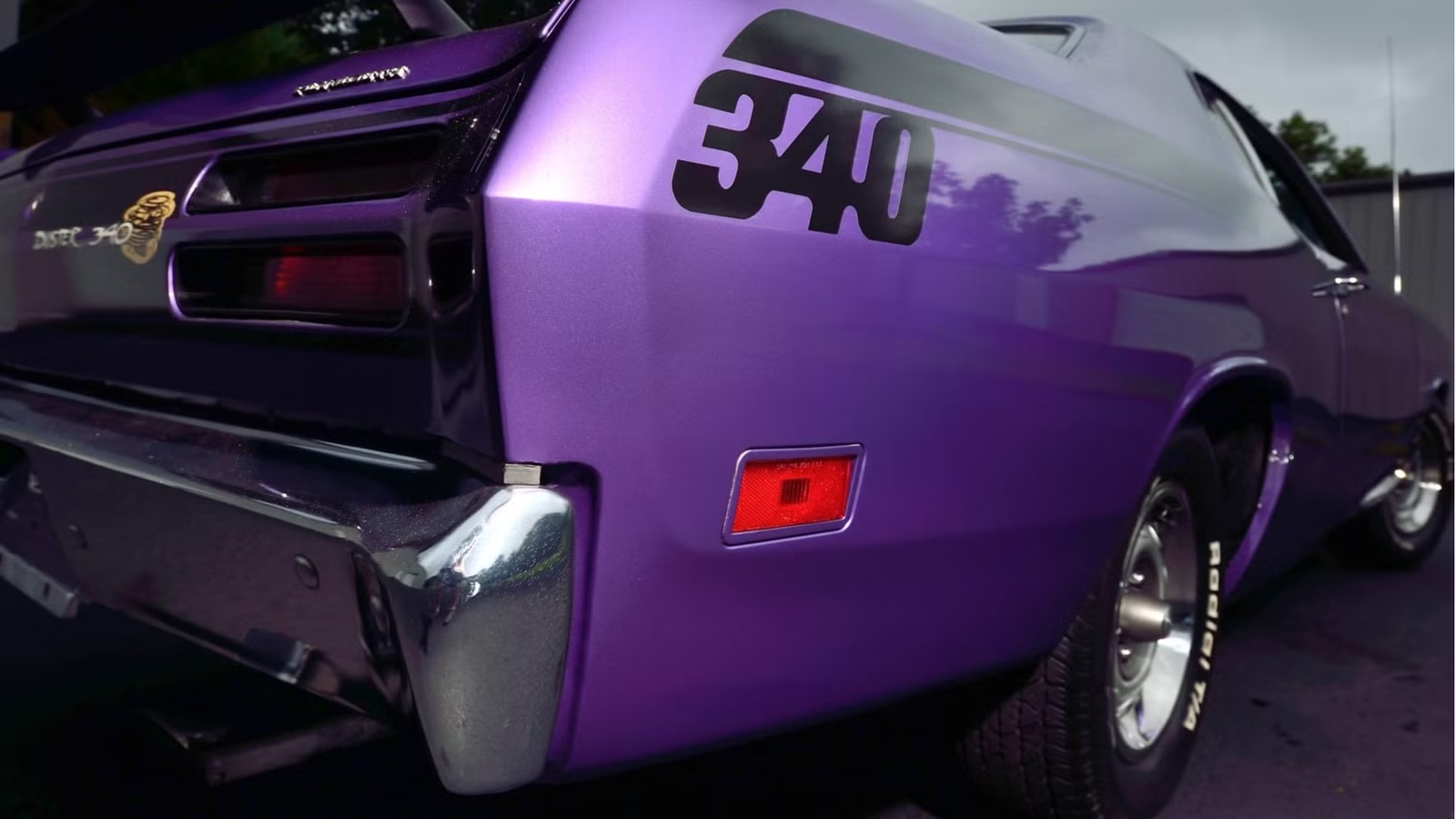
1970 Plymouth Duster 340
340 V8 – 275 hp
By 1970, insurance premiums were starting to crush young drivers who wanted big-block power. Plymouth’s response was pure genius: stop trying to make big blocks lighter, and start making small blocks faster. Enter the Duster 340. Built on the compact A-body platform, the Duster was cheap, lightweight, and had a fastback roofline that looked fast even with a slant-six. But when you ordered the 340 package, Plymouth dropped in a high-revving, small-block 340-cubic-inch V8 pushing 275 horsepower to the rear wheels.

Because the car weighed barely over 3,000 pounds, its power-to-weight ratio allowed it to easily gap much heavier big-block cars out on the street. The Duster 340 had a unique shark-tooth grille, dual exhaust tips snorting out a high-pitched small-block rasp, and a cartoonish “Duster” spinning-dust-cloud decal on the tail panel. It was a giant-killer. It looked sharp, handled far better than its big-block siblings, and proved you didn’t need a big 450-cubic-inch engine to be dangerously fast.
The 10 Rarest Street-Legal Muscle Cars Produced In The ’70s
We looked high and low for the most elusive muscle cars made during the 1970s, and these few are exceptionally rare.
9
1969 AMC SC/Rambler
390 AMC V8 – 315 hp

When American Motors Corporation wanted to prove they weren’t just building sensible economy cars for grocery runs, they didn’t just dip a toe into the muscle car world—they dove in. They teamed up with the transmission legends at Hurst Performance to build a factory street-legal drag racer. The result was the SC/Rambler.
Hurst took a featherweight, bare-bones Rambler Rogue chassis and stuffed AMC’s biggest engine under the hood: a 390-cubic-inch V8 pushing a highly underrated 315 hp and a massive 425 lb-ft of torque. Every single one came standard with a Borg-Warner T-10 close-ratio four-speed manual, a Hurst shifter, and a 3.54:1 Twin-Grip rear axle.
But it’s the styling that makes this car look flat-out hazardous. The standard “A-Scheme” paint job features a blinding white body accented by massive red side panels, blue racing stripes, and a snorkel hood scoop that looks less like an intake and more like an industrial chimney. Emblazoned on that scoop is bold text reading “AIR”, with an arrow pointing directly into the opening with the text “390 CU-IN.” It was totally unhinged and could run low-14s right off the showroom floor. Only 1,512 were ever built, making them a ghost at modern shows. You don’t see these, but when you do, they make a statement.
8
1970 Buick GSX
455 V8 – 360 hp

Buick built plush, comfortable highway land-yachts. Then came 1970: GM lifted its self-imposed 400-cubic-inch displacement limit for mid-sized cars, and Buick went absolutely wild with the Gran Sport, unleashing the GSX. Buick built just 678 GSX specials for the 1970 model year, making it one of the rarest production muscle cars in existence. You could only get it in two high-impact colors: Apollo White (280 built) or the loud, unmistakable Saturn Yellow (398 built). The appearance package said it all. A thick black stripe running the length of the body, a matching black hood treatment, a front chin spoiler, a heavy rear deck lid spoiler, and a factory hood-mounted tachometer canted toward the driver.
But the real magic was under the hood. While 278 came with the standard 455, the remaining 400 cars were optioned with the Stage 1 package. The Stage 1 featured high-flow cylinder heads, a hotter cam, and a massive quadrajet carb. While rated at 360 hp, it produced an astonishing, record-setting 510 lb-ft of torque at just 2,800 RPM. That torque rating remained an American production car record for decades. It was a luxury coupe that could humiliate Hemi-powered Mopars without breaking a sweat.
7
1971 Buick GS 455 Stage 1
455 V8 – 360 hp

By 1971, most manufacturers detuned their engines to run on lower-octane unleaded fuel, causing horsepower figures to plummet. But Buick still managed to preserve a massive amount of performance in the 1971 GS 455 Stage 1, making it one of the absolute last true heavy hitters of the golden era. While the loud graphics of the ’70 GSX were gone, the ’71 GS 455 Stage 1 wore its muscle in a tailored suit. It retained the functional dual-snouted hood scoops that fed cold air directly into the air cleaner, minimal chrome, and an aggressive split-grille design.
Buick dropped the compression ratio to 8.5:1, but thanks to massive valves and the efficient Stage 1 head design, the 455 big block still cranked out 345 hp and 460 lb-ft of torque. It was a sophisticated street brawler that could quietly pull up next to a screaming pony car, completely pull its doors off in the quarter-mile, and then drive home with the air conditioning blasting and the radio playing.
’70s Muscle Cars Collectors Are Quietly Buying Again
These underrated 1970s muscle cars are gaining momentum as collectors search beyond mainstream automotive icons.
6
1970 Oldsmobile 442 W-30
455 Rocket V8 – 370 hp

Oldsmobile always cultivated a “doctor’s car” image—sophisticated, luxurious, and mature. But in 1970, the engineers decided to let loose and build an absolute monster. The 442 was already a heavy hitter, but adding the legendary W-30 option package turned it into an elite-tier collector’s item. Very few people ticked that package, meaning they are incredibly rare today.
They featured a lightweight fiberglass dual-intake ram-air hood, aluminum intake manifolds, a high-lift cam, and distinct red plastic inner fender wells that saved weight and immediately tipped off anyone looking through the front wheel openings that this wasn’t a standard cruiser. With 500 lb-ft of torque twisting from the Rocket 455 V8, the W-30 had enough low-end grunt to alter the earth’s rotation. The subtle vertical bar grille, paired with the sweeping Hurst Dual-Gate shifter inside, gave it an air of sophistication mixed with lethal drag-strip capability.
5
1970 Ford Torino Cobra
429 Cobra Jet – 370 hp

While the Mustang Fastback took home all the glory, the 1970 Ford Torino Cobra was the car you bought if you actually wanted to go hunting on the interstate. Completely redesigned for 1970, the Torino grew longer, lower, and wider, trading its boxy 60s angles for an aerodynamic, fastback shape inspired by supersonic aircraft. The Cobra was the no-nonsense, budget-performance model in the lineup. It came standard with a blacked-out grille, exposed headlights, a Hurst shifter, twist-lock hood pins, and massive Cobra emblems on the fenders. It looked like it was going 100 mph while sitting on jack stands.
The real threat lived beneath that long hood: the 429 Cobra Jet engine. If you checked the box for the “Drag Pack” option, Ford upgraded you to the Super Cobra Jet, which added four-bolt mains, forged pistons, a solid-lifter camshaft, and a huge Holley carburetor. The Drag Pack also threw in a 3.91 or 4.30 rear axle with a Detroit Locker differential. It was an incredibly heavy, durable, over-built highway missile that collectors criminally overlook today in favor of the smaller pony cars.
4
1969 Chevrolet Nova SS 396
396 V8 – 375hp

Everyone loves the ’69 Camaro, but its stablemate, the Nova SS, always felt a little more violent. While standard Novas were bought by grandmas and high school teachers, checking the box for the L78 performance package converted this lightweight compact into an absolute weapon. The 1969 Nova SS 396 didn’t need wild spoilers or neon decals to look dangerous; its menace came from its stark simplicity.
With a blacked-out grille, subtle hood inserts, and small “SS” badges, it looked like a standard family sedan that had been rewired for demolition. Under the hood lived the iron-block 396 big block V8 punching out 375 hp. Because the Nova carried virtually no weight over the rear axle, driving an L78 was an exercise in managing chaotic wheelspin. It was loud, it rattled, and it lacked the refined manners of the Chevelle. It was a street-fighting machine designed to do one thing: obliterate anything lined up in the next lane.
The Fastest Muscle Cars Over The Quarter Mile In The ’70s
These American icons can lay down some seriously quick quarter times.
3
1970 Ford Ranchero GT (429 Cobra Jet)
429 Cobra Jet – 375 hp

Let’s address the elephant in the staging lane right upfront: yes, this is a car-based pickup. No, it is not a traditional coupe. It is essentially a pickup truck, a utility vehicle packed with a 429 Cobra Jet. It is one of the most sinister sleepers Dearborn ever forged. For 1970, Ford restyled the Ranchero with the sharp, aggressive, coke-bottle lines of the Torino. Drop the GT trim on it, and you got a blacked-out grille, hideaway headlights, a laser stripe running down the body, and a wide-mouth shaker scoop vibrating through the hood.
More importantly, it backed up the looks. Opt for the 429 Cobra Jet V8, and you were commanding 370 hp (though anyone with a dyno knows it was pushing closer to 400). Mated to a Toploader four-speed manual and a Traction-Lok rear end, this utility vehicle legitimately ran mid-14s on bias-ply tires. It bent the rules of the segment, but when a truck sounds like a literal thunderstorm and can smoke its rear tires through third gear, enthusiasts have to respect it.
2
1970 Dodge Coronet Super Bee
426 Hemi – 425 hp

Mention a 1970 Mopar big block, and everyone immediately pictures a Charger or a Challenger. But if you want a B-body that looks like it wants to physically bite you, the 1970 Dodge Coronet Super Bee is the undisputed king. For 1970 only, Dodge stylists gave the Coronet a completely unique front-end treatment known as the “twin-loop” or “bumblebee” wing grille. The chrome bumper split the front fascia into two massive, distinct loops, completely separating the headlights and surrounding a pair of blacked-out snorkels. It was highly polarizing back in the day—which is a major reason why sales plummeted and the car is so rare today—but decades later, it looks beautifully aggressive.
Add the optional “Ramcharger” hood, which featured twin functional scoops operated by a vacuum lever under the dash, and the Super Bee looked downright terrifying in a rearview mirror. Power came from either a 383 Magnum, a 440 Six-Pack (three two-barrel carbs), or the legendary 426 Hemi. It was loud, unapologetic, and completely Mopar styling at its peak.
10 Best Hemi-Powered Muscle Cars Ever Made
Both famous and infamous, read our top ten picks for the best Hemi-powered Mopars of all time.
1
1971 Plymouth GTX
426 Hemi – 425 hp

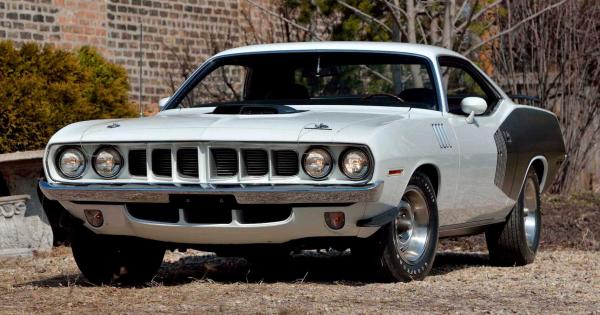
The 1971 model year brought a massive redesign to Plymouth’s intermediate lineup. They embraced the “Fuselage” styling trend—curved sides, deeply recessed grilles, and bumpers that were completely integrated into the bodywork. The result was a car that looked wider, meaner, and lower than anything that had come before it. The GTX was the pinnacle of this luxury-performance look.
The defining styling cue of the ’71 GTX was the loop front bumper that encased the hidden headlights and a deep-set grille. But the absolute party piece was the optional vacuum-operated Air Grabber hood. With the flip of a switch inside the cockpit, a flush-mounted panel on the hood would slowly rise up, revealing an aggressive scoop painted with a set of cartoon shark teeth.
Underneath that hood lived either a 440 Super Commando or a 426 Hemi. 1971 was the final standalone year for the GTX before it was folded into the Road Runner lineup as an option package, making these sleek, fuselage-style big blocks an incredibly rare sight on the road today. They represent the absolute twilight of pure, unadulterated muscle car styling.
Sources: General Motors, Chrysler, Ford.

Related posts


Latest Post


No Comments