
A New Tesla Patent Reveals A Deployable Rear Wing On A Two-Door Body, And It Points Straight At The Roadster
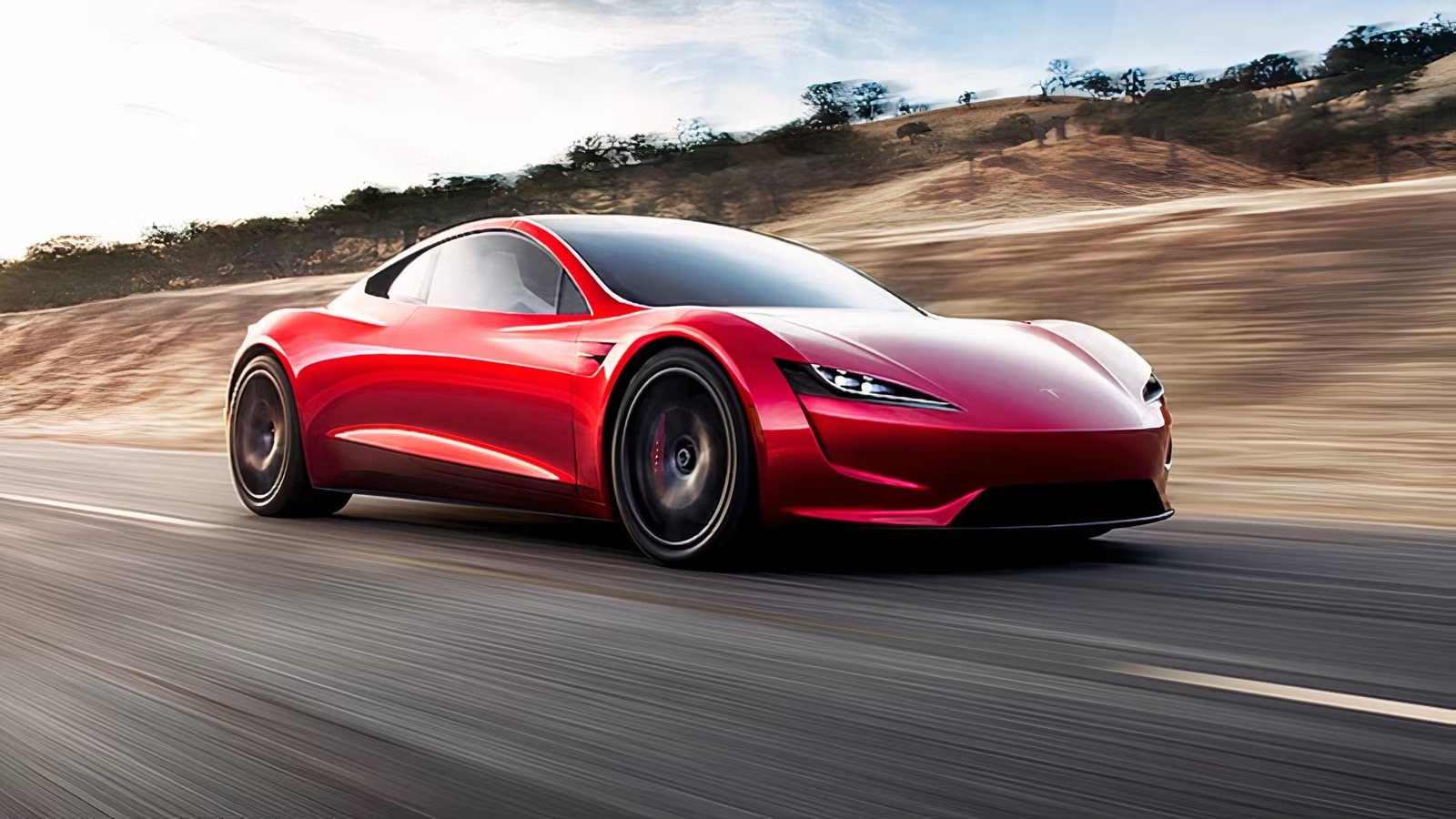
Tesla’s second-generation Roadster is less than a week from its October 1 debut at SpaceX’s Texas test site, and a freshly published patent is offering the clearest hardware detail yet on how the long-delayed hypercar will handle itself at speed. The filing, published this week with the United States Patent and Trademark Office, describes an active aerodynamic rear wing — one that sits flush with the bodywork when stowed, deploys to generate real downforce under hard acceleration or cornering, and can pivot to shed drag during high-speed runs.

This isn’t a passive spoiler managing airflow in a single fixed position. It’s a multi-mode system integrated directly into Tesla’s automated driver-assist software, capable of responding dynamically to what the car is doing — and even retracting automatically if a collision is predicted. For a car that has spent nearly a decade living mostly in the realm of powertrain promises and SpaceX thruster speculation, a patent this specific in its mechanical detail is a meaningful signal.
How the Deployable Wing System Actually Works
The distinction between a spoiler and a wing matters here. A spoiler manages airflow to reduce lift — it’s what you get on most performance road cars, including a standard Porsche 911. A wing, like the one on a 911 GT3, generates actual downforce by acting as an inverted airfoil, pushing the rear of the car into the pavement and increasing grip. Tesla’s patent describes the latter.

The system operates in at least three distinct states. Fully retracted, the wing sits flush with the body — clean lines, minimal drag at highway speeds. Deployed, it extends to maximize downforce for the kind of lateral grip and traction that matters in hard cornering or off-the-line acceleration. In a third mode, it pivots to a lower-drag angle, trading grip for top-speed efficiency. The software integration is what sets it apart from a speed-triggered spoiler: because the system ties into Tesla’s driver-assist stack, it can theoretically respond to sensor data in real time — adjusting based on speed, steering input, braking force, or an impending obstacle.
The Patent Drawings Hint at a Coupe, Not a Targa

One detail in the filing that will catch the attention of Roadster watchers: the accompanying drawings depict a two-door coupe body, not the targa-roof layout that has circulated in renderings and speculation for years. Whether that reflects the final production direction or simply represents a generic test-case body for the patent application isn’t confirmed, but it’s a notable data point this close to the reveal.
The Roadster prototype first appeared in 2017 — shown dramatically rolling off the back of a Semi at a Hawthorne event — and has been delayed repeatedly since. The October 1 launch event at SpaceX’s Texas facility is the first hard date Tesla has publicly committed to in years, which makes every technical detail surfacing ahead of it worth scrutinizing.
Aerodynamic Credibility Beyond the Powertrain Hype

The Roadster’s performance claims have always been extraordinary — sub-two-second zero-to-sixty times, a 250-mph-plus top speed, quarter-mile numbers that would embarrass purpose-built drag cars. The skepticism, fair or not, has centered on whether Tesla would engineer the chassis, aerodynamics, and dynamics to actually support those numbers at speed, or whether the car would be a straight-line spectacle that struggles when the road curves.
A deployable active wing doesn’t answer every question, but it does answer one of the important ones. Generating and managing downforce at hypercar speeds requires engineering commitment — it’s not something you bolt on as an afterthought. The sophistication described in this patent, particularly the software-linked collision-response behavior, puts the system in the same conversation as the active aero packages found on the McLaren 720S or the Porsche 911 GT3 RS. Whether it debuts on the current Roadster is still unconfirmed — patents don’t guarantee production — but the level of detail in this filing suggests the engineering work is well past the concept stage.
The SpaceX thruster package remains the wilder card. That rumored compressed-gas system has generated most of the headlines, but the wing patent is the concrete news: hardware-level proof that Tesla is thinking carefully about how the Roadster behaves when the road gets complicated, not just when the light turns green.
Six days out from the Texas reveal, the Roadster’s spec sheet is still mostly locked away. But a wing that knows when to bite and when to let go is exactly the kind of detail that separates a hypercar from a fast car. October 1 can’t come soon enough.

Related posts

Latest Post


No Comments