
How The U.S. Accidentally Helped Create Lexus’ Most Iconic Luxury Car While Trying To Save Detroit
In 1981, American automakers faced severe financial stress due to ongoing global financial disruptions. Car consumers across the U.S. increasingly chose fuel-efficient, reliable Japanese sedans over domestic alternatives. This resulted in Detroit losing significant market share every month.

To protect the domestic auto industry, the Reagan administration negotiated a Voluntary Export Restraint with Japan. This agreement capped Japanese passenger-car exports to the U.S. at approximately 1.68 million vehicles annually. Washington intended this restriction to limit Japanese competition and buy time for General Motors, Ford, and Chrysler to restructure their product lineups.
New Policies Developed Home-Grown Japanese Cars
The policy succeeded in limiting import volumes, but it triggered a fundamental shift in strategy. Deprived of the ability to expand market share through high-volume sales of compact cars, Japanese manufacturers reallocated their finite export allowances. Shipping low-margin economy cars no longer maximized corporate profit, so Japanese automakers realized that higher retail prices per unit would offset the volume ceiling. The trade quotas created a financial incentive to build and export premium vehicles.

Toyota faced a distinct customer retention problem alongside these trade barriers. Drivers who purchased reliable Toyota Corollas and Camrys in the 1970s progressed into higher income brackets by the early 1980s and now desired more luxurious options. Because Toyota offered no true luxury vehicle in North America, these loyal customers systematically migrated to European brands like Mercedes-Benz and BMW. Toyota executives identified both trade restrictions and customer attrition as urgent commercial challenges.
The Lexus Brand Introduced True Japanese Luxury To The U.S.

In August 1983, Toyota Chairman Eiji Toyoda initiated a secret project designated Flagship One. The project objective was to build a world-class luxury sedan capable of rivaling the best European flagships while outperforming them in quietness, ride quality, and high-speed stability. Toyota launched this program without reusing existing platforms, engines, or design components. The vehicle required a completely new design from the ground up.
The development scale of Project F1 set new industry standards. Over 1,400 engineers, 2,300 technicians, and 200 support staff joined the effort. Engineering teams constructed approximately 450 vehicle prototypes and tested over 900 engine prototypes. Test drivers logged millions of miles across German autobahns, North American deserts, and frozen Scandinavian tracks. Toyota assigned dedicated teams to refine micro-details, including the precise tactile resistance of interior switches and the acoustic profile of door latches.
Perfecting A Powerful And Reliable V-8 Engine

Engineers engineered a dedicated powertrain specifically for the vehicle. The resulting 4.0-liter 1UZ-FE V-8 engine featured dual overhead camshafts, four valves per cylinder, and aluminum construction. It delivered 250 horsepower with exceptional mechanical smoothness. Drive power was routed to the rear wheels, matching the traditional layout of premium European sedans. The aerodynamic body achieved a drag coefficient of 0.28, a benchmark figure for production sedans at the time.
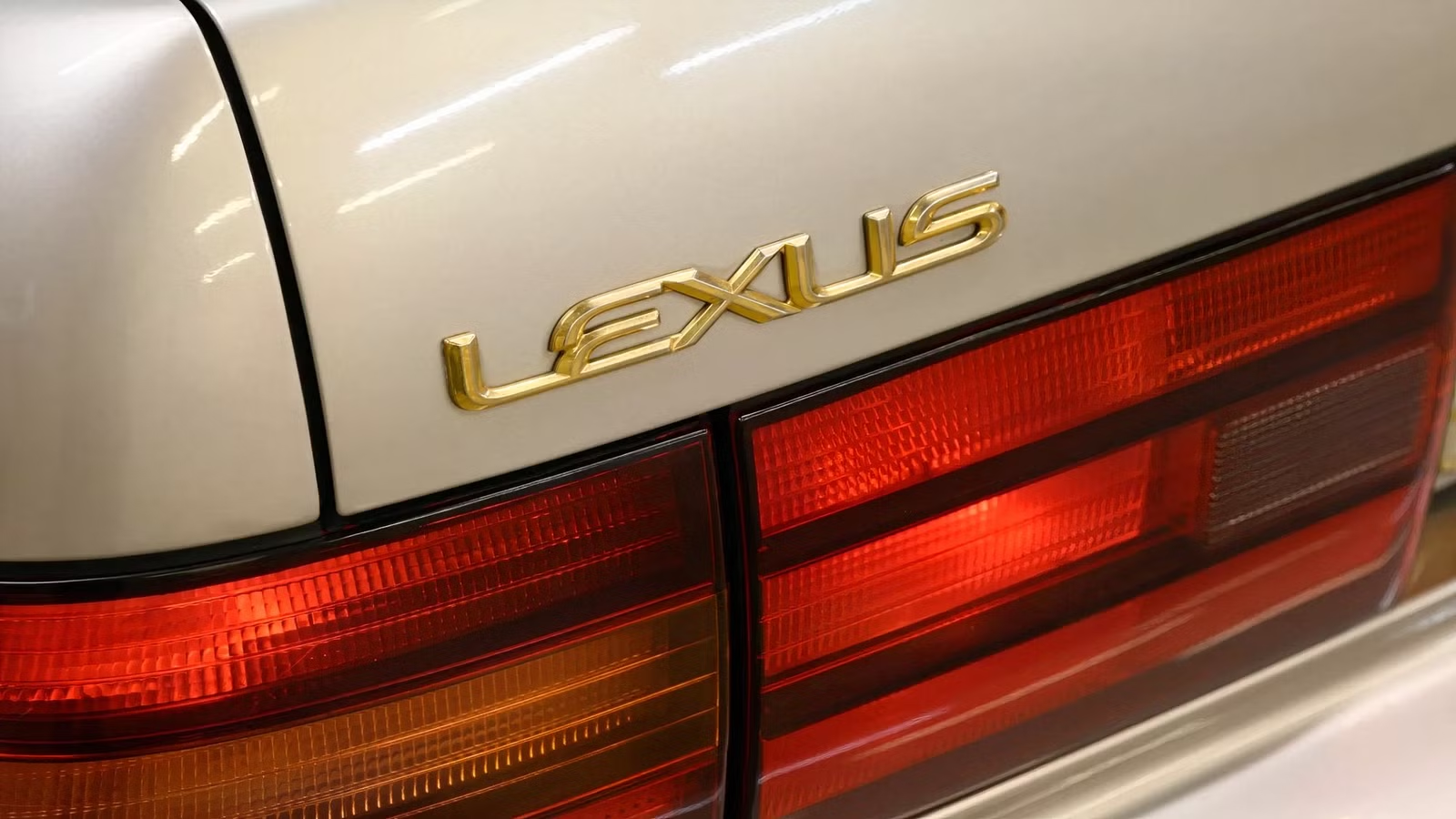
Toyota formally introduced the Lexus brand and its flagship LS 400 at the North American International Auto Show in Detroit in January 1989. The luxury sedan featured no visible visual connection or branding ties to standard Toyota products, and showcased quiet operation, rich interior materials, and rigorous build quality at a price point substantially below comparable European competitors.
The LS 400 Changed The Luxury Car Game Forever

The launch transformed the global luxury automotive market. Established domestic brands like Cadillac and Lincoln faced immediate pressure, while European manufacturers encountered a competitor operating with Japanese reliability standards and superior customer service practices. The Lexus LS 400 altered consumer expectations regarding luxury assembly standards and long-term mechanical dependability.
The protectionist trade measures of 1981 intended to insulate American carmakers from foreign economic competition. Instead, those quotas altered market dynamics. By capping export numbers, Washington encouraged Japanese automakers to move upmarket. The import restrictions served as a key catalyst that helped create the market conditions for the Lexus LS 400. That flagship vehicle permanently reshaped the competitive landscape for American and European luxury brands alike.
Toyota’s Billion Dollar Engine Development Project

Toyota engineered the 1UZ-FE V-8 after spending close to $1 billion and running 1.67 million real-world test miles across global climate zones. The resulting motor features a race-inspired bottom end constructed around a lightweight aluminum block, a forged steel crankshaft with eight counterweights, and robust six-bolt main bearing caps that secure the rotating assembly against high stress.
The double overhead camshaft valvetrain avoids failure-prone hydraulic lifters entirely, utilizing solid aluminum alloy valve lifters with steel outer shim adjusters that maintain exact tolerances over hundreds of thousands of miles. Pre-1995 versions feature a non-interference engine design, meaning a snapped timing belt will not cause the pistons to strike the valves, preventing catastrophic engine damage. This over-engineered construction was so mechanically sound that it later earned FAA approval for light aircraft use. This race-grade architecture gives the 1UZ-FE far greater mechanical longevity than the complex, leak-prone V-8 engines produced by contemporary European manufacturers.
The 1UZ Still Requires Hands-On Maintenance

Maintaining the 1UZ-FE engine requires basic preventive care to ensure its legendary durability remains intact. Owners must replace the rubber timing belt and water pump every 50,000 to 60,000 miles to maintain precise engine timing and cooling efficiency. While the engine block routinely exceeds 300,000 miles without requiring a rebuild, high-mileage examples require attention for specific age-related wear items. Leaking electronic control unit capacitors can cause random misfires or stalling.
Failing lower ball joints require inspection to prevent front suspension collapse, and power steering pump fluid leaks can drip onto the alternator directly below, causing electrical failure. Crucial repairs for existing used models consist almost entirely of aged suspension bushings, tired shock absorbers, and minor external oil leaks. It’s common to leave the engine internals untouched and healthy on its path to one million miles.
How Lexus Perfected The LS 400’s Ride

The LS 400 utilizes an advanced double-wishbone suspension architecture at all four corners to deliver an exceptional balance of ride comfort, body control, and high-speed stability. Toyota chose traditional steel coil springs and gas-pressurized shock absorbers over fragile pneumatic air springs or active hydraulic setups for standard models. This deliberate mechanical simplicity prevents the costly suspension sag, compressor burnouts, and blown hydraulic lines that routinely plague contemporary European luxury sedans as they age.
The double-wishbone geometry keeps the tire contact patch flat relative to the road surface during cornering and vertical suspension movement. This configuration isolates cabin occupants from sharp pavement impacts and road expansion joints while maintaining stable, predictable handling characteristics when cruising at highway speeds.
Bose Took The LS 400’s Suspension To The Next Level
The famous experimental active suspension fitted to the Lexus LS 400 prototype comes from the audio company Bose, spearheaded by Dr. Amar Bose himself. Starting in 1980 under “Project Sound,” this system replaced traditional springs and shock absorbers with high-speed linear electromagnetic motors at each wheel, controlled by a central computer that processed sensor data in real time. The technology proved revolutionary because it operated proactively rather than reactively.
Instead of responding to bumps or body roll after impact, the actuators instantly extended or retracted to neutralize road surface irregularities, keep the chassis completely flat during aggressive cornering or braking, and even allow the test sedan to literally leap over obstacles. Despite demonstrating an unmatched ride quality, the system never reached production because the massive weight of the electromagnetic motors, high electrical power requirements, immense production costs, and overall system complexity made commercial mass manufacture completely unviable for automakers.
A True Business-Class-Level Interior

Inside the cabin, the LS 400 offers a luxurious sanctuary constructed with premium leather upholstery, real California walnut wood trim, and precise panel fitment. Electroluminescent gauge clusters light up vividly behind dark glass, providing sharp instrument visibility under all exterior lighting conditions while reducing night driving eye strain.
Lexus LS 400 interior, closeup of front Optional features include a Nakamichi premium sound system, power-adjustable shoulder seat belts, and dual-zone climate control. The full-size cabin provides ample interior space for five adult occupants, offering 38.8 inches of front headroom, 43.5 inches of front legroom, 36.8 inches of rear headroom, and 34.1 inches of rear legroom. The rear luggage compartment holds 14.4 cubic feet of cargo space, easily accommodating multiple full-sized suitcases for extended cross-country travel.
The Lexus LS 400 Is An Affordable Luxury Classic

Current market values for first-generation Lexus LS 400 sedans reflect a growing appreciation among car enthusiasts, mechanics, and young collectors seeking dependable daily transportation. High-mileage driver-quality examples with minor cosmetic flaws sell between $3,000 and $6,000, offering reliable luxury transportation for the price of a used economy hatchback.
Well-maintained examples showing under 150,000 miles with documented service records command between $8,000 and $14,000 in the private market. Exceptionally preserved, low-mileage collector cars occasionally fetch over $20,000 at modern online auctions. Depreciation on early LS 400 models has fully bottomed out. Market values show steady upward appreciation as buyers recognize these nineties Japanese luxury sedans as virtually indestructible vehicles that quietly outlast modern cars.

Available Models
Lexus
- Founded
-
1989
- Founder
-
Eiji Toyoda, Toyota
- Headquarters
-
Nagoya, Japan
- Owned By
-
Toyota Motor Corporation
- Current CEO
-
Takashi Watanabe (President)
Sources: Lexus, MotorTrend, Edmunds, EPA, iSeeCars, and J.D. Power

Related posts


Latest Post


No Comments