
The Hybrid SUV That Quietly Became The Smartest Buy In America
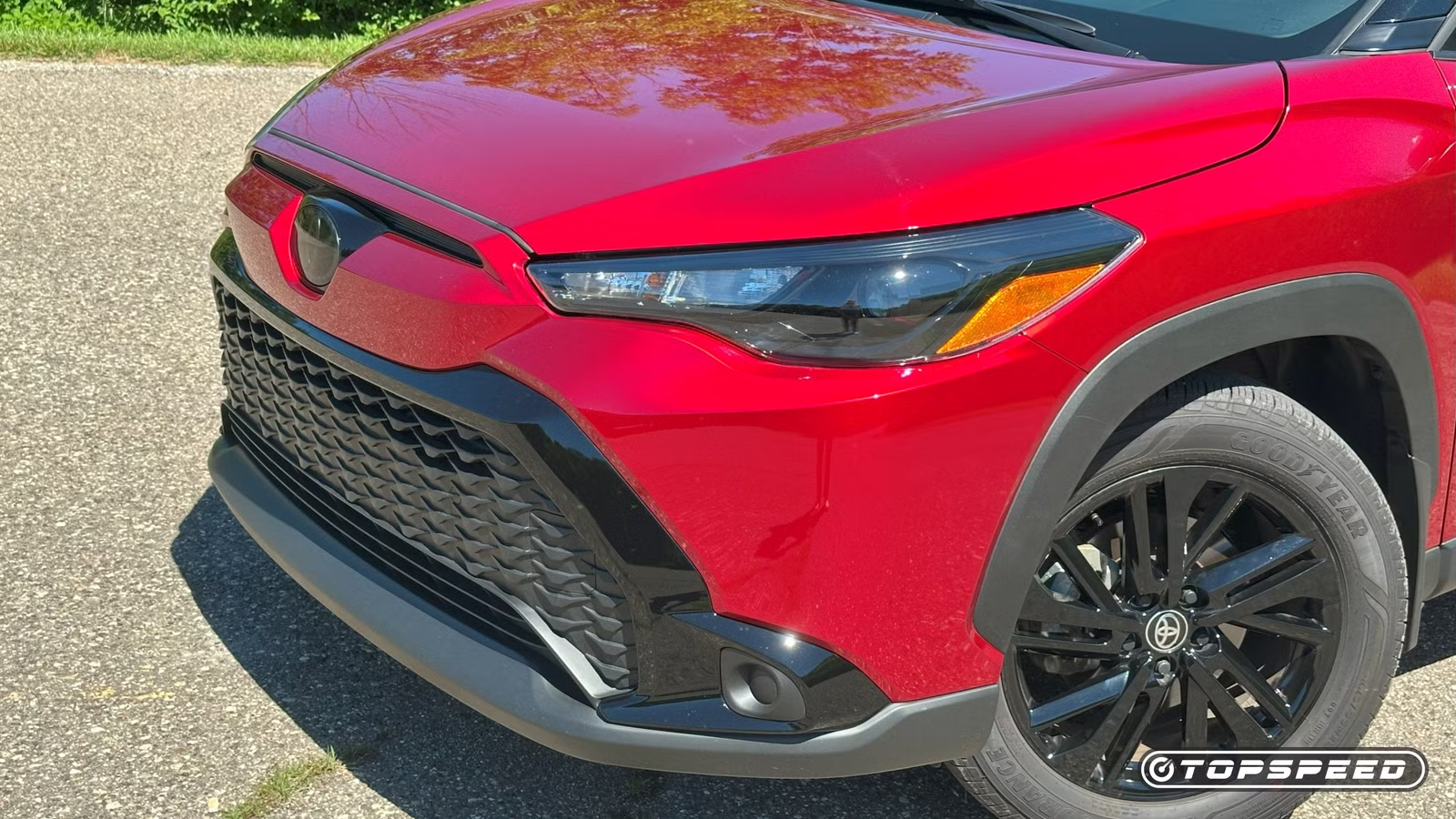
With fuel prices unpredictable and hybrid SUV transaction prices climbing steadily, finding a crossover that delivers genuine efficiency, standard all-wheel drive, and Toyota-grade dependability without pushing into RAV4 Hybrid territory feels nearly impossible. Yet one compact Japanese crossover manages nearly 42 MPG combined, starts well under $30,000, and still flies under the radar for most shoppers. It checks almost every practical box — and most buyers walk right past it.
The Affordable Hybrid SUV Hiding In Plain Sight

Most buyers shopping for a hybrid crossover expect to make a familiar trade-off. Either they stretch their budget for a larger, better-known SUV, or they settle for something smaller that saves fuel but gives up the all-weather confidence and daily practicality people now expect from this segment.
That is what makes this overlooked Toyota so interesting. It does not chase flash, record-breaking performance, or luxury-brand attention. Instead, it quietly focuses on the things that matter most to everyday drivers: excellent fuel economy, standard all-wheel drive, low ownership costs, and a starting price that still feels within reach. For shoppers who want hybrid efficiency without paying RAV4 Hybrid money, this may be the small SUV they have been walking past without realizing it.
And once the name is finally revealed, the real surprise is not just how affordable it is — it is how much Toyota managed to bundle into such an understated package.

The 2026 Toyota Corolla Cross Hybrid
America’s $29,595 Efficiency Secret

The popularity of compact crossovers and SUVs has surged in 2026. This solidifies the segment’s position as the dominant force in the American automotive market by capturing more than 40 percent of all new SUV purchases. It’s a shift largely driven by a significant migration of consumers away from traditional sedans in favor of vehicles that offer better daily versatility — combining the maneuverability and fuel efficiency of a smaller car with the elevated seating position and cargo flexibility of an SUV.
In an increasingly urbanized landscape across the U.S., higher-riding vehicles have become the preferred choice for buyers focused primarily on city commuting. New models also typically feature advanced driver assistance systems, which are now essential to the modern consumer. Furthermore, the segment has benefited from a rapid influx of hybrid and mild-hybrid options, which now account for a growing share of sales as manufacturers use modular platforms to lower production costs. American consumers are no longer willing to sacrifice utility for economy, instead gravitating toward the refined, tech-forward, and adaptable nature of the modern compact crossover.
That shift helps explain why Toyota’s broader SUV strategy has become so effective, and why this small hybrid fits neatly into a much larger takeover plan.
Toyota’s Dominant SUV Takeover

Toyota’s strategy in the U.S. for 2026 continues to center on a multi-pathway approach. The Japanese brand prioritizes a diverse lineup of crossovers and SUVs that cater to varying consumer needs rather than pivoting exclusively to battery-electric vehicles. This strategy has proven exceptionally successful. As of the first quarter of 2026, the brand’s hybrid vehicles accounted for over 50 percent of total sales volume — a milestone that reinforces their market dominance. Sales of their most popular compact and midsize utility models remain at historic highs.
Specific off-road-focused entries saw year-on-year surges as high as 84 percent for ICE variants and even more dramatic triple-digit growth for their hybridized counterparts as new generations reached dealerships. Toyota treats hybridization as a core powertrain pillar, often making it the standard or exclusive offering for high-volume models to normalize the technology. By integrating planetary gear-based power-split devices and high-capacity lithium-ion batteries across its catalog, the brand delivers a seamless driving experience that requires no change in consumer behavior. Toyota’s choice to standardize hybridization effectively captures 37 percent of buyers who prioritize long-term resale value and low maintenance costs over early adoption of fully electric platforms.
But the clearest expression of that strategy is not one of Toyota’s biggest or most expensive SUVs. It is the smaller, more affordable hybrid that quietly makes one of the strongest value arguments in the entire lineup.
The 2026 Toyota Corolla Cross Hybrid Is A Smart Buy
At $30,414 in five-year ownership costs — $6,645 less than the RAV4 Hybrid — the Corolla Cross Hybrid delivers premium efficiency at compact car prices.
The 2026 Corolla Cross Hybrid range starts at $29,595 for the entry-level S trim. The SE follows at $30,915, with the flagship XSE topping out at $33,630. This pricing makes the range a competitively positioned model that should appeal to most new-car buyers seeking a well-rounded hybrid. These figures exclude Toyota’s $1,450 destination, processing, and handling fee. The Corolla Cross rides on the same TNGA-C platform shared with the Corolla sedan and hatchback, and it is also a locally built model, assembled at Toyota’s Huntsville, Alabama, plant.
The Corolla Cross Hybrid is Toyota’s most affordable hybrid crossover, aimed at first-time buyers who spend most of their time in urban and suburban driving environments. It serves as a natural companion to the Corolla sedan and hatch lineup, but benefits from the brand’s more advanced gasoline-electric hybrid technology without the burden of a higher starting price.

The standard features for the 2026 Corolla Cross Hybrid include a seven-inch digital gauge cluster paired with an eight-inch touchscreen that supports wireless Apple CarPlay and Android Auto. Entry-level materials are straightforward, with fabric-trimmed 60/40-split fold-flat seating on the Hybrid S.

Moving up the trim ladder unlocks features that push the understated Corolla Cross into near-premium territory. The top-trim Hybrid XSE adds a 12.3-inch gauge cluster, a 10.5-inch touchscreen, a leather-trimmed heated steering wheel, premium upholstery, heated front seats, and wireless charging as standard amenities.
The equipment list makes it a compelling buy on paper, but the real reason this crossover stands out lies beneath the sheet metal.
Toyota’s Intelligent And Efficient Drivetrain

All four Corolla Cross trims share Toyota’s naturally aspirated 2.0-liter four-cylinder Atkinson-cycle engine and triple electric motor configuration, which made its first appearance in the current-generation Prius. A direct-drive eCVT channels a combined 196 horsepower and 152 pound-feet to all four wheels, resulting in a claimed 0–60 mph time of 7.3 seconds — a figure that independent tests have confirmed in real-world conditions. The engine and two electric motors drive the front wheels, while a third motor at the rear completes the all-wheel-drive setup. Beyond the acceleration numbers, the 196-horsepower hybrid system delivers something arguably more valuable: a 445-mile range per tank, meaning a trip from New York City to Washington, D.C., without a fuel stop.
In isolation, the combustion engine generates 169 hp and 152 lb-ft of torque. The front electric motors contribute 110 hp, while the rear motor adds 40 hp and 62 lb-ft. Toyota does not publish a combined torque figure. Compared to ICE-only crossovers it is not the most capable hauler, but the Corolla Cross Hybrid can tow up to 1,500 pounds when equipped with the optional Activity Mount.
Highly Favorable Fuel Consumption

The Corolla Cross Hybrid ranks among the most efficient hybrid crossovers currently available in the new-car market, posting EPA estimates of 46/39/42 MPG city/highway/combined. The 0.9-kWh battery pack means the drivetrain offers limited EV-only functionality — this is a conventional hybrid that uses its electric motors to reduce powertrain losses and lighten the combustion engine’s load, rather than providing meaningful zero-emission range. Even so, it will cover an impressive 445 miles from a single 10.6-gallon fill-up.
The Corolla Cross Hybrid’s running costs are another draw. The EPA estimates up to $3,750 in fuel savings over five years compared to the average new vehicle on sale today. Expect to spend around $1,400 on fuel annually, approximately $2.38 to drive 25 miles, and roughly $42 to fill the tank.
The Three Trade-Offs That Keep This Affordable Hybrid A Secret

Toyota’s efficiency-first approach to the Corolla Cross Hybrid comes with trade-offs worth understanding before signing anything. The most significant is the powertrain’s 0.9-kWh battery pack, which is small enough that it provides no meaningful electric-only driving range. This is a cost- and fuel-efficient hybrid, not an EV-adjacent plug-in.
Performance is the other concession. The combined 196 horsepower sounds adequate on paper, but the 7.3-second 0–60 time — while quicker than the gas-only version — can feel drawn out thanks to the droning of the engine under load. It is composed and comfortable at a steady pace, but drivers who regularly merge onto busy highways or pass on two-lane roads will notice that it feels more confident off the line than at higher speeds.
Cargo space is also tighter than the segment average. With 21.5 cubic feet behind the rear seats, the Corolla Cross Hybrid trails roomier compact rivals like the RAV4 and Hyundai Tucson Hybrid by a meaningful margin. For buyers regularly hauling strollers, sports gear, or anything beyond weekly groceries, that gap is a practical consideration that the efficiency numbers alone will not offset.
Close Competitors To Consider If You’re Not Sold On The Corolla Cross Hybrid

As noted, the Corolla Cross does come with a few trade-offs. When measured against the RAV4 and Hyundai Tucson Hybrid, the tighter cargo hold is a limitation that families and buyers with frequent hauling needs will feel more than they would like. That said, both of those competitors fall short on EPA figures and starting price.
The 2026 Kia Niro is the most competitive rival if outright speed is not a deciding factor, offering higher EPA estimates, more cargo room, and a lower starting price. The Niro also pairs its powertrain with a dual-clutch six-speed automatic transmission, which feels livelier than the eCVT in the Corolla Cross Hybrid. On the other hand, it produces less power and is slower to 60 mph at a leisurely 8.9 seconds. There is also no AWD option, which may be a dealbreaker for buyers in harsher climates. So while solid alternatives exist, none check as many boxes as the Corolla Cross Hybrid, making it an all-around smart buy despite its shortcomings.
It Remains An Underrated Niche

According to Toyota’s sales report for April 2026, 4,289 American consumers purchased a new Toyota Corolla Cross Hybrid so far this year, reflecting a 66.2 percent year-on-year decline in demand. Interestingly, the non-hybrid model is performing considerably better. The report reveals that Toyota sold 41,135 units during the first four months of the year, representing a 21.4 percent year-on-year decline.
J.D. Power gives the Toyota Corolla Cross range an 80/100 consumer-verified overall score, which includes 79/100 for quality and reliability, 75/100 for the driving experience, 88/100 for resale, and 78/100 for the dealership experience. iSeeCars assigns the same model an 8.8/10 retained value rating, indicating it will lose $9,918 — or 34.8 percent of its value — over five years, which is somewhat better than most of its key rivals.
Ownership Costs Make It A Smart Buy

According to Edmunds, owning a Toyota Corolla Cross Hybrid costs $30,414 over five years and 60,000 miles. That figure includes $3,381 in maintenance, $601 in repairs, and $8,401 in depreciation. CarEdge puts the average five-year ownership cost for the full range at $37,059, accounting for $9,940 in depreciation, $7,220 in fuel, and $1,873 in maintenance.
It is also a strong performer for long-term value retention. iSeeCars finds that after five years of ownership, the Corolla Cross Hybrid will lose $8,810 — or 30 percent of its value — which is modestly better than the current segment average.
Sources: Toyota, iSeeCars, CarEdge, J.D. Power, and the EPA.

Related posts




Latest Post


No Comments