
2027 Triumph Tiger 1200 Range First Look: Four Big Cats, Sharper Senses
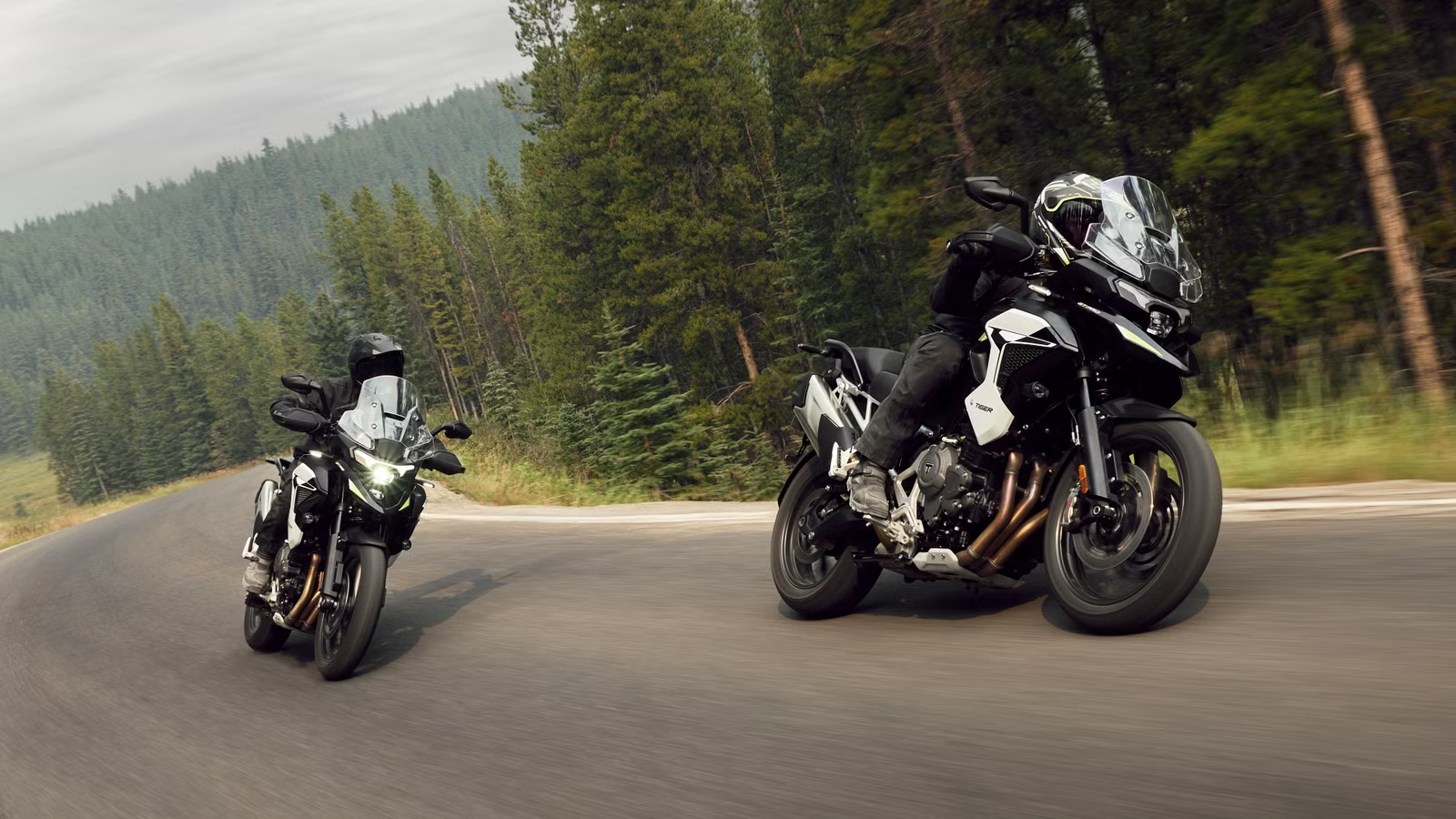
Triumph’s flagship ADV platform isn’t getting a mere facelift for the coming model year; its mission is changing. The entire 2027 Tiger 1200 range gets more power from its updated 1,160cc triple, front and rear Bosch radar, Apple CarPlay and Android Auto, and new SHOWA semi-active suspension that lowers the seat 1.2 inches when you come to a stop.

Yet the biggest shift is what each Tiger rolls on. All four models now run a 19-inch front and a 17-inch rear. The GTs move from a 19/18 setup to a 19/17 cast-aluminum combo, while the off-road-biased Rally versions trade their 21/18-inch wheel set for 19/17-inch spoked hoops. All in all, Triumph is going against the grain. While rivals keep releasing more off-road-focused ADV variants, it has taken the entire Tiger 1200 range road-first, leaving the Rally models as trail-capable options rather than dirt-focused specialists.
For a lot of riders, it’s the right call. Most big-bore ADV owners spend the vast majority of their miles on pavement, and the Tiger is now tuned for that reality. A 550-plus-pound motorcycle comes with some heavy penalties off-road, mostly due to its sheer size and heft, though the audience that rides these bikes in intense off-road terrain is relatively narrow.
All four models (GT Pro, Rally Pro, GT Explorer, and Rally Explorer) share the same engine, chassis, suspension, and electronics. Grab your Wheaties and settle in because this Tiger evolution is sizable.

Engine: More Top End, but the Real Story Is Down Low
Powering the Tiger range is Triumph’s 1,160cc liquid-cooled triple, with its T-plane crankshaft and uneven firing order. The T-plane’s character is to deliver a gruntier, almost V-twin-like pulse at low rpm instead of a conventional triple’s high-rpm purr. Bore and stroke stay at 90.0 x 60.8mm, and compression remains a high 13.2:1, though the cylinder head and pistons are new.
Claimed output rises to 155.8 hp at 9,250 rpm, a 7.9-hp gain over the previous model. Peak torque holds at 95.9 lb-ft, but it now arrives at 6,750 rpm instead of 7,000 rpm, and that often matters more in the real world than extra horsepower up top.
The gains come from physical updates, not a retune: lighter intake and exhaust valves, sharper fueling, camshafts with more progressive profiles, and a revised crankshaft and balancer shaft that optimize rotating mass. Together, they should add up to a freer-revving, smoother triple. A less restrictive, Euro 5+-compliant exhaust rounds out the changes.

The gearing was reworked as well. First, second, and third gears are revised, along with the primary and final-drive ratios. Combined with more torque just above idle, Triumph says crawl speed drops by about 3.7 mph, which means less clutch work and less fatigue in tricky trail sections and stop-and-go traffic.
Both the six-speed gearbox and, more importantly, the shaft final drive have been reworked to run quieter, shift more crisply, and smooth out on/off-throttle transitions. That’s a notable claim, since shaft drives are prone to clunky driveline lash. The brand’s bidirectional quickshifter is also updated.
Exhaust is a stainless 3-into-1 system with an underslung primary silencer and a side-mounted secondary can. Service intervals are 10,000 miles or 12 months, whichever comes first, though we’d encourage riders to change the oil well before the 10,000-mile mark. For a bike built to rack up miles, that’s a strong selling point, and the shaft drive means no chain to clean or adjust in between.
Chassis and Suspension: Tigers That Kneel at Stops
Wheels and Tires
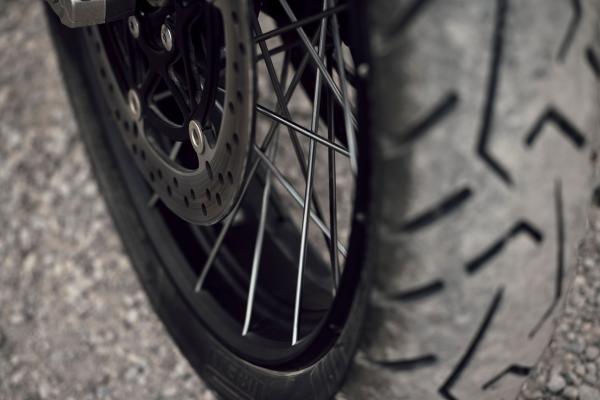
All models now use a 19 x 3.0-inch front and a 17 x 4.5-inch rear, with a 120/70R19 front tire and a 170/60R17 rear. The GTs get cast-aluminum 10-spoke wheels; the Rallys get side-laced spoked wheels. Suspension travel is 7.9 inches (200mm) front and rear on every model. For the Rallys, that’s a sacrifice: the outgoing versions had 8.7 inches (220mm) at each end, so they give up 0.8 inch of travel along with the 21-inch front wheel.
The updated wheel sizes do make life easier when it’s time to find new rubber. A 170/60R17 is one of the most common rear sizes in the ADV segment, and 120/70R19 is just as common up front. Owners will have plenty of choices, with options ranging from street-biased to more off-road-oriented 50/50 rubber. Hardcore off-road ADV fans do lose out a bit with this change, since the most aggressive knobbies are still more plentiful in 21-inch front and 18-inch rear wheel sizes. Riders tackling deep sand, rocky terrain, and rutted passes will miss the 21-inch front, since it rolls over obstacles more easily, but the 19-inch hoop is a balanced design choice. It will likely outperform the larger 21-inch wheel on the road, and the off-road sacrifices won’t matter to most owners. During the technical presentation, Triumph said the move was in response to current customer surveys, signaling that the heavyweight ADV off-road riding demographic was limited.

Frame and Geometry
The basic architecture carries over. It’s a tubular-steel frame featuring a bolt-on aluminum rear subframe, meaning it can be replaced fairly promptly. The Tri-Link aluminum swingarm houses the shaft drive and uses twin aluminum anti-torque struts. Rake is 24.3 degrees, trail is 4.5 inches (115mm), and wheelbase is about 61.7 inches (1,567mm).
Claimed wet weight ranges from 551 pounds for the GT Pro to 591 pounds for the Rally Explorer, which carries the larger fuel tank. That’s typical for the liter-plus adventure class, and it’s exactly why the next feature matters.

Showa EERA Heightflex Suspension
Every Tiger 1200 uses Showa Electrically Equipped Ride Adjustment (EERA) Heightflex semi-active suspension is a mouthful to say, but it’s just as loaded in terms of features, too. Up front is a 49mm inverted fork; out back is a monoshock with automatic self-leveling preload. Fed by a six-axis IMU and other sensors, the system tweaks compression and rebound damping on the fly, while automatic preload keeps ride height steady whether you’re solo, two-up, or packed for a week.
You now get three damping settings: Firm, Medium, and Soft. They have their own button, separate from the riding modes. That’s a meaningful usability fix. On many bikes, changing suspension feel means switching riding mode, which also changes throttle response and traction control. Here you can soften the ride for broken pavement without touching anything else. A new hydraulic secondary bump stop adds control when the suspension is pushed hard over rough terrain.

Auto-Lowering and Seat Heights
The headline feature is automatic ride-height adjustment, and it builds on something the Tiger already had. Since late 2023, every Tiger 1200 has offered Active Preload Reduction, which reduced rear preload as the bike slowed to drop the seat by up to 0.8 inch (20mm). It had two catches: the rider had to switch it on by holding the Home button for a second, and the actual drop depended on how much weight was on board.
The new Showa system addresses both problems simultaneously. It works automatically, monitoring speed and braking as you slow and lowering the rear ride height accordingly. Triumph says it drops the seat about 1.2 inches (30mm) every time, whether you’re solo, two-up, or loaded with luggage. The old system topped out at 0.8 inch (20mm), and how much it actually dropped depended on how much weight was on board. Pull away, and the bike rises back to its normal height within a few seconds. The Tiger now stands alongside the Harley-Davidson Pan America Special (the somewhat unlikely pioneer of automatic ride-height adjustment in the ADV class), Ducati’s Multistrada V4 S, and BMW’s R 1300 GS, rather than a step behind them.

In North America, every Tiger 1200 can be fitted with either a cushier comfort seat or a low seat that sits 0.8 inch (20mm) lower, and both have two positions 0.8 inch apart. Measured at a standstill with the suspension lowered, the comfort seat ranges from 31.9 to 32.7 inches (810–830mm) and the low seat from 31.1 to 31.9 inches (790–810mm). Add 1.2 inches once you’re rolling; the low seat in its lower position, for example, sits at 32.3 inches (820mm) on the move.
The cleanest seat-height comparison with the outgoing Tiger 1200s uses measurements with no suspension lowering applied. All four 2027 Tiger 1200s now share one seat-height range, which shakes out like this: the comfort seat sits at 33.1 or 33.9 inches (840 or 860mm), depending on position, and the low seat at 32.3 or 33.1 inches (820 or 840mm). For context, the outgoing GTs’ standard seat ranged from 33.5 to 34.3 inches (850–870mm), while the old Rally variants sat between 34.4 and 35.2 inches (875–895mm). That puts the new comfort seat 0.4 inch (10mm) lower than the old GT seat in either position, and 1.4 inches (35mm) lower than the old Rally seat. The 2027 Rally models see the biggest drop, and that’s no coincidence. Giving up 0.8 inch of suspension travel and trading the taller 21/18-inch wheels for 19/17s brought them down to the GTs’ level.

The same hardware powers a new Center Stand Assist feature. Drop the center stand, and the shock momentarily cranks up preload, lifting the tail, so, the bike goes up with far less heave, even with full luggage installed, according to Triumph. Anyone who has wrestled a loaded ADV bike onto its stand at a campsite will appreciate that.
Brakes
Braking hardware carries over, which is fine, because it was already top-shelf kit. Up front are twin 12.6-inch (320mm) floating discs with Brembo M4.30 Stylema four-piston monobloc radial calipers, fed by a span-adjustable Magura HC1 radial master cylinder. The rear uses a single 11.1-inch (282mm) disc and a single-piston Brembo caliper.
Electronics: Radar at Both Ends and a Dash That Speaks Your Phone’s Language

The Radar Suite
Previously, rear radar for blind-spot detection was limited to pricier Explorer models. Now, the Tiger 1200 range carries Bosch radar front and rear, running a suite of Advanced Rider Assistance Systems (ARAS) that riders can tailor function by function.
Cruise Functions (Front Radar)
- Adaptive Cruise Control (ACC): Keeps pace with traffic, holding either your chosen speed or a chosen gap to the vehicle ahead and working both the throttle and the brakes to do it. Comfort and Dynamic settings change how assertively it reacts.
- Overtake Assist: Readies the bike for a pass when you hit the turn signal and the blind spot is clear, instead of hanging back at the set following distance.
- Curve Speed Control: Can trim speed through longer sweepers, but only in ACC’s Comfort setting.
- Group Ride Assist: Uses the radar to maintain an appropriate gap based on your speed and where the bikes ahead are riding. This is a smart addition. Staggered group formations have historically confused motorcycle ACC systems, which are built to track one vehicle directly in front.
- Dynamic Cruise Control: A separate cruise control mode that ignores traffic and just holds your speed. Unlike basic throttle-only cruise, it can call on engine braking and the brakes.
Forward Protection (Front Radar)
- Riding Distance Assist: Maintains distance from other vehicles by acceleration and, when necessary, braking for you.
- Forward Collision Warning: Alerts riders via a notification on the instrument panel. If the gap keeps closing, it sends a haptic pulse through the rear brake pedal. That second stage is clever: you feel it through your boot even if your eyes aren’t on the screen.
- Emergency Brake Assist: A new safety feature that steps in during hard stops. If it senses an impact is likely, it adds extra brake pressure. Essentially, it boosts braking you’ve started. During the technical briefing, Triumph stated that the system does not apply brakes on its own and emphatically positioned it as an assistance feature.
Rear Awareness (Rear Radar)
- Blind Spot Assist: Warns of vehicles in your blind spot, or closing in quickly from behind, with warning lights in the mirrors.
- Rear Distance Warning: tells you when someone is tailgating.

The Rest of the Electronics
All of these features work alongside the Tiger’s existing cornering ABS and traction control, which draw on the six-axis IMU and wheel-speed data to judge intervention.
Radar-assisted cruise control is no longer exotic in this class, but a full front-and-rear package with blind-spot and tailgater warnings puts the Tiger on equal footing with the segment’s tech leaders, BMW and Ducati, and a step ahead of KTM, whose 1390 Super Adventure S Evo uses front radar only.

All of this is managed via the new 7-inch glove-friendly touchscreen TFT display, featuring wireless Apple CarPlay and Android Auto for navigation, media, and messaging. The touchscreen only responds below about 1.2 mph (2 km/h). Once rolling, riders navigate with the now-backlit switch cubes or use voice commands via Siri on an iPhone or Google Gemini on Android.
The screen carries an IP6K9K rating against dust and water, uses optically bonded, glare-cutting glass, and adjusts its own brightness to suit the light. It seems like marketing fluff, but these features will help in the bright, dusty environments that ADV bikes often inhabit.
The new phone bay is a nice update, one that many brands have adopted. The sealed cubby sits atop the fuel tank and offers USB-C charging at up to 3A/15W, while vents and a fan that kicks on automatically keep the phone from cooking under heavy load, such as when running navigation or other media.

The GTs get seven riding modes: Road, Rain, Eco, Sport, Off-road, and two customizable Rider modes. The Rallys add an eighth, Off-road Pro. Modes adjust throttle response, ABS, traction control, and engine braking. You can now select Off-road modes while moving, so there’s no need to come to a complete stop and confirm choices.
A new adaptive LED projector headlight adds cornering elements in two stages, at 15 and 30 degrees of lean, to brighten the inside of a turn. A small electric motor re-aims the beam as the suspension rises and falls. That’s essential on a bike whose ride height now changes on its own. A new DRL, separate LED marker lights, and rear LED units that combine turn signals and taillights round out the lighting.
Every model comes with heated seats front and rear and three-level heated grips. The redesigned seats use foam about 0.4 inch (10mm) thicker, and Triumph revised the ergonomics overall. The bodywork is restyled too, with a new tank, radiator shrouds, beak, and windscreen, but the big Tiger is still fairly easy to spot in the wild.
Choosing Your Tiger: Two Questions, Four Bikes
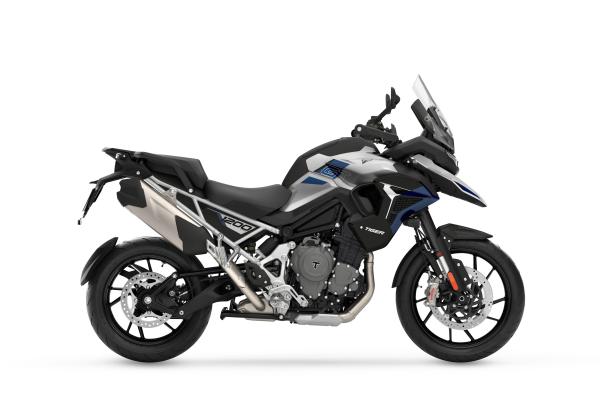
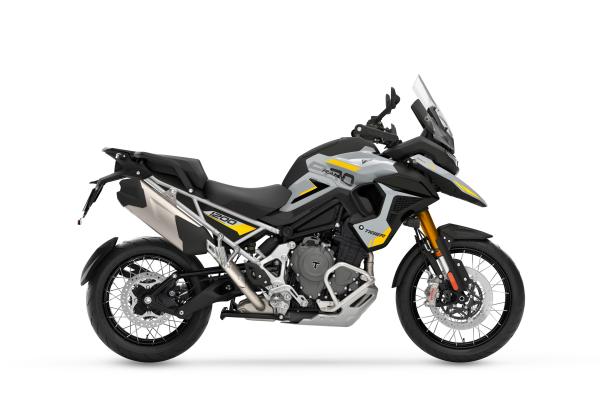
Picking a Tiger 1200 comes down to two choices. GT or Rally decides how much off-road equipment you get. Pro or Explorer decides how far you go between fill-ups.
GT vs. Rally
GT models use cast-aluminum wheels and are aimed at the road. Rally models swap in side-laced spoked wheels, which take hard off-road hits better. The Rally machiens lean even far more into off-road territory by adding the Off-road Pro riding mode, engine protection, and an adjustable, folding rear brake pedal.
With wheel sizes and travel now shared, the gap between GT and Rally is narrower than it used to be. In practice, the Rally is now the GT with the hardware you’d otherwise buy from the accessory catalog before your first dirt road.


Pro vs. Explorer
Pro models carry a 5.3-gallon tank. Explorers carry 7.9 gallons and add a Tire Pressure Monitoring System (TPMS), Explorer-specific lower engine bars, and handlebars 0.4 inch taller and wider than the Pro’s. The Rally Explorer also gets upper engine bars.
Triumph’s mpg claim is 40.1 for all Tigers. Naturally, your mileage will vary, but at that rate, the Explorer’s larger tank is good for roughly 350 miles, against about 235 miles for the Pro. In exchange, the GT Pro and Rally Pro are 22 and 29 pounds lighter, respectively, than their GT Explorer and Rally Explorer counterparts.
One thing stands out: TPMS is Explorer-only. On a top-tier adventure bike with radar and semi-active suspension, leaving tire-pressure monitoring off the Pros is a curious omission.
At A Glance:
|
GT Pro |
Rally Pro |
GT Explorer |
Rally Explorer |
|
|---|---|---|---|---|
|
Wheels |
Cast aluminum |
Wire-spoke |
Cast aluminum |
Wire-spoke |
|
Fuel capacity (gal) |
5.3 |
5.3 |
7.9 |
7.9 |
|
Riding modes |
7 |
8 |
7 |
8 |
|
Off-road equipment |
— |
Off-road Pro mode, engine protection, folding brake pedal |
— |
Off-road Pro mode, engine protection, folding brake pedal, upper engine bars |
|
Touring equipment |
— |
— |
TPMS, lower engine bars, taller/wider bars |
TPMS, lower engine bars, taller/wider bars |
|
Wet weight (lb, claimed) |
551 |
562 |
573 |
591 |
|
MSRP |
$22,995 |
$23,995 |
$24,995 |
$25,995 |
Options: Colors and Luggage

Triumph’s Evo luggage system, developed with GIVI, carries over and gains a new 58-liter (15.3-gallon) top case that can fit two full-face helmets, alongside the existing 42-liter (11.1-gallon) case. Both are aluminum, come in silver or anodized black, and can have an optional passenger backrest. The matching side cases can be fitted with waterproof liners, and Trekker soft luggage is also available.
Color choices are Sapphire Black or Aluminum Silver/Pacific Blue for the GT Pro; Aluminum Silver/Pacific Blue or Granite for the GT Explorer; Matte Khaki Green or Ash Grey for the Rally Pro; and Ash Grey/Sapphire Black or Matte Khaki Green for the Rally Explorer.
Pricing and Availability

The 2027 Tiger 1200 range is open for orders now in the U.S. and Canada, with bikes arriving at dealers beginning in December 2026.
Pricing in the United States starts at $22,995 for the GT Pro, $23,995 for the Rally Pro, $24,995 for the GT Explorer, and $25,995 for the Rally Explorer. Each step up the U.S. range adds $1,000, so the fully loaded Rally Explorer costs $3,000 more than the GT Pro.
2027 Triumph Tiger 1200 Range Photo Gallery:
2027 Triumph Tiger 1200 Range Specifications:
Engine:
|
Model |
GT Pro |
Rally Pro |
GT Explorer |
Rally Explorer |
|
Type |
Inline three-cylinder |
Inline three-cylinder |
Inline three-cylinder |
Inline three-cylinder |
|
Displacement |
1160cc |
1160cc |
1160cc |
1160cc |
|
Bore x stroke |
90.0mm x 60.8mm |
90.0mm x 60.8mm |
90.0mm x 60.8mm |
90.0mm x 60.8mm |
|
Maximum horsepower |
155.8 horsepower at 9,250 rpm, claimed |
155.8 horsepower at 9,250 rpm, claimed |
155.8 horsepower at 9,250 rpm, claimed |
155.8 horsepower at 9,250 rpm, claimed |
|
Maximum torque |
95.9 lb-ft at 6,750 rpm, claimed |
95.9 lb-ft at 6,750 rpm, claimed |
95.9 lb-ft at 6,750 rpm, claimed |
95.9 lb-ft at 6,750 rpm, claimed |
|
Compression ratio |
13.2:1 |
13.2:1 |
13.2:1 |
13.2:1 |
|
Valvetrain |
DOHC; 4 valves per cylinder (12 valves total) |
DOHC; 4 valves per cylinder (12 valves total) |
DOHC; 4 valves per cylinder (12 valves total) |
DOHC; 4 valves per cylinder (12 valves total) |
|
Fueling |
Multipoint sequential electronic fuel injection w/ electronic throttle control (ride-by-wire). |
Multipoint sequential electronic fuel injection w/ electronic throttle control (ride-by-wire). |
Multipoint sequential electronic fuel injection w/ electronic throttle control (ride-by-wire). |
Multipoint sequential electronic fuel injection w/ electronic throttle control (ride-by-wire). |
|
Exhaust |
Stainless steel 3-into-1 header system w/ underslung primary silencer and side-mounted secondary silencer. |
Stainless steel 3-into-1 header system w/ underslung primary silencer and side-mounted secondary silencer. |
Stainless steel 3-into-1 header system w/ underslung primary silencer and side-mounted secondary silencer. |
Stainless steel 3-into-1 header system w/ underslung primary silencer and side-mounted secondary silencer. |
|
Cooling |
Liquid |
Liquid |
Liquid |
Liquid |
|
Transmission |
6-speed w/ Triumph Shift Assist (clutchless upshifts and downshifts) |
6-speed w/ Triumph Shift Assist (clutchless upshifts and downshifts) |
6-speed w/ Triumph Shift Assist (clutchless upshifts and downshifts) |
6-speed w/ Triumph Shift Assist (clutchless upshifts and downshifts) |
|
Clutch |
Wet multi-plate w/ slip and assist function. Cable actuated. |
Wet multi-plate w/ slip and assist function. Cable actuated. |
Wet multi-plate w/ slip and assist function. Cable actuated. |
Wet multi-plate w/ slip and assist function. Cable actuated. |
|
Final drive |
Shaft drive. |
Shaft drive. |
Shaft drive. |
Shaft drive. |
Chassis:
|
Frame |
Tubular steel w/ forged aluminum components; bolt-on aluminum rear subframe. Tri-Link aluminum swingarm w/ twin aluminum anti-torque struts and integrated shaft drive |
Tubular steel w/ forged aluminum components; bolt-on aluminum rear subframe. Tri-Link aluminum swingarm w/ twin aluminum anti-torque struts and integrated shaft drive |
Tubular steel w/ forged aluminum components; bolt-on aluminum rear subframe. Tri-Link aluminum swingarm w/ twin aluminum anti-torque struts and integrated shaft drive |
Tubular steel w/ forged aluminum components; bolt-on aluminum rear subframe. Tri-Link aluminum swingarm w/ twin aluminum anti-torque struts and integrated shaft drive |
|
Front suspension; travel |
Showa EERA HEIGHTFLEX semi-active 49mm upside-down fork; electronically adjusted damping w/ Firm, Medium and Soft settings; 7.9 inches (200mm) |
Showa EERA HEIGHTFLEX semi-active 49mm upside-down fork; electronically adjusted damping w/ Firm, Medium and Soft settings; 7.9 inches (200mm) |
Showa EERA HEIGHTFLEX semi-active 49mm upside-down fork; electronically adjusted damping w/ Firm, Medium and Soft settings; 7.9 inches (200mm) |
Showa EERA HEIGHTFLEX semi-active 49mm upside-down fork; electronically adjusted damping w/ Firm, Medium and Soft settings; 7.9 inches (200mm) |
|
Rear suspension; travel |
Showa EERA HEIGHTFLEX semi-active monoshock w/ automatic self-leveling preload, Auto Ride Height (lowers seat 1.2 inches/30mm at a stop) and hydraulic secondary bump stop; 7.9 inches (200mm). |
Showa EERA HEIGHTFLEX semi-active monoshock w/ automatic self-leveling preload, Auto Ride Height (lowers seat 1.2 inches/30mm at a stop) and hydraulic secondary bump stop; 7.9 inches (200mm). |
Showa EERA HEIGHTFLEX semi-active monoshock w/ automatic self-leveling preload, Auto Ride Height (lowers seat 1.2 inches/30mm at a stop) and hydraulic secondary bump stop; 7.9 inches (200mm). |
Showa EERA HEIGHTFLEX semi-active monoshock w/ automatic self-leveling preload, Auto Ride Height (lowers seat 1.2 inches/30mm at a stop) and hydraulic secondary bump stop; 7.9 inches (200mm). |
|
Wheels |
Cast aluminum alloy, 10-spoke |
Side-laced wire-spoke. Tubeless. |
Cast aluminum alloy, 10-spoke |
Side-laced wire-spoke. Tubeless. |
|
Front wheel |
19 x 3.0 |
19 x 3.0 |
19 x 3.0 |
19 x 3.0 |
|
Rear wheel |
17 x 4.5 |
17 x 4.5 |
17 x 4.5 |
17 x 4.5 |
|
Tires |
Radial |
Radial |
Radial |
Radial |
|
Front tire |
120/70R19 |
120/70R19 |
120/70R19 |
120/70R19 |
|
Rear tire |
170/60R17 |
170/60R17 |
170/60R17 |
170/60R17 |
|
Front brake |
Dual 320mm floating discs w/ Brembo M4.30 Stylema 4-piston monobloc radial-mount calipers; Magura HC1 span-adjustable radial master cylinder w/ separate reservoir |
Dual 320mm floating discs w/ Brembo M4.30 Stylema 4-piston monobloc radial-mount calipers; Magura HC1 span-adjustable radial master cylinder w/ separate reservoir |
Dual 320mm floating discs w/ Brembo M4.30 Stylema 4-piston monobloc radial-mount calipers; Magura HC1 span-adjustable radial master cylinder w/ separate reservoir |
Dual 320mm floating discs w/ Brembo M4.30 Stylema 4-piston monobloc radial-mount calipers; Magura HC1 span-adjustable radial master cylinder w/ separate reservoir |
|
Rear brake |
282mm single disc w/ Brembo 1-piston axial caliper |
282mm single disc w/ Brembo 1-piston axial caliper |
282mm single disc w/ Brembo 1-piston axial caliper |
282mm single disc w/ Brembo 1-piston axial caliper |
|
ABS |
Standard; IMU-based Optimized Cornering ABS (OCABS) |
Standard; IMU-based Optimized Cornering ABS (OCABS) |
Standard; IMU-based Optimized Cornering ABS (OCABS) |
Standard; IMU-based Optimized Cornering ABS (OCABS) |
|
Electronic rider aids |
IMU-based Optimized Cornering Traction Control; 7 ride modes (Road, Rain, Eco, Sport, Off-road, Rider A, Rider B), Off-road modes selectable while moving; Front and rear Bosch radar w/ Adaptive Cruise Control (Comfort and Dynamic modes, Overtake Assist, Curve Speed Control, Group Ride Assist), Dynamic Cruise Control, Riding Distance Assist, Emergency Brake Assist, Forward Collision Warning, Blind Spot Assist and Rear Distance Warning; Center Stand Assist; TPMS not fitted |
IMU-based Optimized Cornering Traction Control; 8 ride modes (Road, Rain, Eco, Sport, Off-road, Off-road Pro, Rider A, Rider B), Off-road modes selectable while moving; Front and rear Bosch radar w/ Adaptive Cruise Control (Comfort and Dynamic modes, Overtake Assist, Curve Speed Control, Group Ride Assist), Dynamic Cruise Control, Riding Distance Assist, Emergency Brake Assist, Forward Collision Warning, Blind Spot Assist and Rear Distance Warning; Center Stand Assist; TPMS not fitted |
IMU-based Optimized Cornering Traction Control; 7 ride modes (Road, Rain, Eco, Sport, Off-road, Rider A, Rider B), Off-road modes selectable while moving; Front and rear Bosch radar w/ Adaptive Cruise Control (Comfort and Dynamic modes, Overtake Assist, Curve Speed Control, Group Ride Assist), Dynamic Cruise Control, Riding Distance Assist, Emergency Brake Assist, Forward Collision Warning, Blind Spot Assist and Rear Distance Warning; Center Stand Assist; TPMS standard |
IMU-based Optimized Cornering Traction Control; 8 ride modes (Road, Rain, Eco, Sport, Off-road, Off-road Pro, Rider A, Rider B), Off-road modes selectable while moving; Front and rear Bosch radar w/ Adaptive Cruise Control (Comfort and Dynamic modes, Overtake Assist, Curve Speed Control, Group Ride Assist), Dynamic Cruise Control, Riding Distance Assist, Emergency Brake Assist, Forward Collision Warning, Blind Spot Assist and Rear Distance Warning; Center Stand Assist; TPMS standard |
Dimensions & Capacities:
|
Wheelbase |
61.7 inches (1567mm) |
61.7 inches (1567mm) |
61.7 inches (1567mm) |
61.7 inches (1567mm) |
|
Rake |
24.3 degrees |
24.3 degrees |
24.3 degrees |
24.3 degrees |
|
Trail |
4.5 inches (115mm) |
4.5 inches (115mm) |
4.5 inches (115mm) |
4.5 inches (115mm) |
|
Seat height |
31.9–32.7 inches (810–830mm) w/ comfort seat; 31.1–31.9 inches (790–810mm) w/ low seat (low/high seat positions, at a standstill w/ Auto Ride Height lowered; add 1.2 inches/30mm when moving). |
31.9–32.7 inches (810–830mm) w/ comfort seat; 31.1–31.9 inches (790–810mm) w/ low seat (low/high seat positions, at a standstill w/ Auto Ride Height lowered; add 1.2 inches/30mm when moving). |
31.9–32.7 inches (810–830mm) w/ comfort seat; 31.1–31.9 inches (790–810mm) w/ low seat (low/high seat positions, at a standstill w/ Auto Ride Height lowered; add 1.2 inches/30mm when moving). |
31.9–32.7 inches (810–830mm) w/ comfort seat; 31.1–31.9 inches (790–810mm) w/ low seat (low/high seat positions, at a standstill w/ Auto Ride Height lowered; add 1.2 inches/30mm when moving). |
|
Ground clearance |
TBA |
TBA |
TBA |
TBA |
|
Fuel capacity |
5.3 gallons (20 liters) |
5.3 gallons (20 liters) |
7.9 gallons (30 liters) |
7.9 gallons (30 liters) |
|
Estimated fuel consumption |
44.1 mpg, claimed |
44.1 mpg, claimed |
44.1 mpg, claimed |
44.1 mpg, claimed |
|
Curb weight |
551 pounds (250 kg), claimed |
562 pounds (255 kg), claimed |
573 pounds (260 kg), claimed |
591 pounds (268 kg), claimed |
Price & Warranty:
|
Website |
triumphmotorcycles.com |
triumphmotorcycles.com |
triumphmotorcycles.com |
triumphmotorcycles.com |
|
Price |
$22,995 MSRP |
$23,995 MSRP |
$24,995 MSRP |
$25,995 MSRP |
|
Warranty |
3-year, unlimited-mileage warranty |
3-year, unlimited-mileage warranty |
3-year, unlimited-mileage warranty |
3-year, unlimited-mileage warranty |
|
Service interval |
10,000 miles (16,000 km) or 12 months, whichever comes first. Oil and valve service intervals not specified separately |
10,000 miles (16,000 km) or 12 months, whichever comes first. Oil and valve service intervals not specified separately |
10,000 miles (16,000 km) or 12 months, whichever comes first. Oil and valve service intervals not specified separately |
10,000 miles (16,000 km) or 12 months, whichever comes first. Oil and valve service intervals not specified separately |
|
Color |
Sapphire Black, Aluminum Silver/Pacific Blue |
Matte Khaki Green, Ash Grey |
Aluminum Silver/Pacific Blue, Granite |
Ash Grey/Sapphire Black, Matte Khaki Green |
Source: Triumph

Related posts


Latest Post


No Comments