
How Much It Costs To Replace A 2025 Lexus ES Hybrid Battery
Buying a hybrid vehicle for the long haul means eventually facing one unavoidable reality: the battery pack will need replacing. The good news is that hybrid batteries are substantially cheaper and easier to swap than their full EV counterparts, thanks to their smaller dimensions and lower capacity. They also tend to outlast EV packs by a considerable margin, since they share propulsion duties with a combustion engine rather than shouldering the entire load on their own.

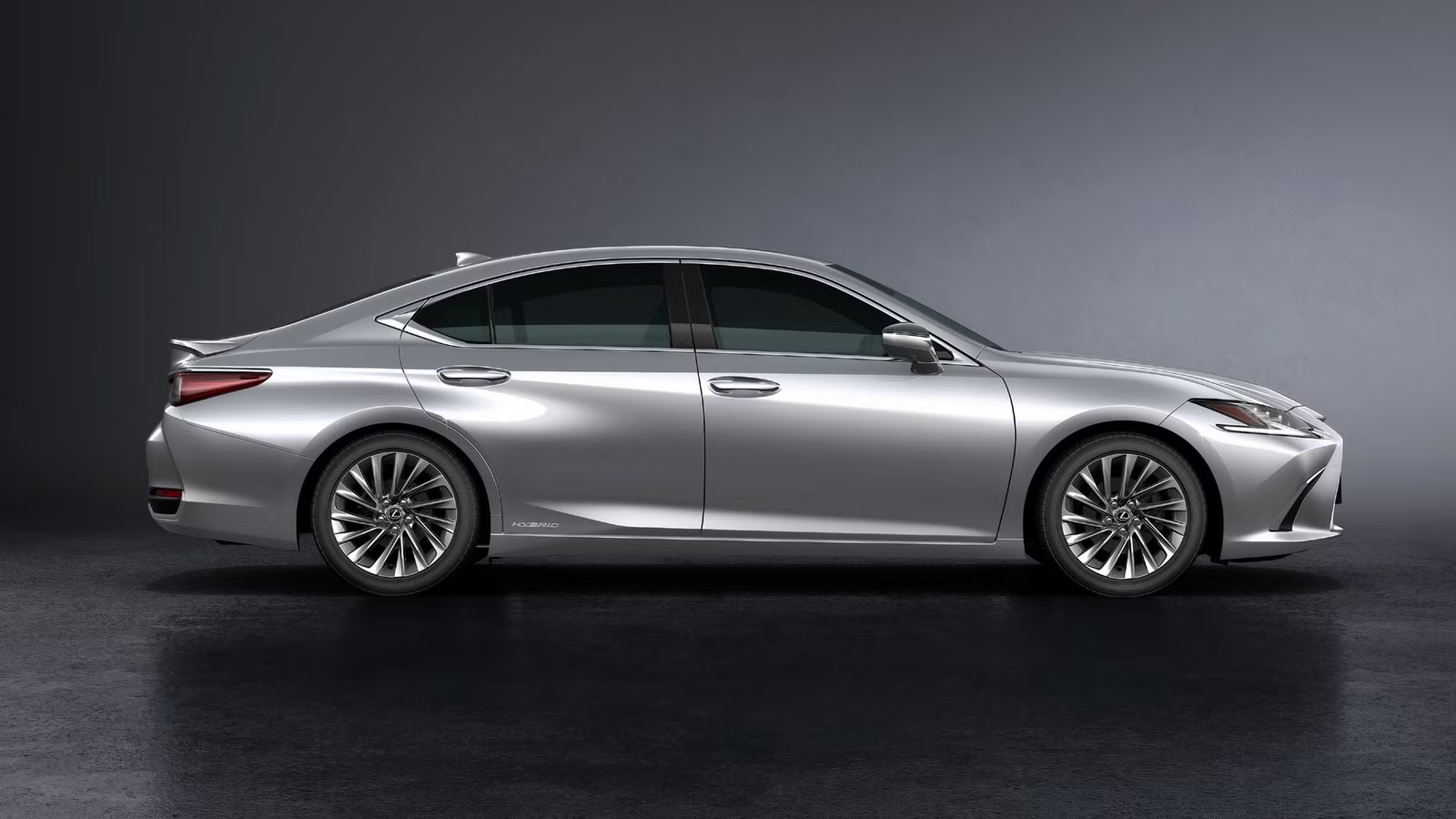
Among Lexus’s hybrid lineup, the Toyota Camry-based 2025 ES 300h stands out as one of the brand’s most accomplished and well-rounded HEV offerings. It combines a comprehensive standard specification with striking exterior styling, a high-quality interior, a plush yet engaging ride, and class-leading fuel efficiency — all at a price that’s easier to justify than many rivals. Sharing its drivetrain architecture with the Camry also means the ES 300h inherits some of the best reliability and lowest maintenance costs in the segment, and that extends to the compact lithium-ion hybrid battery pack.
How Much A 2025 Lexus ES 300h Battery Replacement Costs
According to a Lexus parts catalog listing, you can expect to spend $3,365.69 on a replacement battery pack for the 2025 ES 300h. This figure excludes labor costs and represents the price of the complete assembly, which bundles in several auxiliary components you wouldn’t necessarily need to replace if only the battery itself had reached the end of its useful life. Unlike EVs, hybrid battery packs typically consist of one or two modules, which is why the entire pack is usually exchanged rather than individual cells when replacement time arrives.

We were also able to uncover a new battery pack configuration for the previous-generation Lexus ES Hybrid, priced at $4,870, from Exclusively Hybrid. According to several Lexus dealer sites, a hybrid battery replacement, including labor, can cost anywhere between $2,000 and $8,000, depending on how severe the degradation is.
It Features A 1.6 kWh Battery
The Lexus ES Hybrid is a mechanical twin of the Toyota Camry Hybrid, distinguished by significantly more refined materials and a more upscale design. The powertrain pairs an Atkinson-cycle naturally aspirated 2.5-liter four-cylinder engine with two permanent-magnet-synchronous motors that drive the front wheels through an eCVT. The result is a combined output of 215 horsepower — enough to carry the ES 300h from 0–60 mph in 8.1 seconds and on to a 112-mph top speed. Lexus doesn’t publish a combined torque figure for the system, but the combustion engine alone produces 163 lb-ft before the electric motors add their contribution.
Performance Specifications
| Powertrain | 2.5-Liter Four-Cylinder And Two Permanent-Magnet Motors |
| Horsepower | 215 HP |
| Torque | N/A |
| Transmission | Direct Drive eCVT |
| Driveline | Front-Wheel Drive |
| Battery | 1.6 kWh |
| Range | 581 Miles |
| Fuel Economy | 44 MPG |
| 0-60 MPH | 8.1 Seconds |
| Top Speed | 112 MPH |
According to the EPA, the ES Hybrid will cover 581 miles on a single tank of gas, while returning 43/44/44 MPG on the city/highway/combined cycle. You can also expect to save as much as $3,000 over five years in fuel costs, spend $1,050 on fuel every year, and spend $1.74 to drive it 25 miles. A full tank of gas will also cost you $41.
How Long Lexus’s Hybrid Battery Lasts

Lexus hybrid batteries typically last anywhere between eight and 15 years or around 100,000 to 150,000 miles under regular use before needing replacement. This depends entirely on usage and conditions, so it will differ from one owner to the next. Many Lexus hybrids achieve even greater longevity, especially when owners follow the recommended maintenance schedule and drive the vehicle consistently. The battery performs best when it isn’t subjected to deep discharge cycles, and Lexus’s battery management system is specifically designed to prevent that from happening during normal operation. Climate, driving habits, and regular use all influence battery lifespan — though to a far lesser degree than they would with a much larger EV pack.
For context, milder climates and smooth driving conditions contribute to extended battery life, while excessive heat or frequent aggressive driving can accelerate wear. Lexus’s design integrates the battery within the car’s cooling and management systems to keep temperatures moderate and efficiently extend its life. Lexus’s hybrid systems also benefit from regenerative braking, made possible by the direct-drive motor setup rather than a conventional transmission. This helps preserve battery health by reducing reliance on the pack during high-energy demands such as hard acceleration.

In real-world usage, some Toyota-based hybrids have shown robust battery performance, exceeding 200,000 miles without significant degradation. Regular hybrid system checks and adhering to Lexus’s maintenance schedule allow technicians to monitor battery health and address any issues early, which also boosts longevity. Many Lexus owners experience long-lasting hybrid batteries, sometimes beyond the initial warranty period, with minimal noticeable reduction in battery performance.
Should replacement be necessary, Lexus hybrid batteries are generally available for a few thousand dollars, with refurbished options often costing less. The long-term cost-effectiveness of Lexus hybrid batteries, coupled with the vehicle’s overall fuel efficiency, continues to appeal to owners seeking low maintenance and high reliability, even when factoring in the eventual cost of a battery replacement.
Thankfully, the Lexus ES 300h excels at returning impressive reliability standards. Consumer Reports hands it a 66/100 predicted reliability rating alongside a 91/100 road test score and a 5/5 predicted owner satisfaction rating, bringing its overall score to 86/100. J.D. Power awards it 88/100 for quality and reliability, 73/100 for the driving experience, 74/100 for resale, and 87/100 for the dealership experience, resulting in an 82/100 overall score.
Lexus’s Class-Leading Hybrid Battery Warranty

Lexus covers all of its hybrid vehicles with a standardized warranty package that includes a 36-month or 36,000-mile basic warranty, a 60-month or 60,000-mile powertrain warranty, and 60-month corrosion coverage with unlimited miles. The brand also covers all hybrid components for 96 months or 100,000 miles, while the battery features a class-leading coverage of 120 months or 150,000 miles. You also have the option of extending the basic warranty package up to 10 years or 125,000 miles through Lexus.
Lexus’s Standard Warranty Offering
|
Type |
Length |
|---|---|
|
Full Warranty |
36 Months/36,000 Miles |
|
Powertrain Warranty |
60 Months/60,000 Miles |
|
Maintenance Warranty |
24 Months/25,000 Miles |
|
Roadside Warranty |
24 Months/25,000 Miles |
|
Corrosion Warranty |
60 Months/Unlimited Miles |
|
Federal Emissions Performance |
24 Months/24,000 Miles |
|
Federal Emissions Defect |
36 Months/36,000 Miles |
|
Seat Belt And Airbags |
60 Months/60,000 Miles |
Lexus implemented this warranty structure in 2020, extending coverage from the previous eight-year or 100,000-mile limit. The warranty covers the hybrid battery for defects and manufacturing issues, ensuring repair or replacement at no cost within the coverage period. The hybrid component warranty also extends to the electric motor and power control unit. Routine maintenance items and wear-and-tear components — such as the 12-volt battery — fall outside this coverage. As noted, Lexus’s hybrid systems are typically very reliable, though the brand has issued its share of recalls in this area over the years.
Sources: Lexus, Consumer Reports, J.D. Power, and the EPA

Related posts






Latest Post


No Comments