
This Cheap Used Sedan Has One Of The Greatest Engines Ever Made
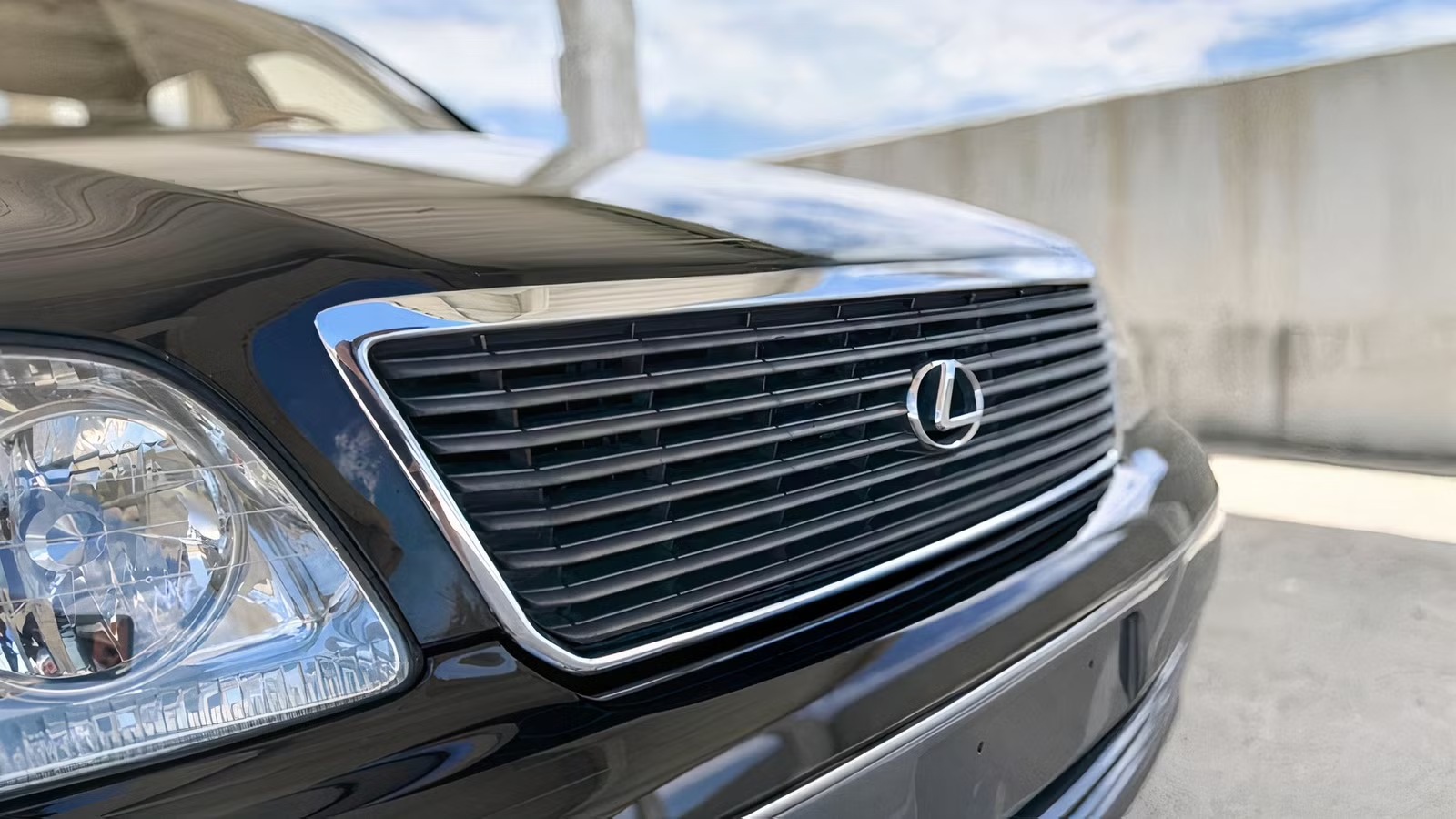
Sometimes, buying a used luxury car is not just about buying for the badge, the fancy interior, or the bragging rights, but something that is arguably overlooked today: the engine. Some of the best luxury sedans with the best engines should be purchased when depreciation has turned something once very expensive into something very affordable.

This sedan may not be the first car that springs to mind when shopping for a cheap used luxury car, but beneath its old cruiser look lies an engine with a reputation that has earned it a place among the greats.
Some Great Engines End Up In Surprisingly Cheap Cars
According to Classic.com, the average auction price for a Mazda RX-8 is just over $12,200. While it may not be the legendary predecessor that showed the world what Mazda can do, for a relatively small amount of money, you get a 1.3-liter Wankel rotary engine good for 232 horsepower and 159 pound-feet of torque. This legendary mill revs up over 9,000 rpm, and delivers power with a smoothness and character few piston engines can truly match.

Then there are posher models like the E60 5 Series. Classic.com says the average auction price is just under $25,000. Its 3.0-liter N52 inline-six makes 268 horsepower and 232 pound-feet of torque, with silky power delivery, an engaging naturally aspirated response, and a raucous induction note, all of which make it very appealing for its price point.
Depreciation Can Turn A Luxury Car Into A Serious Bargain

Buying a new luxury sedan can be a money pit. Not only is it typically more expensive to keep them on the road, but depreciation knocks a lot of value off luxury sedans relatively quickly.
CarEdge estimates that, on average, luxury brands lose around 50.4 percent of their value in the first five years and around 70 percent of their value over 10 years. In comparison, mainstream brands lose around 47.5 percent of their value after five years and around 68.3 percent of their value after 10 years.
That is no good if you are buying new luxury (unless you plan on keeping it), but that kind of depreciation makes a lot of models from the likes of BMW, Audi, Mercedes, Lexus, Maserati, Porsche, and Jaguar obtainable after a few years.
The Lexus LS 400 Was Built Around The 1UZ-FE V8

This is where the Lexus LS 400 comes in. Built between 1990 and 2000 over two generations, the LS 400 may look like a bit of an old-fashioned sedan today, but it is built around one of Toyota’s finest creations: the naturally aspirated 1UZ-FE V8.
The 4.0-Liter V8 Gave Lexus The Power To Challenge Mercedes And BMW
When the LS 400 was first released in 1990, BMW had the E34 M5, which was equipped with a naturally aspirated 3.6-liter inline-six, good for 311 horsepower; Audi had the 220-horsepower Audi 200 Quattro 20V; and Mercedes had the 500 E, which featured a 5.0-liter M119 V8 that produced 322 horsepower and 354 pound-feet of torque.
The LS 400 was one of the first models Lexus put on the U.S. market, so it had to make an impression. It did; the 4.0-liter 1UZ-FE V8 in the LS 400 is rated at between 250 and 290 horsepower at 5,600 rpm and between 260 and 300 pound-feet of torque. 0–60 mph times are clocked between 6.1 and 6.9 seconds. This placed it squarely in the middle of what German brands were producing at the time.
Overbuilt Design And A Legendary Reputation

That kind of output is relatively easy to produce today, but considering that this was Lexus’ first flagship sedan, the LS 400 showed the Japanese marque’s intentions from the off, and they certainly rocked the market stalwarts. Toyota/Lexus also created an engine that would go on to gain a reputation for being both smooth to use and nearly indestructible, which, compared to some of the more finicky luxury engines we have seen, makes it a solid choice on the used market.
It is designed with six-bolt bearing caps, which means nearly no crank flex under high loads; the forged internals mean there is a huge safety margin for something without a turbo; and the close-deck aluminum block is both lightweight and very rigid, with good thermal stability.
The V8 is arguably the best engine configuration, and the 1UZ-FE V8 is arguably one of the best. It is exceptionally smooth-running, with next to no vibrations or noise sent through the cabin when you press the accelerator; output is not particularly large considering the displacement of the engine; torque is delivered at a relatively low rpm (4,000–4,600 rpm), and power is delivered in a clean, linear fashion.
The LS 400 Is Now Surprisingly Affordable

All of these engine characteristics make the LS 400 ideal for luxury cruising, and while we would not suggest buying one in stock form to outrun a 1990s BMW sport sedan, that is not the point of this flagship.
Classic.com says the overall average auction price of a 1990–2000 Lexus LS 400 is $17,748. The first-generation LS 400 (1990–1994/XF10) has an average auction price of $12,300, while the second-generation LS 400 (1995–2000/XF20) has an average auction price of $14,172.
The XF20 Generation Offers The Best Balance Of Price And Power
Those kinds of prices may not be that surprising, even considering Lexus’ seemingly otherworldly ability to retain value; these cars are between 26 and 36 years old. However, thanks to the engine, its reliability, and the all-round old-school luxe of them, you are getting a lot of bang for your buck.
You could opt for the cheaper XF10 option and get a 250-horsepower/260-pound-foot 1UZ-FE V8 under the hood, and using the average auction price, that means you are paying around $49 per horsepower.
If you look at buying a 1995–1997 XF20 LS 400, horsepower and torque are slightly increased to 260 and 260, respectively, thanks to minor tuning and a bit of weight reduction. That means paying around $54.51 per horsepower. The final MYs between 1998 and 2000 get the most oomph, with 290 horsepower and 300 pound-feet of torque on tap.
This is courtesy of lighter pistons, a refined valvetrain, and the addition of VVT-i. It also works out slightly cheaper, on average, per horsepower. For the final model years of the XF20 LS 400, you are paying around $48.97 per horsepower.
There’s A Gap Between Average And Collector-Grade Examples

Like buying any older car, condition makes a difference to price. The lowest price paid for an XF10 model in the last year via auction was $3,050, which had 159,000 miles on the clock and was in need of a bit of TLC. The most expensive first-gen model recently went under the hammer for $38,000. This 1994 model only had 20,000 miles on the clock and was in near-mint condition.
The same goes for the XF20 generation. The cheapest model sold at auction in the past year was a 155,000-mile ’97 model, which fetched $4,700. The most expensive model sold was a 2000 LS 400, with just 1,000 miles on the clock. It was in totally original condition and needed no work done to it. This model went under the hammer for $46,000.
The LS 400’s V8 Was Built To Last

Both Toyota and Lexus are renowned for dependability, and primarily thanks to the 1UZ-FE V8, the LS 400 is one tough sedan. It is widely reported that the LS 400 and the 4.0-liter 1UZ-FE V8 cost $1 billion to research, build, and roll out, with thousands of engineers and technicians working on it over a six-year development period. There were no half measures to ensure that European luxury brands had something to worry about.
Unlike many V8s of the era, which tended to have four-bolt bearing caps, the six-bolt main bearing caps are more in line with how race engines are built to withstand high strain. The quad-cam 32-valve layout means efficient breathing and reliability at high revs, and early models (1990–1994) get a non-interference design, so if the timing belt snaps, the engine isn’t totally destroyed.
High-Mileage Examples Show What The 1UZ-FE Can Still Do

There are multiple owners out there who have claimed to put well over 250,000 miles on their LS 400 models with relatively simple maintenance. One owner has claimed to put over 630,000 miles on their model, thanks to proper maintenance that includes belt and fluid changes, while some owners on Reddit say they still drive their LS 400 models daily and have racked up over 700,000 miles in them.
However, that is nothing compared to the highest-mileage Lexus model: a 1996 Lexus LS 400. Journalist Matt Farah bought a cheap LS 400 as an experiment, which saw dozens of drivers put miles on it until the odometer rolled past one million. Routine maintenance was needed, and the transmission had to be rebuilt, but the core engine lasted without anything major.
The LS 400 Made A Great Engine Hard To Ignore


There is a solid-looking quality to the Lexus LS 400; it is fairly large compared to today’s standards, it looks like it is made more for highway cruising, and the interior is very much of its era. However, thanks to Lexus-grade quality and attention to detail, it has a charm that is still hard to knock.
You get real leather upholstery, real wood trim, power-adjustable seats, physical controls, dual-zone climate control, and solid sound insulation. When you are buying a luxury sedan of any age, these things matter. The LS 400 also has one of the most reliable V8s ever.
Originally, the look and feel of the LS 400 would have gotten a lot of people interested in Lexus as the brand entered the U.S. market, but after all these years, it is the 1UZ-FE V8 that people still talk about.
In short, the engine needed the LS 400, and the LS 400 needed the engine to work. And it did; few cheap luxury sedans can match the LS 400’s blend of V8 refinement, engineering overkill, durability, and sheer class, even today.
Sources: Lexus, Classic.com, CarEdge, and Bring A Trailer.

Related posts




Latest Post


No Comments