
Every Chevy Monte Carlo Generation Ranked From Overlooked To Iconic
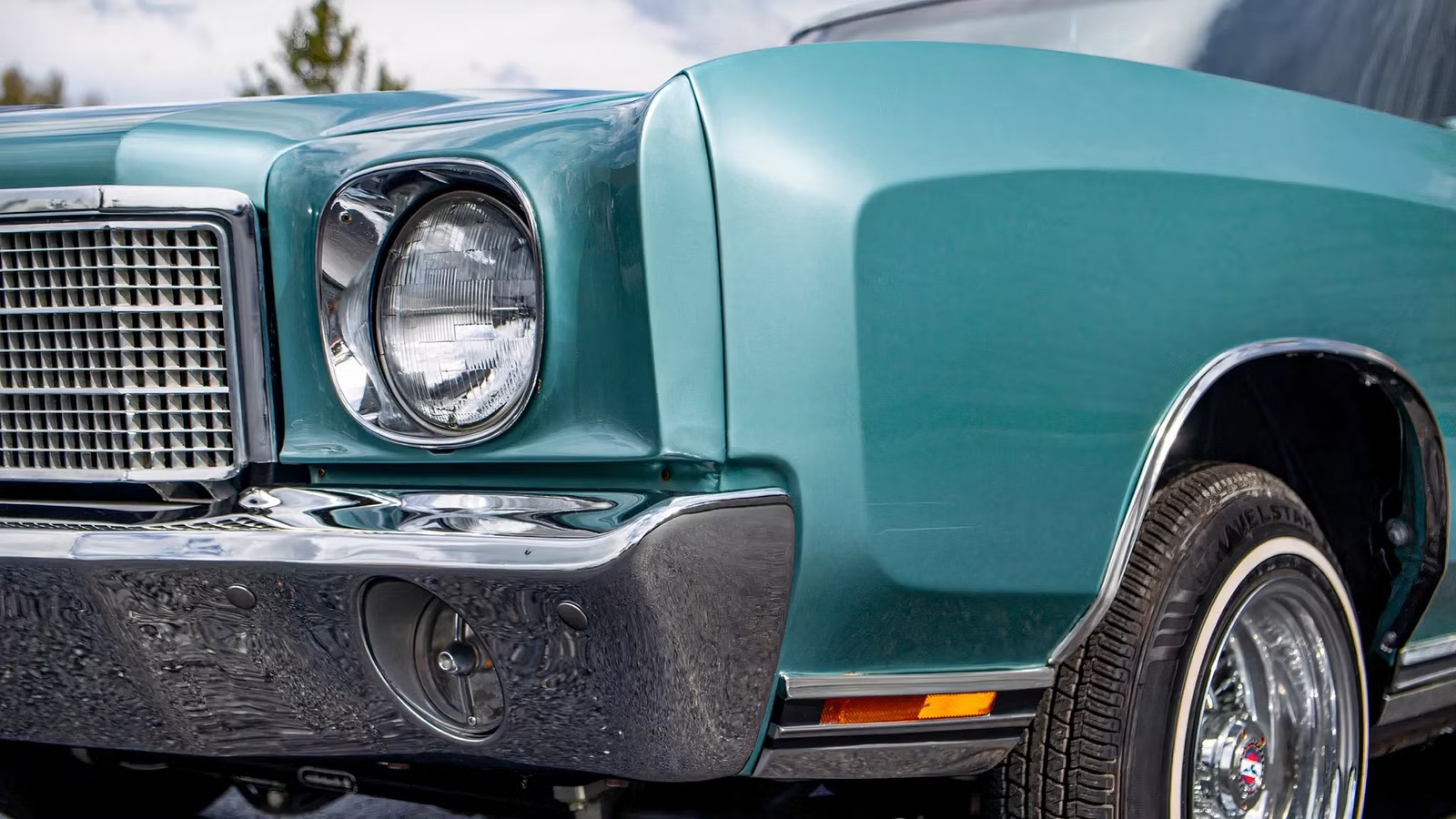
It is easy to forget sometimes that Chevrolet used to make more than the Corvette, trucks, and SUVs. Back in the day, their muscle cars, sports coupes, and sedans were some of the best around and took the fight straight to the likes of Ford, Dodge, Pontiac, and Plymouth.

Of the most venerated yet sometimes most overlooked is the Chevrolet Monte Carlo. From 1970 to 2007, with a six-year model gap between ’89 and ’95, it appealed to speed freaks, NASCAR fans drawn to one of the most successful NASCAR models ever built, big-engine fanatics, and buyers looking for something a little different from a Mustang. These are all six generations of the Monte Carlo, ranked from the most overlooked to the most iconic.
Sixth-Generation Chevrolet Monte Carlo (2000–2007)
The V8-Powered Comeback Nobody Saw Coming
As the final generation of the Chevrolet Monte Carlo, the 2000–2007 model arrived with a choice of three engines: a 3.8-liter L36 V6 good for 211 horsepower and 214 pound-feet, a supercharged 3.8-liter L67 V6 that produced 237 horsepower, and a V8 under the hood of the SS (Super Sport) models (2006 and 2007). This beast has the following specs.
 32 autotech Spec |
2006–2007 Chevrolet Monte Carlo SS |
|---|---|
|
Engine |
5.3-Liter V8 |
|
Transmission |
Four-Speed Automatic |
|
Horsepower |
303 hp |
|
Torque |
323 lb-ft |
Top speeds of the sixth-gen Monte Carlo have been clocked at around 115 mph with the stock limiter on, but some have claimed to have pushed 130 mph without it. 0–60 mph times for the 2007 Monte Carlo SS have been clocked at around 6 seconds. You get a front-wheel-drive layout, a heavy-duty four-speed box, a comfortable cabin, and today, low prices.

The 2007 Monte Carlo saw the end of a nearly-four-decade continuous production run, and while the nameplate is missed by some today, we can see why Chevy pulled it. In 2009, they brought back the Chevrolet Camaro, and with the healthy horsepower and speed of a naturally aspirated V8 under the hood of the SS’s final model year, Chevy thought the Monte Carlo might have taken some sales away from the newly reintroduced Camaro.
Today, prices for the sixth generation are in keeping with the overlooked nature of it. According to Classic.com, the average auction price of a sixth-gen Monte Carlo is $13,198, with the highest price paid for one in recent years being $40,000, and the lowest being $1,399.
10 Legends That Prove 1970 Was GM’s Muscle Car Magnum Opus
1970 saw a convergence of style and performance, creating an epic year for GM muscle cars.
Third-Generation Chevrolet Monte Carlo (1978–1980)
When Downsizing Took The Edge Off A Legend

It has the classy looks of vintage American cars; the interior features plush carpet, thickly padded seats, and oodles of space, and it is bound to turn heads. Unfortunately, the downsizing of the third-gen Monte Carlo in response to the 1973 Oil Embargo and CAFE requirements shaved off some of the boldness of the previous generation.
By today’s standards, the short-run that was the third generation is still not a small two-door coupe, measuring in at 200.4 inches by 71.8 inches, but that is still some 15 inches shorter than the last MY of the second-generation models. However, affordable luxury was still the name of the game for the third-gen.

The long hood houses a plethora of engines, with the lowest output coming from a 100-horsepower 3.3-liter V6 in 1978 and the highest output coming from an optional 3.8-liter Buick turbocharged V6 good for 170 horsepower in 1979. The tight dimensions still look good today, and the interior was designed for comfort, thanks to woodgrain-style dash trim, thick carpeting, good sound deadening, and nicely bolstered seats.
Also originally available was the Landau Package. This was the poshest option, and got you pinstriping, vinyl roof covering, premium wheel covers, and sportier-looking touches around the build. The third-gen is an overlooked generation because it follows the muscle car and luxury generations that made the Monte Carlo such a celebrated car, and precedes another well-regarded generation. Today, you can get a 1978–1980 Monte Carlo for between $6,500 and just under $26,000.
How GM’s Most Reliable V8 Became A Performance Legend
The small block Chevy V-8 has become a staple of the American motoring industry since its inception.
Second-Generation Chevrolet Monte Carlo (1973–1977)
Peak Personal Luxury During The Malaise Era

The second-generation Chevrolet Monte Carlo arrived at exactly the wrong time if you prioritized horsepower, but exactly at the right time if you wanted one of the most stylish luxury coupes of the 1970s. Introduced in ’73, it landed just as emissions regulations tightened, insurance rates for performance cars soared, and the oil crisis changed what was wanted from cars.
However, instead of fighting these trends, Chevy rolled with them. Early models could still be bought with a 7.4-liter big-block V8 good for 245 horsepower and 375 pound-feet of torque, which was powerful enough to push the nearly two-ton car to 60 mph in around 7.5 seconds. However, as the years rolled on, the power outputs dropped. The second-gen is available on the used market with the following engine options.
|
Spec |
1973–1975 Monte Carlo |
1974–1976 Monte Carlo |
1973–1977 Monte Carlo |
1976–1977 Monte Carlo |
|---|---|---|---|---|
|
Engine |
7.4-Liter V8 |
6.6-Liter V8 |
5.7-Liter V8 |
5.0-Liter V8 |
|
Transmission |
Three-Speed Automatic or Three-Speed Manual |
Three-Speed Automatic or Three-Speed Manual |
Three-Speed Automatic or Three-Speed Manual |
Three-Speed Automatic or Three-Speed Manual |
|
Horsepower |
245 hp |
180 hp |
175 hp |
145 hp |
|
Torque |
390 lb-ft |
305 lb-ft |
270 lb-ft |
245 lb-ft |

Paradoxically, the loss of performance prowess compared to earlier models helped make the second-gen Monte Carlo one of the most revered coupes of the time. While there wasn’t much that could be done about emissions rules and horsepower strangulation, the interiors could be made more luxurious and comfortable.
The luxury features of this Malaise Era Monte Carlo are arguably more important than the engine options. You could originally get rotating bucket seats that make it easier to get in and out, custom upholstery, air conditioning, cruise control, power door locks, remote-control mirrors, and illuminated entry lighting. Chevrolet sold over 230,000 of these “underpowered” Monte Carlos in 1973 alone, and today, they can be picked up for a relatively low average auction price of $18,052.
Fifth-Generation Chevrolet Monte Carlo (1995–1999)
The Reboot That Split Enthusiast Opinion

After a six-year hiatus, the Monte Carlo returned for the 1995 model year as a completely different car. The rear-wheel-drive personal luxury formula that had defined the nameplate since 1970 was replaced by a front-wheel-drive platform shared with GM’s midsize sedans. For many who love the Monte Carlo, this was a betrayal of its roots. For Chevy, though, it was where the market was heading at the time.
The fifth-generation Monte Carlo traded its traditional American coupe proportions for a more aerodynamic shape inspired by NASCAR. The rounded nose, sweeping roofline, and integrated bodywork were a huge change from the previous generation. Engine options were streamlined, and this generation was even marketed through Chevy’s NASCAR connections, hoping to create some buzz for it.

There are three engine options available, depending on trim and model year. They are as follows.
|
Spec |
1995–1999 Monte Carlo LS |
1995–1997 Monte Carlo Z34 |
1998–1999 Monte Carlo Z34 |
|---|---|---|---|
|
Engine |
3.1-Liter 3100 V6 |
3.4-Liter LQ1 V6 |
3.8-Liter 3800 Series II V6 |
|
Transmission |
Four-Speed Automatic |
Four-Speed Automatic |
Four-Speed Automatic |
|
Horsepower |
160 hp |
215 hp |
200 hp |
|
Torque |
185 lb-ft |
215 lb-ft |
225 lb-ft |
Though the fifth-gen Monte Carlo lacked V8 power, it compensated with refinement, including a quieter cabin, better ride quality, and improved safety features. You also get more in the way of “modern features,” such as anti-lock brakes, dual airbags, traction control, and climate control. It was the generation that brought the Monte Carlo into the modern era.
The fifth-gen was also an exceptionally successful NASCAR model. In the 1995 season, it won the NASCAR Manufacturers’ Championship and Drivers’ Championship, and it won the Manufacturers’ Championship in the 1998 season. Classic.com says that a fifth-gen Monte Carlo has an average auction price of $15,228, with a top recent sale of $23,100.
1992 Chevrolet Camaro: A Look Back At The End Of A Generation
Unleashing power and style, the 1992 Camaro is a true ’90s icon. With bold looks and the legendary Z28 trim, it roars into muscle car history.
Fourth-Generation Chevrolet Monte Carlo (1981–1988)
The G-Body Hero That Became An ’80s Performance Icon

Some 1980s cars are just cool; the fourth-gen Monte Carlo is one of them. However, it is not cool for reasons like the Testarossa or the Countach are. This is one of the less overlooked Monte Carlo models, and Classic.com reports that the current auction price ranges from $5,250 to $49,500. So, at the high end, a fair amount more than the other generations we have looked at.
Built on GM’s rear-wheel-drive G-body platform, it has both luxury styling and surprising motorsport DNA woven in. It is effectively NASCAR-born, street-legal muscle, despite the still-underpowered engine options. The effects of the malaise era were still lingering, but as the generation progressed, engine outputs got more powerful, with the following engine options.
|
Spec |
1981–1984 Monte Carlo Base |
1981–1988 Monte Carlo Base |
1981–1988 Monte Carlo CL |
1983–1988 Monte Carlo SS |
|---|---|---|---|---|
|
Engine |
3.8-Liter V6 |
4.4-Liter V8 |
5.0-Liter V8 |
5.0-Liter HO V8 |
|
Transmission |
Three-Speed Automatic |
Three-Speed Automatic |
Three-Speed Automatic or Four-Speed Automatic |
Four-Speed Automatic |
|
Horsepower |
115 hp |
125 hp |
165 hp |
180 hp |
|
Torque |
190 lb-ft |
210 lb-ft |
240 lb-ft |
245 lb-ft |

The model that transformed the fourth-gen Monte Carlo into an icon was the Monte Carlo SS. After a break in the SS badge following 1971, when it was reintroduced in 1983, it became the definitive performance variant of the Monte Carlo lineup. Not only does it look the part with an aerodynamic front fascia, rear spoiler, blacked-out trim, and bold graphics, but it also features a number of athletic enhancements.
You get unequal-length control arms with coil springs up front, and four-link rear suspension with coil springs. Chevy also fitted revised shocks, thicker anti-roll bars, and quicker steering than the other models. While recent sales of the fourth-gen have only topped out at just shy of $50,000, there are currently some exceptionally expensive, highly original SS models up for sale for over $100,000. The rare Aerocoupe NASCAR homologation model seldom comes up for sale, but when it does, sales are also for over $40,000.
This Classic Muscle Car Could Outrun Modern Performance Cars
The 1970 Chevelle SS 454 set a muscle car performance standard the lasted almost four decades and still impresses.
First-Generation Chevrolet Monte Carlo (1970–1972)
The Big-Block Muscle Car That Made History

If you are a fan of the best American muscle cars from the golden age and old-school V8 brute force, the first-generation Chevrolet Monte Carlo is likely one you haven’t overlooked. It may be overlooked compared to other iconic muscle cars of the era, but as Monte Carlo models go, it is the cream of the crop. Introduced as the 1970 Chevrolet Monte Carlo, this was Chevrolet’s answer to the growing demand for luxury models with a touch of sportiness.
Beneath the elegant sheet metal, the first-gen Monte Carlo is closely related to the almighty Chevelle, sharing GM’s A-body platform, suspension architecture, and much of its engine options. This means that buyers could originally get much of the same performance prowess while also enjoying a more refined package.

There are a number of engine options for the 1970–1972 Monte Carlo. All of them benefit from being relatively unrestricted compared to the later generations; they have the following specifications.
|
Spec |
1970–1972 Monte Carlo |
1970–1972 Monte Carlo |
1970–1971 Monte Carlo |
1970 Monte Carlo |
|---|---|---|---|---|
|
Engine |
5.7-Liter V8 |
6.6-Liter V8 |
6.6-Liter V8 |
7.4-Liter V8 |
|
Transmission |
Three-Speed Manual or Four-Speed Automatic |
Four-Speed Automatic |
Three-Speed Manual or Four-Speed Automatic |
Three-Speed Automatic |
|
Horsepower |
250 hp – 270 hp |
265 hp |
300 hp |
360 hp |
|
Torque |
345 lb-ft – 360 lb-ft |
400 lb-ft |
400 lb-ft |
500 lb-ft |
While all the first-gen models have hefty outputs compared to the later years, the real legend here is the Monte Carlo SS 454. It is equipped with a 7.4-liter (454 cubic-inch) Turbo-Jet big-block V8 paired with a Turbo Hydra-Matic 400 transmission. Despite Chevrolet’s luxury ambition, this massive coupe (4,662 pounds) can still sprint to 60 mph in the high 6-second range, which means it can run with some of the best muscle cars of the era.
The SS 454 also features heavy-duty suspension tuning, reinforced internals, and a comfortable interior that allows this rare Chevy to serve as both a sporty performer and a comfortable highway cruiser. Only circa 3,800 Monte Carlo SS 454 models were ever produced in 1970, so while the average auction price of the whole first-generation Monte Carlo is $26,087, good-condition SS 454 models are reaching prices of over $90,000.
Sources: Classic.com, Bring A Trailer, and Chevrolet.

Related posts



Latest Post


No Comments