
The Everyday Sport Bike That Doesn’t Feel Like A Compromise
The ‘sport’ in sport bikes is there for a reason. They’re designed with a very narrow focus, and that’s to perform for speed, not the convenience of riding fast. You can trace the lineage to the 1980s homologation specials, when manufacturers needed enough road-going replicas sold to qualify a race bike for the World Superbike competition.
That meant that the ergonomics were dictated by the racing chassis, so the clip-ons sat low and the rearsets were placed high enough to fold the knees. Four decades on, that homologation-era DNA runs through the genre, which is why an “everyday sport bike” has always seemed like a contradiction rather than a category. Look deep enough, though, and an interesting sub-section comes to light.
What A Sport Bike Would Actually Have To Give Up To Earn The Word Everyday
The riding position, of course, is the most visible compromise, and then comes the powerband hiding a deeper one. A race-replica or a track-focused engine is tuned to wake up near the top of the rev range. The Japanese inline four screamers are infamous for this, but it leaves the torque for a regular commute sitting well below where the engine starts to feel alive.

The result is a rider who is constantly shuffling through the gears. The suspension then compounds the problem further. A chassis that’s primarily calibrated for a smooth racetrack surface turns unforgiving the moment you hit a pothole or a cracked expansion joint. Every imperfection on the road goes straight into the rider’s wrists and lower back instead of getting soaked up. So, maybe commuters shouldn’t get sport bikes like the GSX-R750.

Now, that would be an unreasonable solution. After all, they’ve adorned our walls as posters while growing up; they’re aspirational, and being drop-dead gorgeous defeats all the logic of getting one for the daily grind. The question then becomes: how does one get around the issues? Earning the word would honestly mean fixing the source, not softening just one or two specs.
Torque has to get pulled down into the low and midrange, suspension needs its compliance dialed for real, imperfect roads, and the reach to the bars has to be relaxed enough for the rider to hunch over in a position that warrants a gymnast’s genes. And all this has to be achieved without unzipping the fairing that makes the thing a sport bike to begin with. And that’s the right mix for everyday sport bikes.
The Suzuki GSX-8R Is The Everyday Sport Bike That Doesn’t Feel Like A Compromise

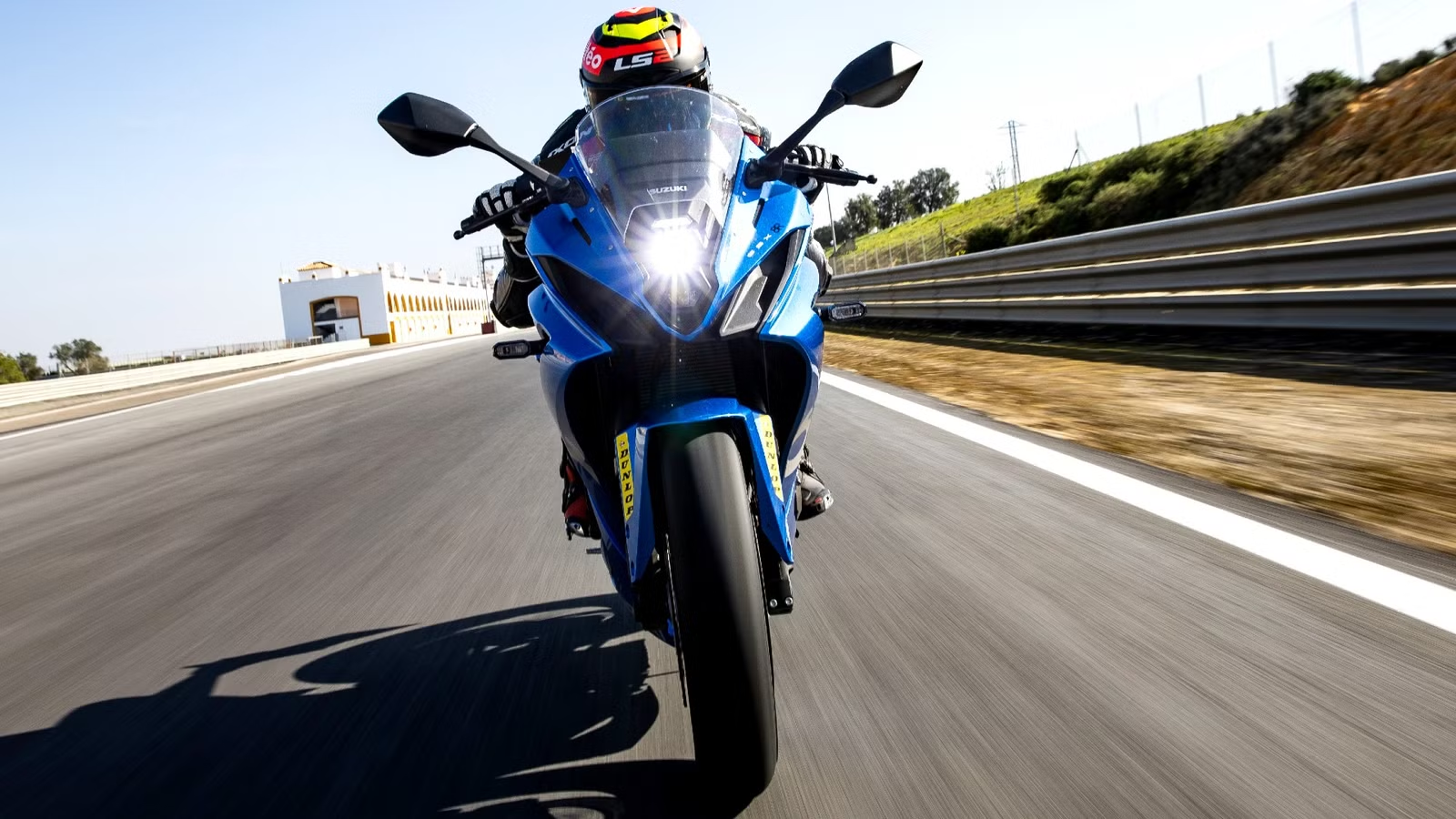
Suzuki built the GSX-8R on the same platform as the GSX-8S naked streetfighter, wrapping the identical 776cc parallel-twin in full sport bike bodywork designed as a visual nod to the GSX-R lineage. That shared foundation is important because a naked bike solves the ergonomic issues of a sport bike by placing the rider upright. And then solves the low-mid-range grunt that nakeds inherently possess to make riding on the streets exciting.

Suzuki’s parallel-twin produces 83.1 hp and 57.5 lb-ft at 6,800 rpm for a smooth, torque-rich pull from low in the rev range, making the naked GSX-8S an easy daily ride, and that gets transferred directly to the 8R. At $9,699, the GSX-8R is right in the ballpark of fully faired middleweights while asking for none of the usual sacrifices.
A 270-Degree Crank And Cross Balancer Built For Low-End Shove

The 270-degree crankshaft fires the twin’s two pistons unevenly, reproducing the uneven pulse of a 90-degree V-twin instead of the buzzy, even beat a conventional parallel-twin produces. This isn’t surprising coming from the makers of the very streetable SV650 and its V-twin, but the 270-degree crank seems to be the norm for most parallel-twins these days. That firing order not only makes for a nice exhaust note, but more importantly, it helps pull the torque curve down low, so the GSX-8R shoves forward the moment the throttle opens without waiting for revs to build.

Suzuki’s Cross Balancer, patented and used here for the first time on a production motorcycle, cancels the extra vibration that uneven firing order would otherwise generate, and does it without the added rotating mass of a conventional balancer shaft. The result is a parallel-twin that stays smooth at low revs, and that makes this sport bike commute far better than a track-bred alternative. Adding to the performance is the reliability factor of an unstressed engine too.
Riding Position And Chassis Geometry That Trade Track Crouch For All-Day Comfort

Despite being based on the GSX-8S naked bike, the 8R retains the look of traditional clip-on style handlebars. While it maintains the sport bike look, it is smartly clamped above the triple clamp instead of below it, on the forks directly. This not only helps keep the riding ergos similarly comfortable to the naked bike, but it trades the low, palm-crushing reach of a typical clip-on setup for what Suzuki itself describes as a “mild, forward-leaning” position. This is right for the daily commute on real roads.

Further enhancing the daily-focused ergonomics is a very approachable 31.9 inches of seat height that should suit a variety of riders. A 57.7-inch wheelbase adds straight-line stability, taking away the twitchy feel that a track-tuned, shorter chassis brings to stop-and-go traffic. Suspension duty falls onto a Showa SFF-BP fork and matching rear shock tuned for compliance and offering a plusher ride than most GSX badge-wearing alternatives have had. And let’s not forget the fairing that completes the sport bike’s list of requirements, as this one features a wind-tunnel-shaped screen that cuts the buffeting, channeling wind effectively for the highway stretch home.
The Suzuki GSX-8R Against The Yamaha YZF-R7, Triumph Daytona 660, And Aprilia RS 660

The Yamaha YZF-R7 shares the same idea as the GSX-8R, using a 689cc twin with its own 270-degree crank tuned for usable torque. At $9,399, it undercuts the GSX-8R by $300 and weighs less at 417 pounds wet. But its riding triangle is more in line with traditional supersport styling, and its 32.7-inch seat sits taller, loading more weight onto the wrists.

Triumph’s Daytona 660 takes the opposite route, a 660cc triple that makes 95 horsepower at 11,250 rpm and 50.88 lb-ft at 8,250 rpm, so a more peaky delivery to get it to sing. At $9,395 and 443 pounds wet, it’s heavier than the Suzuki despite lesser displacement. The feature set is also comparatively simpler with misses like a color TFT.

The Honda CBR650R E-Clutch costs less at $9,199, and its 649cc inline-four makes 94 hp at 12,000 rpm and 47.2 lb-ft of torque at 9,500 rpm. At 466 pounds, it’s heavier than the GSX-8R despite giving up displacement, and the four-pot mill means less usability. Oh, and two extra cylinders mean extra maintenance.

Each rival makes a valid case. But the core of this debate lies in everyday usability, which is only aided by low-end torque and keeping the rider upright while staying fully faired. That combination is what the GSX-8R excels at and closes the sport bike genre’s oldest contradiction by making it usable daily, comfortable, and precisely why it’ll be in your garage for a long time.
Source: Suzuki Cycles

Related posts





Latest Post


No Comments