
The Corvette Chevrolet Rated At 430 HP Actually Made Over 500
In the late 1960s, Detroit was in the golden era of horsepower wars. The spec sheets had the numbers to back it up, yet behind closed doors, one American manufacturer had a factory option on the order sheet that was completely inconsistent with the trend at the time. Chevrolet claimed the Corvette produced 430 horsepower, but the reality was something different: the engine was designed to deceive the corporate gatekeepers, and it produced far more power than advertised, nearly 570 horsepower.
The Late-1960s Horsepower War Met A Sudden Wall

Detroit was in a performance arms race where cars with high displacement numbers and high horsepower figures sold in the showroom. The numbers were touted in the brochures as the Big Three, Ford, Chrysler, and General Motors, competed to produce the nastiest machine. Muscle cars in the 1960s had achieved the status of cultural icons, and the expectation with each model year was higher horsepower, bigger engines, and more aggressive compression ratios designed to win at local drag strips and earn bragging rights.
That unrestrained era of explosive power suddenly hit an aggressive wall as external forces arrived to curb the madness. Insurance companies began imposing heavy financial surcharges on cars with high horsepower ratings, making muscle cars unaffordable to insure for young enthusiasts. During the same time, General Motors imposed corporate restrictions, limiting the power-to-weight ratio of their passenger cars.
Why Chevrolet Deliberately Underrated Its 427 V8 Engine


In 1967, Chevrolet engineers created a very fast endurance-spec big-block V8for track use, but the race homologation rules required the engine to be sold in road cars. General Motors executives were unnerved by this project. So GM imposed an internal policy restricting road cars from exceeding the horsepower threshold that insurance companies were placing heavy surcharges on.
To keep the engine and the program alive, Chevrolet’s engineering team led by Zora Arkus Duntovcame up with a brilliant idea: rather than detuning the hardware components of their race-winning engine, they would change how and where the power was measured on paper. The plan was to list an artificially low horsepower figure measured at a low rev limit where the engine was not truly producing its peak power; using this technique, they slipped a full-blown race engine past GM and the insurance companies without raising any eyebrows.
430 Advertised HP vs. 570 Dyno HP

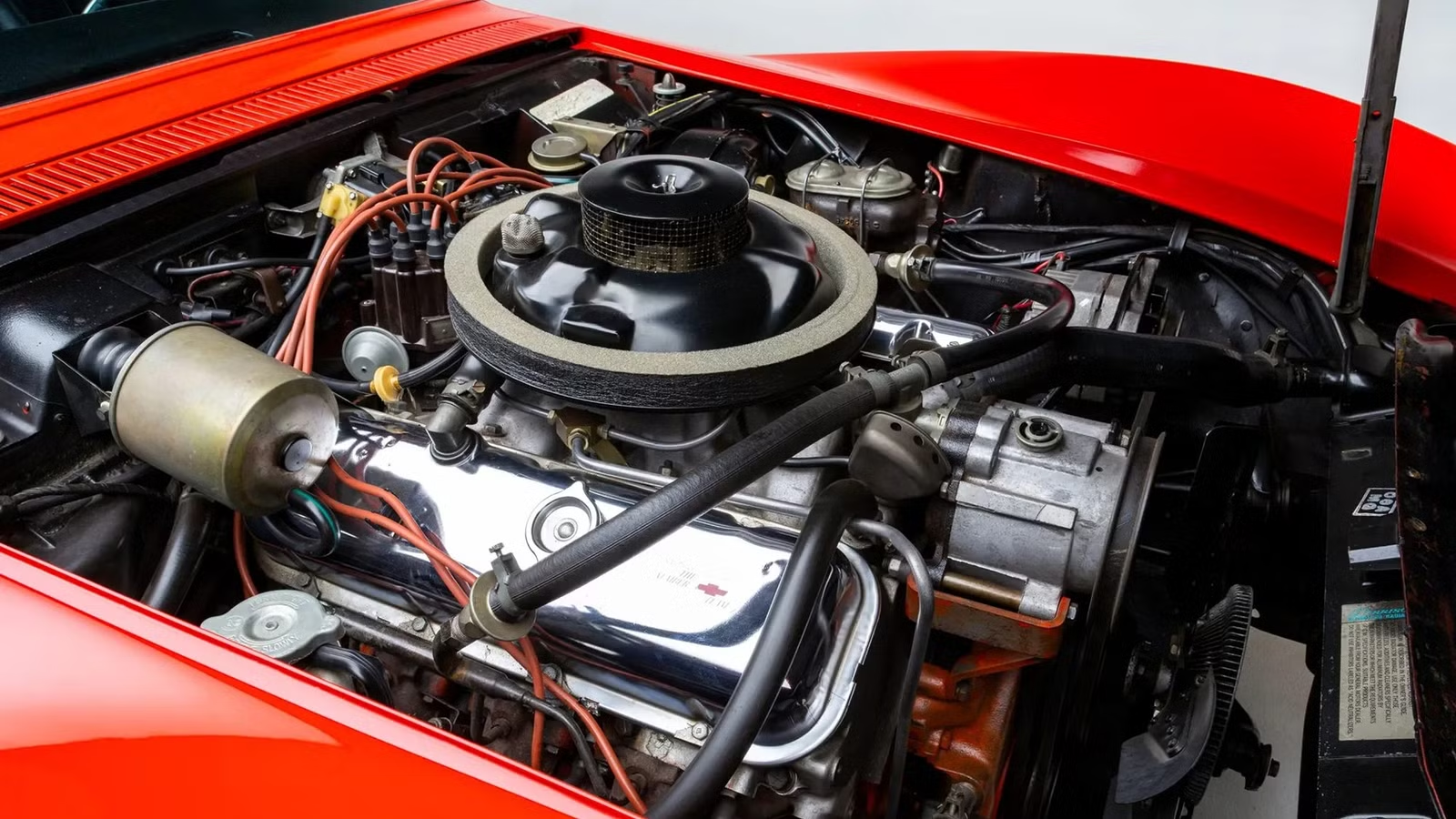
The Chevrolet C3 Corvette was equipped with the ultra-rare L88 427-cubic-inch big-block V8, and only 216 examples were built between 1967 and 1969. On paper, Chevrolet advertised the L88 as producing a respectable 430 horsepower at 5,200 RPM, making it appear less powerful than the street-oriented L71 427, rated at 435 horsepower with its triple-carburetor setup, yet the L88 was built on a competition platform that featured a single Holley 850 CFM four-barrel carburetor, a high-rise intake manifold, and a 12.5:1 compression ratio that required 103-plus octane racing fuel to run properly without detonation.
The advertised figure was a masterful misdirection: Chevrolet intentionally measured the horsepower at 5,200 RPM, where the solid-lifter cam was barely getting started. The 7.0-liter engine was packed with heavy-duty four-bolt main aluminum cylinder heads for quicker heat dissipation, a forged crankshaft, forged aluminum pistons, and a high-flow induction system specifically designed for continuous load tolerance above 6,000 rpm. During a test conducted by Hemmings in 2020, the engine was run with open headers and proper carburetor tuning on an engine dynamometer; the era-correct 427 L88 produced a peak of 574 horsepower at 5,900 RPM and 535 lb-ft of torque at 4,900 RPM. While a modern cam grind was also used, this effectively put the myth of the advertised 430 horsepower to rest.
Setting aside the power figures, the mechanical design of the L88 was completely different from that of the standard street engines of the era. The massive 4.25-inch bore and 3.76-inch stroke allowed the engine to draw in a large volume of air through its oversized rectangular-port aluminum heads. The high-lift cams were aggressive and kept the valves open longer than rival street engines. It was an endurance engine built to run races like the 24 Hours of Le Mans and 12 Hours of Sebring, which required reliable high performance for an extended period.
Living With A Race Car In Street Clothing

The L88 was an uncompromising engine to tame; in a sense, it was made for hardcore enthusiasts, which meant the car became unappealing to drive for the average buyer. Selecting the race-bred L88 for your Corvette meant automatically deleting creature comforts such as the radio, heater, air conditioning, and power steering, none of which were included from the factory. Instead, the car was reinforced with performance hardware such as J56 power disc brakes with dual-pin calipers, stiffened F41 performance suspension springs, a Positraction limited-slip differential for hard launches, and a high-capacity aluminum radiator without a cooling fan shroud.
At idle, the radical solid-lifter cam caused the engine to shake and stutter below 3,000 rpm, as the components were designed for wide-open-throttle application. But once the open highway was in sight, the 850 Holley poured race fuel into the cylinders, unleashing the Corvette in all its V8 glory with brutal acceleration and a loud mechanical howl through the free-flowing exhaust pipes.
The Corvette with its L88 was not a one-trick pony; it had the handling ability to back up the muscle, but without a power steering system, low-speed city driving was very physical. In contrast, on high-speed circuits, the lightweight aluminum cylinder heads shaved roughly 75 pounds from the front of the car, which in turn improved the turn-in response time. The engine was paired with a Muncie M22 four-speed manual transmission, also known as the “Rock Crusher” for its loud whine under heavy acceleration, owing to its straight-cut gears.
Living With A Race Car In Street Clothing

Only 216 units of the L88-equipped Corvette were produced: twenty in 1967, eighty in 1968, and 116 in 1969. With such low production, the L88 is one of the rarest and most valuable Corvettes ever to come out of the factory, as these cars were bought by high-net-worth individuals for the thrill of performance on the drag strip and endurance circuits like Daytona and Sebring. Clean surviving examples are very rare, so the price of the car can easily cross the seven-figure barrier in today’s market.
Beyond the performance figures, Zora Arkus-Duntov and his team created an uncompromising performance machine that could not be stifled by corporate red tape and artificial horsepower rating limits, by hiding a 570 horsepowerLe Mans engine in plain sight. The L88 remains a masterclass in engineering that has not been replicated since.
Source: General Motors, Hagerty, Bring a Trailer, Hemmings

Related posts




Latest Post


No Comments