
Ducati’s New Muscle-Cruiser Hits 60 In 2.43 Seconds Without Leaving First Gear
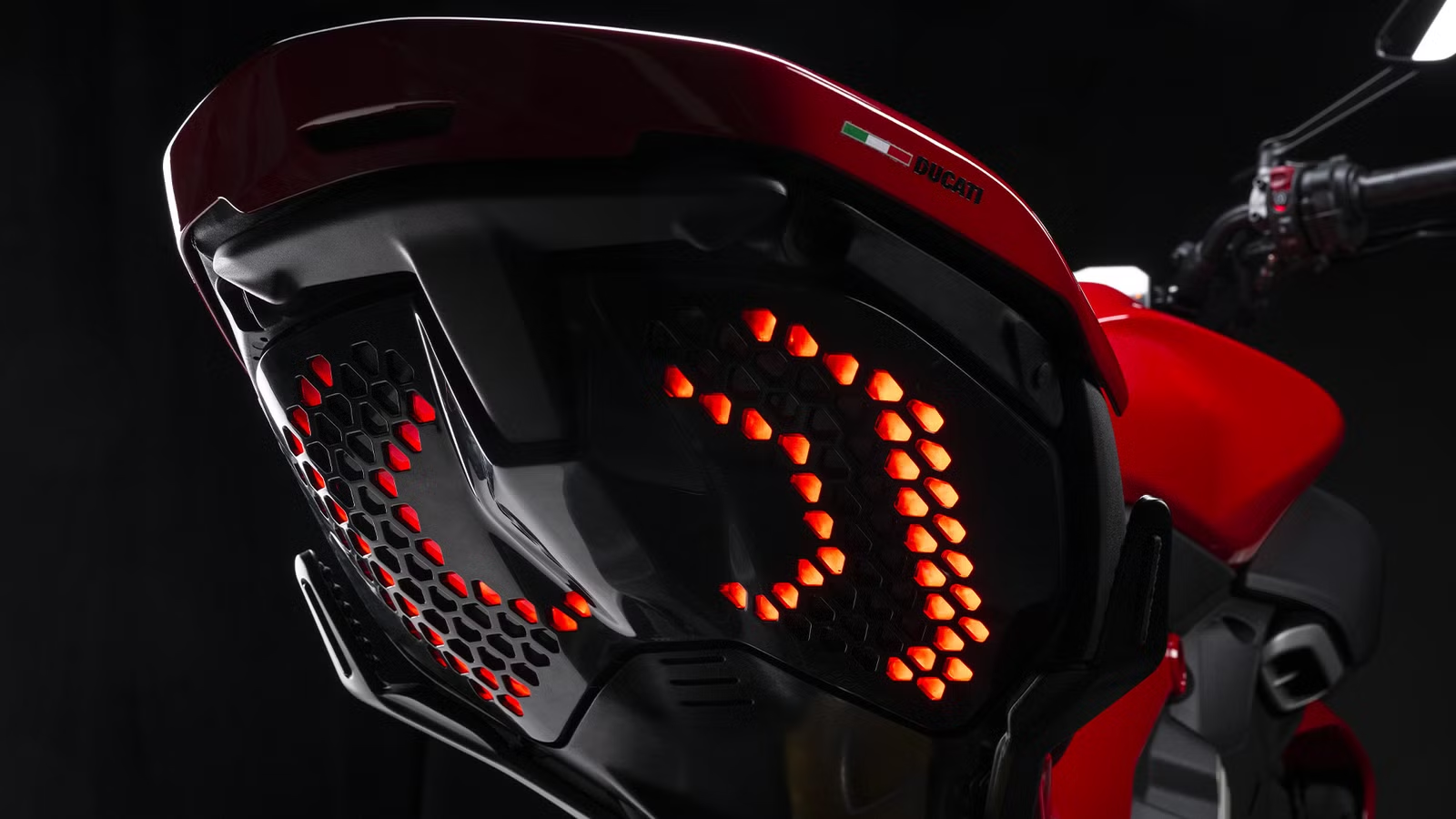
Superbike horsepower has reached the point where adding more does not always make a motorcycle much quicker from a stop – grip, wheelie control, clutch behavior, and gearing can matter just as much. Then there is the shift itself – every gear change costs time, even with a quickshifter. Ducati attacked that problem with a motorcycle that looks more suited to flexing outside a café than chasing superbikes down a drag strip. The result reshuffles the usual idea of what the quickest Ducati should look like.
Superbikes Have One Problem In A 0–60 Sprint: They Have To Shift

A modern superbike can make well over 200 horsepower, but a 0–60 run gives that power very little room to work. The first seconds depend on how much force the rear tire can send into the pavement before it spins or the front wheel rises. That puts a premium on launch grip, wheelie control, clutch management, weight distribution, and gearing. Peak horsepower matters, but only after the motorcycle can use it.
The gearbox creates another problem. Many fast motorcycles need second gear near the end of a 0–60 or 0–100 km/h run. A quickshifter cuts the interruption to a fraction of a second, but a fraction still matters when the entire sprint lasts around 2.5 seconds. If first gear can cover the full run, the engine never has to stop pulling.
Ducati Took A Superbike Engine And Reworked Everything Around The Launch


One motorcycle starts with Ducati’s 1,103cc Desmosedici Stradale V4, an engine family tied directly to the Panigale and Ducati’s superbike program. In this application it makes 182 horsepower and 89 lb-ft of torque. That is a major departure from the 1,158cc V4 Granturismo used by the regular muscle cruiser, which favors a broader, less extreme street character. The Desmosedici brings a higher rev ceiling, desmodromic valve gear, a dry clutch, and the harder-edged personality expected from Ducati’s superbikes.
A racetrack-only open exhaust can raise output by roughly 7 percent, putting peak power near 195 horsepower. Yet the more important change for straight-line acceleration happens in first gear – Ducati lets the engine spin to 14,000 rpm there, compared with 13,500 rpm in the remaining gears, and the overall gearing allows the bike to reach about 62 mph before second is required. The published sprocket sizes actually show a shorter final-drive ratio than the standard model, so the key is not simply a “taller final drive” – it is the combination of ratios, rev limit, tire size, and launch calibration that keeps the sprint inside first gear.
The Ducati Diavel V4 RS Is The Fastest-Accelerating Production Ducati Ever

The motorcycle is the Ducati Diavel V4 RS, and the company identifies it as the fastest-accelerating production bike in its history. Marc Márquez recorded 0–60 mph in 2.43 seconds, and Ducati also lists his 0–100 km/h time at 2.52 seconds. Those are different distances because 60 mph equals about 96.6 km/h. Separately, Ducati development rider Alessandro Valia recorded 0–100 km/h, or 62 mph, in 2.4 seconds on a prepared surface.
The RS reaches those numbers through a very specific mix of hardware. Its 1,103cc Desmosedici Stradale V4 makes 182 horsepower and 89 lb-ft, uses a counter-rotating crankshaft, and works with Ducati Power Launch, Ducati Wheelie Control, and Ducati Traction Control. Power Launch manages engine speed and torque as the clutch comes in, helping the rider use as much available grip as possible without turning the start into a smoke show.

The chassis plays an equally important role – the Diavel’s long, low proportions make front-wheel lift easier to manage than on a shorter sport bike, while its enormous 240/45 ZR17 Pirelli Diablo Rosso IV rear tire gives the electronics plenty of rubber to work with. Ducati also cut roughly 6.6 pounds compared with the regular Diavel V4 through carbon-fiber parts, forged wheels, a lithium-ion battery, and other lighter components. Claimed weight sits at 485 pounds without fuel.
That package creates the contradiction at the center of the bike. The Diavel V4 RS looks long, broad, low, and almost cruiser-like. The rider sits upright behind wide bars, the rear tire looks comically oversized. Park it beside a Panigale and most people would point to the fully faired superbike as the obvious drag-race favorite. But Ducati optimized the RS around the first few seconds after launch, and that narrow focus gives it the advantage.
The Diavel V4 RS Doesn’t Beat The Superbike Formula With More Power

But the Diavel’s acceleration record does not make it a better track motorcycle than a Panigale. Zero-to-60 rewards a different set of priorities – the RS benefits from geometry that helps control wheelies, a huge rear-tire footprint, sophisticated launch electronics, and gearing that avoids an early shift. It also has more engine than the rear tire can fully exploit at very low speed, which means adding more horsepower alone would not guarantee a better launch.
A Panigale has a broader mission. Ducati designs it around braking, corner speed, aerodynamics, high-speed acceleration, and lap times. Some of those priorities work against perfect drag-strip behavior. Sport-bike geometry helps quick direction changes but can make the front easier to lift. Aero matters enormously at high speed and almost not at all leaving a stop. A narrower rear tire helps the bike turn. The Diavel wins this particular contest because Ducati gave it the right tools for this particular job.
The $39,995 Diavel V4 RS Turns The Muscle Cruiser Into Ducati’s Ultimate Stoplight
The Diavel V4 RS starts at $39,995 in the United States, before destination charges. That puts it firmly in flagship territory – this is obviously not a cheap route to Panigale-like performance. Buyers get a numbered model with carbon fiber, forged wheels, Öhlins suspension, Brembo Stylema brakes, a dry clutch, advanced electronics, and one of Ducati’s most serious road-going engines.
Its appeal comes from combining ideas that normally live in separate categories. The firm mixed superbike engine technology, cruiser proportions, and drag-style launch optimization in one motorcycle. The 182 horsepower peak output is important, but the cleverer decision may be making sure the entire 0–60 run happens in one uninterrupted pull. No upshift, no break in acceleration. Just first gear from zero to highway speed.
That makes the performance unusually easy to understand. Riders do not need a racetrack to grasp what brutal low-speed acceleration feels like. The same speed range appears while merging, overtaking, or leaving a stop, even if matching a factory acceleration run belongs on a controlled surface rather than a public road.
For decades, the easy answer to “What is the fastest Ducati?” would have pointed toward something with full fairings, clip-ons, and a Panigale badge. But now, the Diavel V4 RS complicates that answer. The Panigale remains the sharper tool for corners, braking zones, aero, and lap times, but Ducati’s quickest production launch now comes from the big muscle bike with wide bars, a giant rear tire, a Panigale-family V4, and first gear long enough in road speed to finish the job before second gets a chance.
Source: Ducati

Related posts

Latest Post


No Comments